If you are reading this in August, the honest answer is: not yet. Shanghai hairy crab season has not opened, the crabs in the tanks are undersized, and anything sold to you now as a premium Yangcheng Lake crab is almost certainly something else. Wait six weeks and the city changes character — restaurants rewrite their menus, wet markets stack tanks three deep on the pavement, and sensible people start arguing about four-liang crabs versus five-liang crabs. Here is when the season really runs, how to spot a fake, what restaurants charge against markets, how to eat one, and what to drink with it.

Table of Contents
- When the Season Actually Runs
- Before the Season Opens
- What Is Hairy Crab?
- Female vs Male Crabs
- Yangcheng Lake, and Whether It Matters
- How to Spot a Fake
- Where to Eat in Shanghai
- Prices: Restaurant vs Market
- How to Eat a Hairy Crab
- Traditional Accompaniments
- Buying Live Crabs to Cook
- A Day Trip to the Lake
- Mistakes and Scams
- Who This Suits
- Timing Your Trip
- FAQ
When Shanghai Hairy Crab Season Actually Runs
There are three answers, and confusing them is how travellers end up with a thin crab in September or a hollow one in January.
The official Yangcheng Lake opening date is announced by the Suzhou authorities each September and treated as the starting gun by the industry: 27 September in 2024, 26 September in 2025. Expect the last week of September 2026. Nothing tagged as genuine Yangcheng Lake crab is legally on sale before it.
The wider market starts earlier: crabs from Taihu, Gucheng Lake, Hongze and the Chongming ponds reach Shanghai from early September. Decent crabs, simply not the famous ones, and still filling out.
The traditional calendar is lunar, which is why dates move. The saying is jiuyue tuanqi shiyue jian — “ninth month round belly, tenth month pointed” — females in the ninth lunar month, males in the tenth. 2026 runs late (Chinese New Year is 17 February), so the ninth lunar month starts only in the second week of October and the tenth in the second week of November.
| Window | What is good | Verdict |
|---|---|---|
| Early September | Non-Yangcheng crabs, still small | Too early. Eat something else. |
| Last week of September | Official harvest opens | Novelty, high prices, crabs not at their best |
| 1–7 October | Everything, at holiday prices | Avoid. National Day is the worst value of the year. |
| Mid-October to early November | Females, roe at its peak | The headline window. Book ahead. |
| Mid-November to early December | Males, white cream at its peak | Equally good, quieter, slightly cheaper |
| Late December on | Leftover stock, cold storage | Skip. Heavy shells, thin meat. |
If crab is the priority, aim for the last ten days of October or the first ten of November — also the best weather of the year. See Shanghai in autumn and the best time to visit.
Before the Season Opens
Arriving in July or August does not mean going without. Shanghai has a summer crab of its own: liuyuehuang, the “June yellow”, a young mitten crab caught after its second-to-last moult. Soft shell, small body, no roe — so nobody steams it. It is halved, floured, fried and braised in soy and sugar, or wokked with sticky rice cakes. Cheap, and on menus from late June to the end of August.
Year-round there is xiefen: crab meat and roe picked by hand into other things — xiaolongbao, noodles, braised tofu, egg white. Restaurants use preserved xiefen out of season and nobody pretends otherwise. See the best xiaolongbao and the Shanghai food guide.
What Is Hairy Crab?
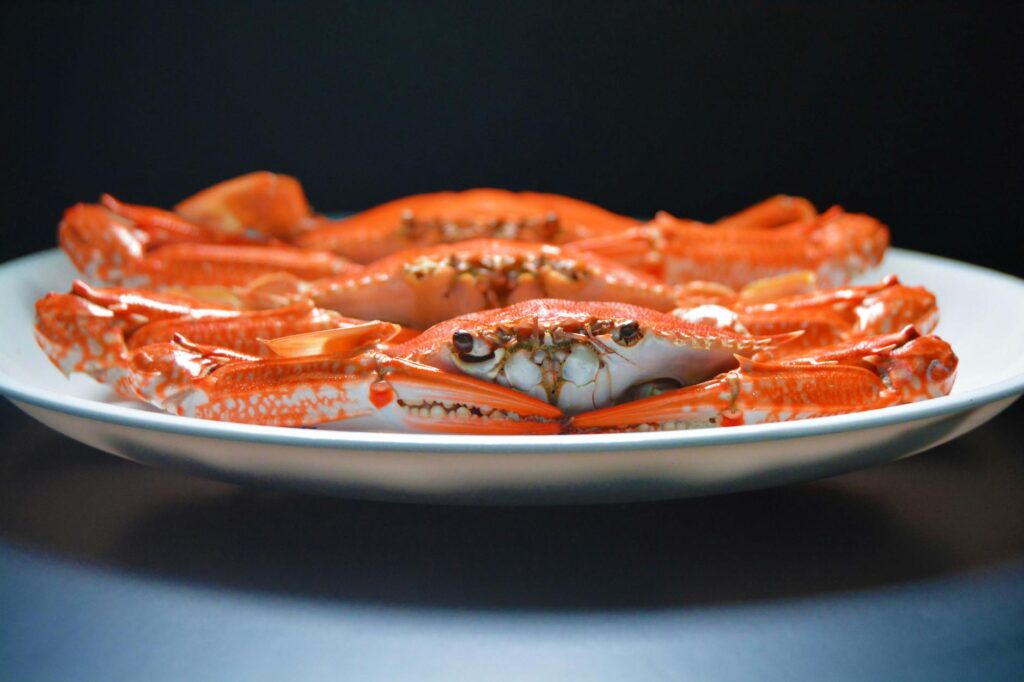
Hairy crab (大闸蟹, dàzháxiè) — the Chinese mitten crab — is a freshwater species native to East Asia, named for the fine brown fur on its claws. Adults span about 8–10 cm, small by the standards of a Western crab dinner. The point is not meat volume but the roe and cream inside.
The biology explains the season. Mitten crabs live in fresh water but breed in brackish estuaries, so every autumn adults fatten hard before migrating downstream to spawn. Farmers catch them at the moment they have loaded up for the journey. Before then the shell is full of water; afterwards the animal has spent everything.
Size is quoted in liang (两), one liang being 50 grams. Four liang (200 g) is the standard restaurant portion; five is where prices climb steeply; six and above is a show-off crab. Males grow larger, so a shop quoting “four-liang female, five-liang male” at one price is not cheating you — that is the normal grading convention.
Female vs Male Crabs
Flip the crab over and look at the flap on its underside.
Female (母蟹)
- Rounded, broad flap covering most of the belly
- Prized for the golden roe (蟹黄) — firm, granular, faintly bitter at the edges
- Peak: mid-October to early November in 2026
- Slightly dearer than a male of equal weight, and the one to order if you eat crab only once
Male (公蟹)
- Narrow, pointed flap like a slim triangle
- Prized for the white cream (蟹膏) — gelatinous, sticky, richer than the roe
- Peak: mid-November into early December in 2026
- Bigger, so more body and claw meat for the money — the connoisseur’s pick, and better value late
Restaurants often sell them as a pair, which is the sensible way to try both.
Yangcheng Lake, and Whether It Matters
Yangcheng Lake (阳澄湖) sits between Suzhou and Kunshan, about 60 km west of Shanghai. Shallow, hard-bottomed, clear — and its crabs command premiums of 30–100% over other lakes. At the top end the difference is real: firmer shell, cleaner belly, sweeter meat.
Whether it is worth the premium depends on where you buy. At a restaurant sourcing direct, yes. In the middle of the market, where most of the price gap is the tag rather than the crab, a good Taihu crab in the right fortnight beats a mediocre Yangcheng crab in the wrong one. Season beats provenance, and most Shanghainese will say the same after the second glass of wine.
Management has tightened. Suzhou now certifies centrally rather than through district associations, on a “one crab, one tag” basis, and caps stocking at 600 crabs per mu of water, so a farm’s tags are tied to the water it holds. The Suzhou government’s consumer notice, published each September, is the most useful thing to read before spending money.
How to Spot a Fake
Counterfeiting defines this industry. Far more crab is sold as Yangcheng Lake crab than the lake could produce, and the gap is filled from cheaper waters, sometimes after a few days in the lake first — the trade calls it “taking a bath”.
Check the tag, then verify it
Genuine crabs carry a plastic ring tag from the Suzhou Yangcheng Lake Hairy Crab Association, clipped round a claw. For 2025 the tags came in two colours — red for the lake’s netted enclosures, blue for high-standard ponds — with a colour-shifting traceability QR code, a serial number and laser security marks. The design changes most years, so check the current season’s tag rather than a description written in 2023.
- Scan the QR code. A real one resolves to the association’s traceability record, not a shop page or a WeChat account.
- Call the verification line. Suzhou publishes 0512-62582879 for authenticity checks; ask your hotel to call.
- Ask for the authorisation certificate for the geographical-indication mark. Licensed shops have one.
- Distrust the price. A genuine five-liang female for ¥90 does not exist. Tags cost the farmer money.
Judge the crab, not the paperwork
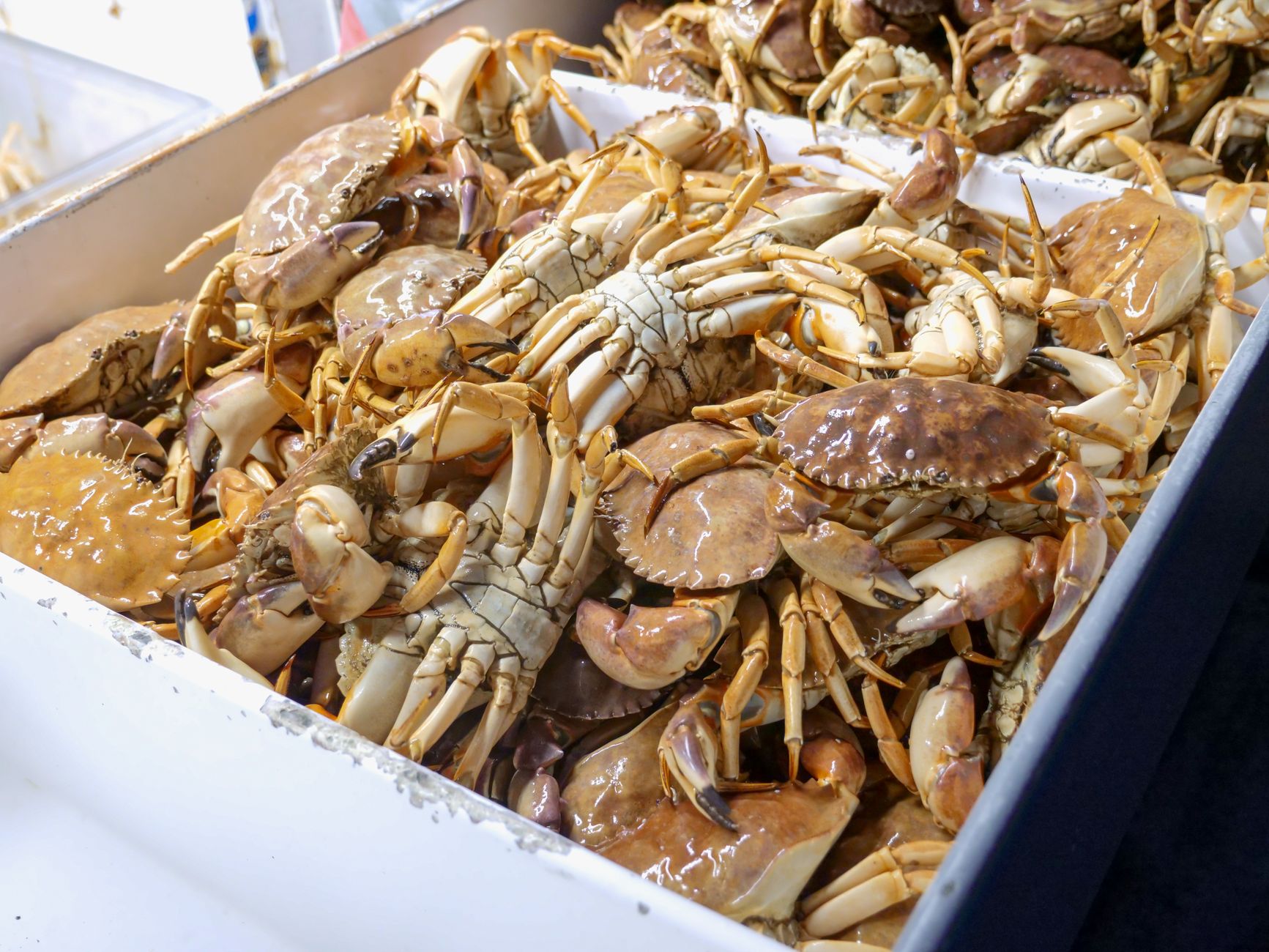
The four traditional signs beat the tag because they are hard to fake: green-black back (青背), dark and glossy rather than muddy; white belly (白肚), bright, not stained yellow-grey; golden hairs (黄毛) on the claws, stiff rather than matted; gold-tipped claws (金爪) strong enough to hold the crab up on a flat surface.
| Test | Good crab | Walk away |
|---|---|---|
| Weight in hand | Heavy for its size, solid | Light, hollow, water sloshes |
| Legs | Springy, pull back when tugged | Limp, loose, missing |
| Eyes | Retract when touched | No reaction |
| Belly | Clean white, firm | Soft, yellowed, dented |
| Tag | QR scans to a traceability record | Dead QR, or no tag |
One rule overrides the rest: never buy a dead one. Mitten crab spoils fast and produces histamine as it does, which is why they are sold and cooked alive. A tray of motionless crabs at a good price is motionless for a reason. Also see markets and haggling and scams.
Where to Eat in Shanghai Hairy Crab Season
Almost every Shanghainese kitchen puts crab on the menu in October. These are the names people actually give you; prices are per person with side dishes.
Heritage specialists
- Wang Bao He (王宝和), 603 Fuzhou Road, Huangpu — trading since 1744, the name everyone reaches for first. The banquet puts crab in every course; the house makes its own yellow wine. ¥800+ per person.
- Cheng Long Hang (成隆行), 216 Jiujiang Road — Michelin-listed, ten-course sets from around ¥1,388, staff who will pick part of the crab for you. Second branch on Fenyang Road.
- Xinguang Jiu Jia (新光酒家), Tianjin Road — old-Shanghai dining room, around ¥500 a head, local families not tourists.
Modern Shanghainese
- Old Jesse (老吉士), Tianping Road — tiny, permanently booked, from about ¥200. Drunken crab, and xiefen through fried bean-thread noodles.
- Fu 1088 — converted villa, private rooms, ¥500 minimum; crab roe with brioche and black vinegar.
- Canton Table, Three on the Bund — Cantonese, around ¥500 a head, braised tofu in crab roe at ¥198.
- Kong Yi Ji (孔乙己) — Shaoxing cooking, crab most of the year, five-glass flight of aged yellow wine around ¥50.
Crab without the banquet
- Crab House (蟹家大院), near the Bund — hand-picked crab meat over noodles; the signature bowl is about ¥360 and holds the meat of roughly a dozen crabs.
- Yuan Yuan (圆苑), 201 Xingguo Road — neighbourhood Shanghainese, no ceremony.
- Lao Zhengxing — classic Shanghainese, ¥300–500 per person.
- Jia Jia Tang Bao — famous for xiaolongbao; the crab-roe version is worth the queue.
- Shouning Road — the crayfish street turns partly to crab in autumn. ¥200–400 a head, plastic stools.
Hotel banquets
Yi Long Court at The Peninsula, Yong Yi Ting at the Mandarin Oriental, Wei Jing Ge at the Waldorf Astoria and the Cathay Room at the Fairmont Peace Hotel all run crab menus in season. They are the easy option — English menus, set price, no negotiation — but rarely the best crab in the city and always the priciest way to eat it. See the best restaurants in Shanghai.
Prices: Restaurant vs Market
The spread is enormous — the difference between a ¥1,100 evening and a ¥240 one.
| Where | Typical price | What you get |
|---|---|---|
| Wet market, ordinary crab by weight | ¥80–140 per kg | A 200 g crab costs ¥20–30. Live, untagged, you cook it. |
| Supermarket or Hema, single crab | ¥40–90 each | Tank, tagged, sold singly, receipt |
| Tagged Yangcheng crab, 4–5 liang | ¥100–250 each | Licensed shop or direct from a farm |
| Live crabs to take home, 300–400 g | ¥80–200 each | Premium size at a market |
| Restaurant, standard crab | ¥80–150 each | Mid-range Shanghainese, steamed, sauce included |
| Restaurant, Yangcheng crab | ¥150–350 each | Premium venue, tag shown at table |
| Crab banquet, two crabs plus dishes | ¥500–1,200 per person | Set menu, most courses contain crab |
| Tasting menu, top house | ¥1,200–2,500 per person | Ten courses, private room |
Prices move with the harvest. The South China Morning Post reported retail at the start of the 2025 season about ¥20 per kilo below the previous autumn, when the range had been ¥100–160 per kilo. Treat any figure as a band.
A worked comparison for two
Restaurant: two four-liang crabs each at ¥180, crab-roe tofu at ¥198, greens at ¥58, a pot of warm wine at ¥120, rice. About ¥1,100 with service — ¥550 a head — and you get tools, gloves, hot towels, ginger tea and somebody else’s washing up.
Market: four good untagged crabs at ¥45 each is ¥180; add ginger, black vinegar and a bottle of Shaoxing for ¥60. Total ¥240, a fifth of the restaurant bill. The catch is somewhere to steam them — a serviced apartment, not a hotel room.
The middle path: some market counters cook what you buy for a small fee. Not guaranteed, but worth asking — the phrase is daijiagong (代加工). See our language barrier tips and money guide; everything here is mobile-payment first and small stalls rarely have change.
How to Eat a Hairy Crab
The ritual is slow on purpose; a crab dinner is designed to take two hours, and rushing marks you out more than any technique error. Traditionally it uses the xie ba jian — eight Suzhou-made tools, from hammer and hatchet to tweezers and pick. Almost nobody uses all eight now: what arrives is scissors, a pick, a spoon, gloves and a finger bowl.
- Glove up and use both hands. Hands are the main tool.
- Twist off the flap on the underside and discard it.
- Prise the top shell off from the rear edge with your thumbs; it should come away whole.
- Clear out what you do not eat — see below — before you start, not halfway through.
- Eat the roe or cream from the top shell with the spoon. This is the point; do not save it for last.
- Snap the body in half to open the meat chambers, then work them out with the pick.
- Cut the legs at the joints and push the meat out with a thinner segment as a plunger.
- Crack the claws last — sweetest meat. Dip as you go, sip warm wine between mouthfuls.
The four parts you do not eat
- The stomach — flat, sandy, pyramid-shaped, behind the mouth on the top shell
- The gills — two rows of soft grey feathery strips, often called the lungs
- The heart — a small white hexagonal piece dead centre, the “coldest” part of the crab
- The intestine — the dark thread running into the flap
Allow 20–30 minutes per crab. Two a head is a normal dinner; four is a statement. Nobody will judge you for asking the kitchen to pick one for you — several better houses do it as standard.
Traditional Accompaniments
Crab is classified as a cooling food in Chinese medicine and every traditional accompaniment is a warming counterweight. Not superstition dressed up: the ginger and vinegar genuinely cut the richness, and warm wine makes the meal sit better.
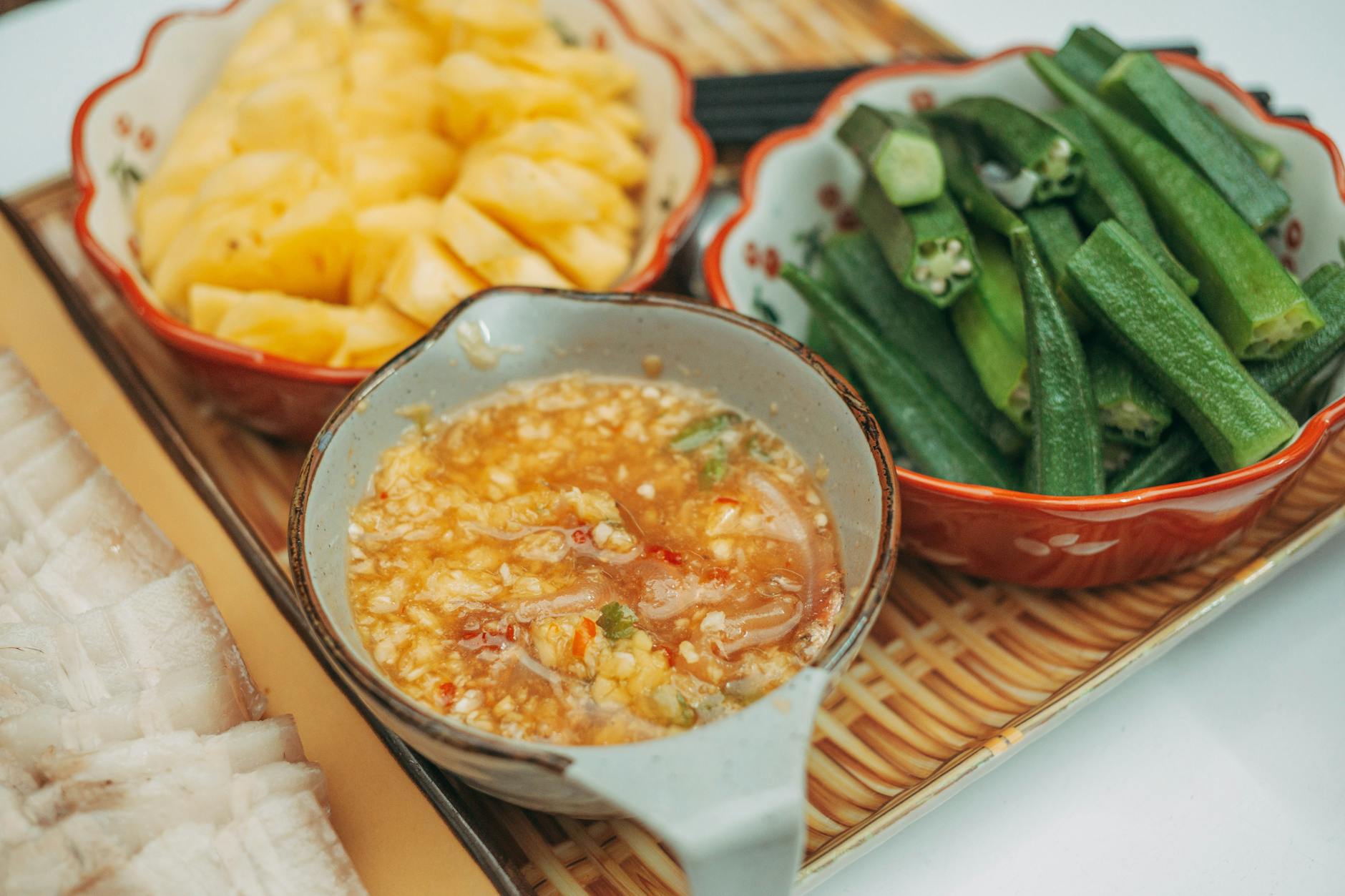
- Ginger-vinegar (姜醋) — Zhenjiang black rice vinegar, a spoon of sugar, a heap of shredded ginger. Ask for more ginger; they under-do it for foreigners.
- Warm yellow wine (黄酒) — a small pot at about body temperature. Shaoxing is the region, huadiao the everyday style, nu’er hong the sweeter aged one.
- Ginger tea — brown sugar and sliced ginger at the end, to settle the stomach. Accept it.
- Perilla leaf (紫苏) — laid in the steamer; faintly medicinal, slightly aniseed
- Osmanthus — in season at the same moment, usually in the dessert
- Chrysanthemum tea — also classified as cooling, so it works against the ginger. Traditionalists skip it.
Two things not to do: no iced beer or cold drinks, which every local will warn you about, and no persimmon afterwards — an old and firmly held pairing taboo. Persimmons ripen at the same time, which is presumably how the rule started. See the etiquette guide.
Buying Live Crabs to Cook
With a kitchen this is the cheapest good meal in the city, and steaming a crab is less cooking than timing.
- Wet markets — every district has one. Live and tied; ¥80–200 each for premium sizes, far less for ordinary ones. Sanyuan, Sanlin and Anhe are long-established.
- Hema (盒马) — live tanks, clear labelling, an app that works in English, delivery in about half an hour centrally. The most foreigner-friendly option by a distance.
- Meituan and JD Daojia — same-day delivery, if you can handle a Chinese-only app
- Direct from a licensed farm — most ship nationally in season
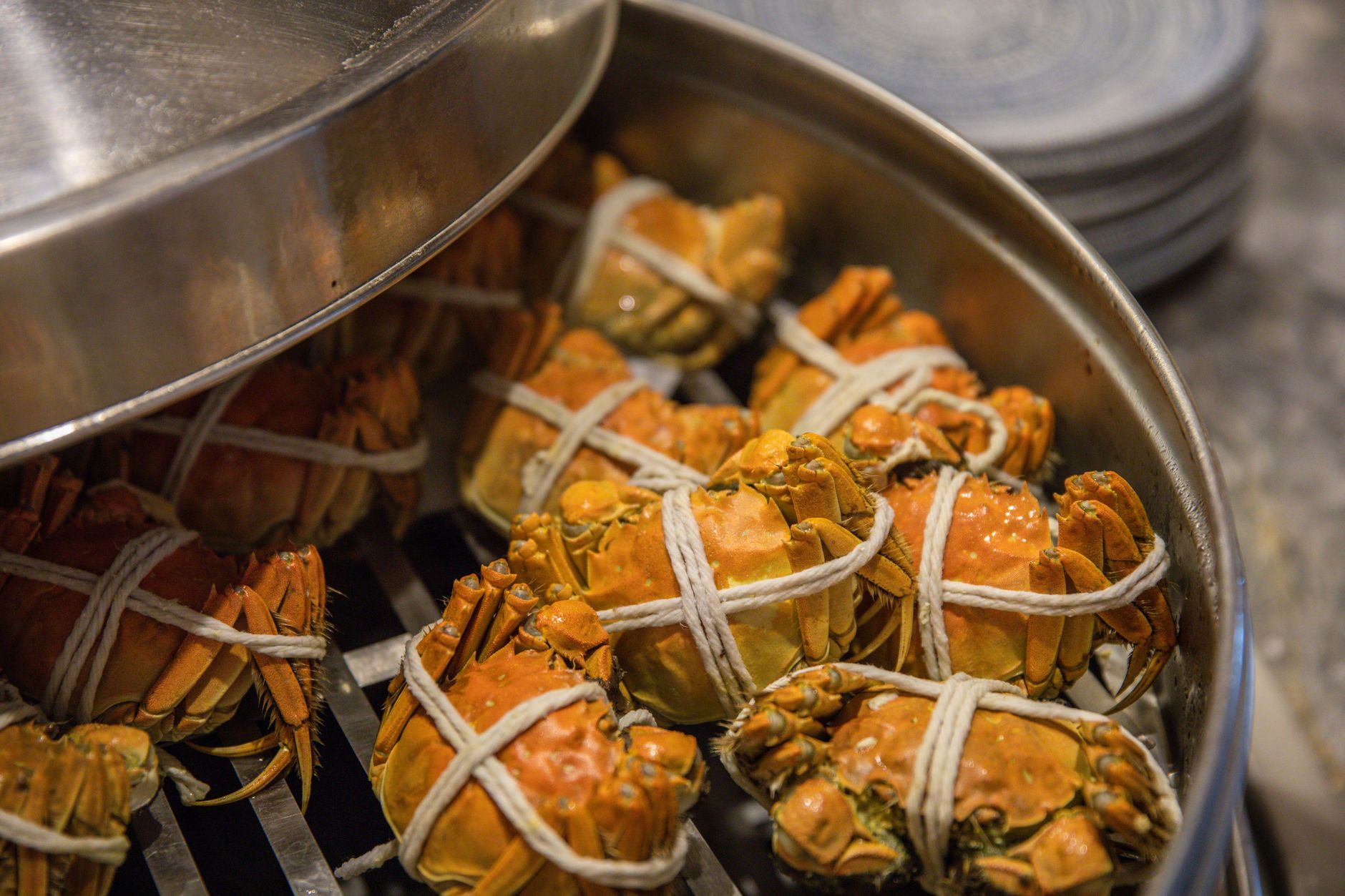
How to steam one. Leave the string on; an untied crab thrashes and sheds legs. Lay them belly up so the roe does not run out. Add ginger and a perilla leaf. Steam over rolling water about 10 minutes for a 200 g crab, 12–15 for a bigger one, counting from when the steam comes up. Rest two minutes. That is the entire traditional repertoire — anything fancier usually means crabs not good enough to steam.
A Day Trip to the Lake
Eating crab beside the water it came from is a genuine autumn ritual for Shanghai families, and easier than it sounds. Kunshan South is the nearest high-speed rail stop, under half an hour from Hongqiao with departures every few minutes; from there a ride-hail reaches the lakeside restaurant villages, where the format is simple — pick your crabs from a tank, agree a weight, wait, eat.
Go on a weekday: autumn weekends bring coach parties and the good places stop taking walk-ins by noon. Agree the price per crab and the total weight before anything goes in the steamer — the standard complaint is a bill computed on a different basis than you thought. Expect no English. Or fold it into a Suzhou trip: gardens in the morning, crab after. See our Suzhou day trip and day trips guides; the water towns, Tongli included, all serve crab in October at tourist prices.
Mistakes and Scams
- Eating crab in September because you are here in September. An early crab is a thin crab.
- Buying a crab card. Prepaid vouchers (蟹卡) are a big domestic gift market, widely reported to be over-issued against supply, with redemption pushed past the peak. Useless to a visitor anyway.
- Trusting a tag on its own. Tags are what counterfeiters copy. Scan it, or judge the crab instead.
- Ordering raw or drunken crab casually. Raw freshwater crab can carry lung fluke, which is why the tradition is to steam it. Drunken crab is a real dish and good kitchens take it seriously, but not one to try at a random restaurant or make yourself.
- Eating a crab that was dead before cooking. Non-negotiable.
- Assuming xiekehuang is crab. The sesame breakfast pastry called “crab shell yellow” (蟹壳黄) contains no crab — it is named for its colour. See the breakfast guide.
- Planning to take live crabs home. The mitten crab is invasive in Europe and North America and live import is banned or heavily restricted almost everywhere. Check the customs guide.
Who This Suits
It suits patient eaters, anyone who enjoys the ceremony of a long meal or has happily dismantled a lobster, and travellers who want one food experience that could not happen anywhere else at any other time. Groups of four to six do better than couples — a banquet is built around a round table.
It does not suit anyone in a hurry, anyone who dislikes fiddly food, small children who lose interest in five minutes, or vegetarians, for whom autumn Shanghai has plenty else — see our vegetarian and vegan guide. Shellfish allergies apply as expected. Pregnant travellers are traditionally advised to avoid crab on the cooling-food principle; that is custom rather than medical advice, and nobody will blink if you decline.
If the price puts you off, it need not stop you eating crab. A bowl of crab-meat noodles, or a crab-roe xiaolongbao at a hole in the wall, gives most of the flavour for a fraction of the outlay — see cheap eats and street food.

Timing Your Trip Around Shanghai Hairy Crab Season
- Book one to two weeks ahead in October; heritage houses earlier, private rooms earliest
- Dinner 18:00–20:00 is standard; weekend crab lunches are quieter and slightly cheaper
- Allow 90–120 minutes and schedule nothing after it
- Two crabs a head, one female and one male
- Spend once at the top, eat cheaply the rest of the week — one good Yangcheng crab plus five days of xiefen dishes beats five mediocre banquets
- Check the harvest date in mid-September before finalising flights
- Layer up — late-autumn evenings drop to 8–12°C and crab restaurants keep the windows open. See the month-by-month weather.
- Skip the airport gift boxes — vacuum-packed cooked crab is a shadow of the fresh thing. The souvenirs guide has better ideas.
Frequently Asked Questions
When is hairy crab season in Shanghai?
The Yangcheng Lake harvest opens in the last week of September — 27 September in 2024, 26 September in 2025 — and runs to about the end of December. The part worth travelling for is mid-October to early December: females first, males from mid-November.
Can I eat hairy crab in Shanghai in August?
Not the autumn kind. You can eat liuyuehuang, the small “June yellow” summer crab, fried or braised with rice cakes, plus year-round dishes made with picked crab meat and roe. Whole steamed crab in August is not worth ordering.
How much does hairy crab cost in Shanghai?
¥80–150 per crab at a mid-range restaurant, ¥150–350 for a tagged Yangcheng Lake crab. Banquets run ¥500–1,200 per person, tasting menus ¥1,200–2,500. At a wet market the same crab costs a fraction of that — ordinary crabs by weight were around ¥80–140 per kilo at the start of the 2025 season.
How do I tell a real Yangcheng Lake crab from a fake?
Scan the tag’s QR code and check it resolves to a traceability record; call the Suzhou verification line if in doubt. Then ignore the paperwork and look at the crab: dark green-black shell, clean white belly, stiff golden hairs, gold-tipped claws, heavy in the hand, legs that push back when tugged.
Is Yangcheng Lake crab actually better?
At the top of the market, noticeably. In the middle you are mostly paying for the tag, and a well-timed crab from another lake beats a badly timed Yangcheng one.
Female or male hairy crab — which should I order?
Female for the golden roe, best from mid-October. Male for the white cream, best from mid-November, with more body meat. One of each if you can.
Which parts should I not eat?
Four: the sandy pyramid-shaped stomach behind the mouth, the grey feathery gills, the small white hexagonal heart, and the dark intestinal thread. Clear them out before you start.
What do you drink with hairy crab?
Warm Shaoxing yellow wine from a small pot, then ginger tea. Not cold beer and not iced anything — the accompaniment tradition exists to balance a food classified as cooling.
Do I need to book a hairy crab restaurant in advance?
In October, yes — one to two weeks for the well-known houses, longer for a private room or a weekend. By late November you can often walk in.
Can I take hairy crab home with me?
Live crab, essentially no: the mitten crab is invasive in Europe and North America and live import is banned or heavily restricted. Vacuum-packed cooked crab travels legally in some cases but is a poor substitute.
Is hairy crab safe to eat?
Yes, steamed fresh at a reputable restaurant. Never eat one that was dead before cooking, and treat raw preparations with caution — raw freshwater crab can carry lung fluke, which is why the tradition is to steam it thoroughly.
Is it worth going to Yangcheng Lake itself?
If you enjoy a food pilgrimage, yes — Kunshan South is under half an hour from Hongqiao by train and the lakeside restaurants are a genuine local outing. Go on a weekday, agree the price before cooking, expect no English. Otherwise Shanghai serves the same crabs.
Plan Your Autumn Crab Trip
Combine with our pillar guides on Shanghai food, Shanghai in autumn, and best restaurants Shanghai. For background, see Chinese mitten crab on Wikipedia and China Daily on the start of the Yangcheng Lake harvest.