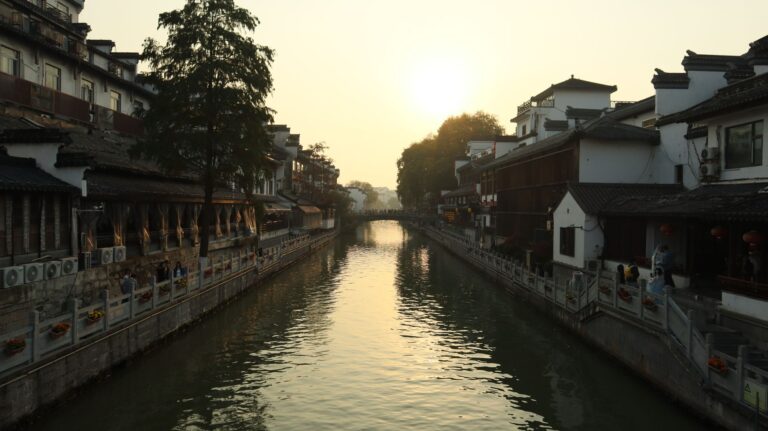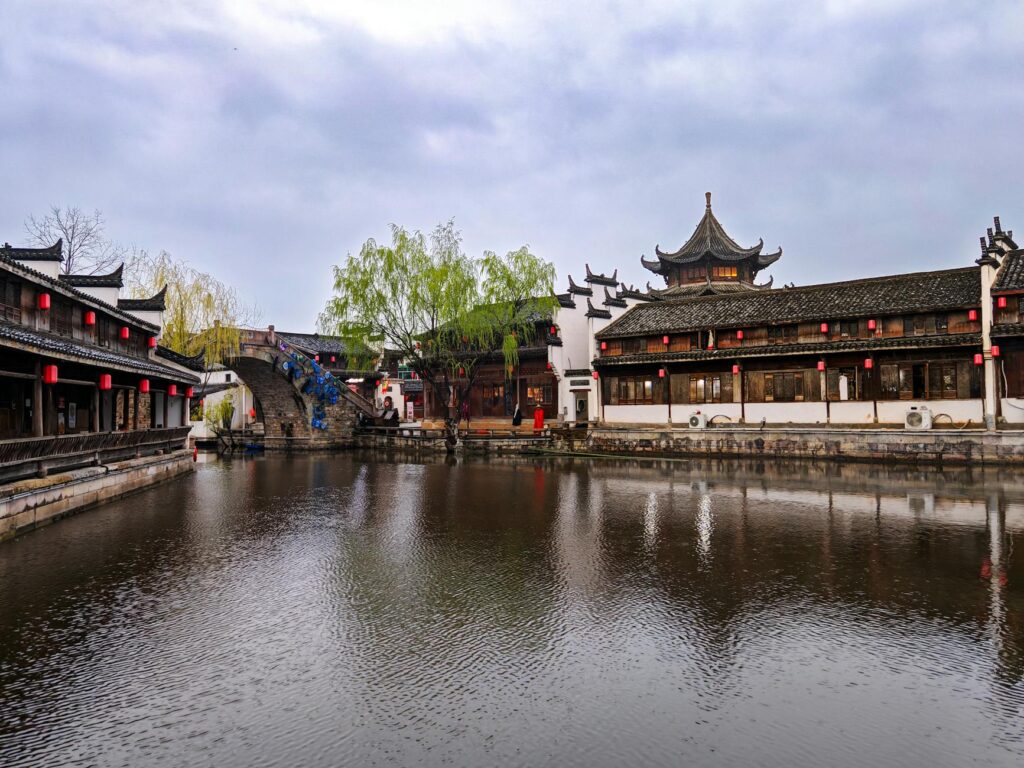
If Tongli is the quietest and Wuzhen the most polished, Zhouzhuang water town (周庄古镇) is the most famous — and for many travellers, the most postcard-perfect. Founded over 900 years ago, Zhouzhuang’s photogenic Double Bridge has appeared in everything from Chinese paintings to international travel posters. This 2026 guide to the Zhouzhuang water town day trip covers exactly how to get there, what tickets cost, what to see, when to go, and how to time a visit so you are not shuffling through 40,000 other people.
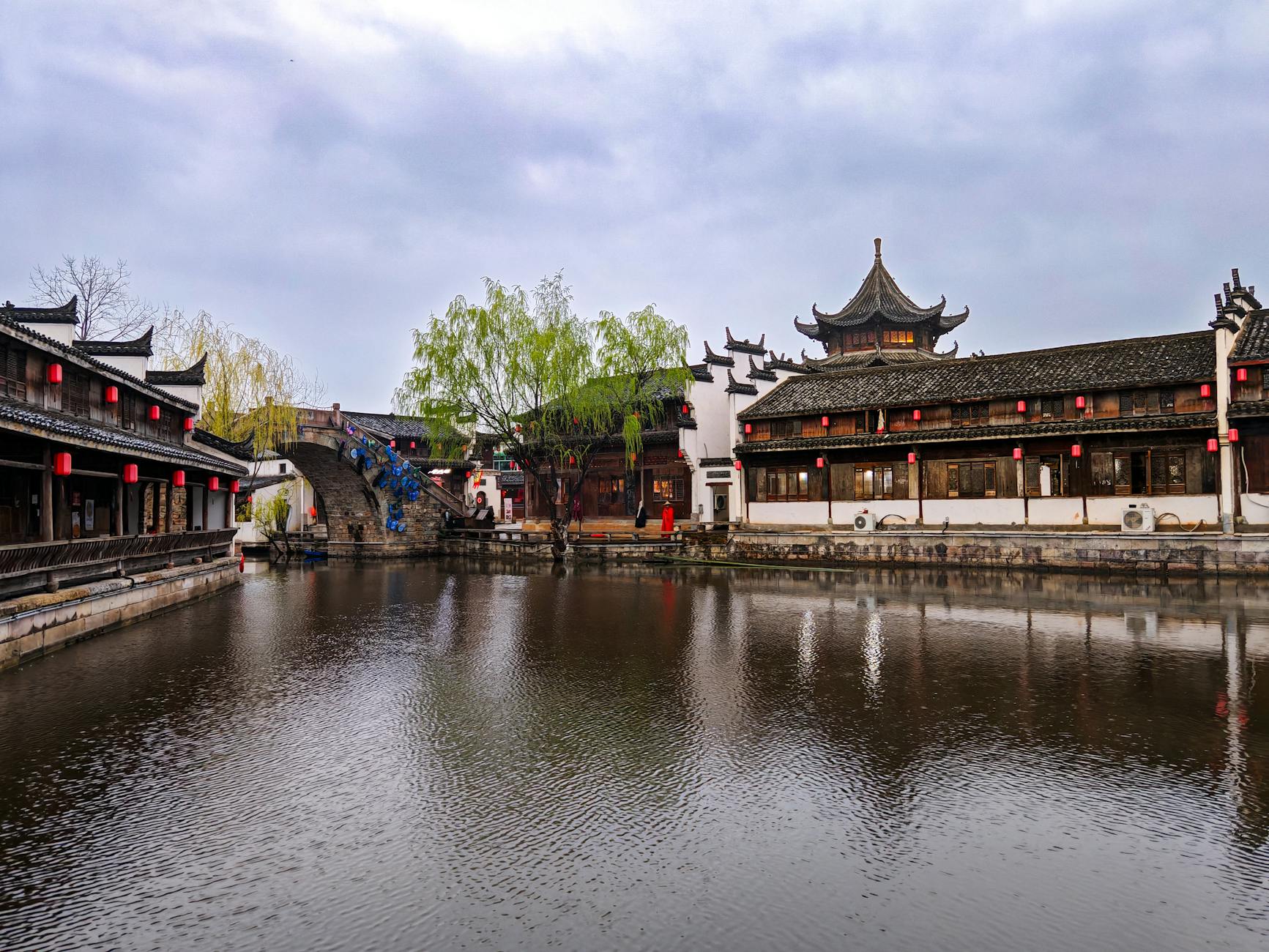
Table of Contents
- Why Zhouzhuang Matters
- Is a Zhouzhuang Water Town Day Trip Worth It?
- How to Get There from Shanghai
- Tickets & Opening Hours
- Top 10 Sights
- The Double Bridge
- Shen’s Residence & Mansions
- Boat Rides
- Zhouzhuang After Dark
- Local Food & Specialties
- Zhouzhuang vs Other Water Towns
- When to Go: Season, Day and Hour
- A Day Plan That Beats the Crowds
- Staying Overnight
- Mistakes and Things That Have Changed
- Tips for Visiting
- FAQ
Why Zhouzhuang Matters
Zhouzhuang, in Kunshan (Jiangsu Province) about 70 km west of Shanghai, calls itself the “First Water Town in China.” The title is contested — Tongli, Wuzhen and Xitang all have a case — but Zhouzhuang is undeniably the most internationally recognised. The town has 14 stone bridges (some 800+ years old), 60+ courtyard residences, and a 0.5-square-km old town encircled by water on all four sides. It survived the 20th century relatively intact because, until the 1980s, it was accessible only by boat.
The name dates to 1086, when a devout Buddhist named Zhou Digong donated land to the Quanfu (Full Fortune) Temple; before that the settlement was called Zhenfengli and had been inhabited since the Spring and Autumn period. What you walk through today is largely Ming and Qing: whitewashed walls, black tile roofs, stone quays cut straight down into the canal, and the arched bridges that let a laden boat pass underneath. CNN named it the third most beautiful water town in China in 2017 and one of Asia’s most picturesque towns in 2019, and it holds China’s top AAAAA scenic-area rating.
Is a Zhouzhuang Water Town Day Trip Worth It?
Honest answer: it depends what you want and when you go. Zhouzhuang at 08:00 on a Tuesday in March is genuinely lovely — mist on the water, shopkeepers hosing down the stone, one boat sculling past. Zhouzhuang at 13:00 on a Saturday in October is a slow-moving crowd on a two-metre-wide lane between shops selling the same pork knuckle and the same silk scarves. Same town, entirely different experience.
Some perspective on the numbers: the official scenic area publishes a daily carrying capacity of 95,000 visitors and an instantaneous cap of 40,000. Those caps exist because they get approached. This is not a place you can wander into casually at midday on a holiday weekend.
| Zhouzhuang suits you if… | Choose elsewhere if… |
|---|---|
| You want the single most recognisable water-town image | You want quiet lanes and locals going about their day — go to Tongli |
| You care about Ming merchant architecture (Shen and Zhang houses are the best of any water town) | You want to stay the night in something polished — go to Wuzhen Xizha |
| You can leave Shanghai by 07:00 or stay overnight | You only have half a day and no early start — go to Zhujiajiao on the metro |
| You are combining it with Suzhou or Kunshan | You hate crowds and are travelling in Golden Week — go anywhere else |
How to Get There from Shanghai
Zhouzhuang doesn’t have a direct rail station. Options from Shanghai:
- Direct bus from Shanghai South Bus Station — ¥35, 90 minutes; departures every 30–60 minutes
- Bullet train + bus — High-speed rail to Kunshan South (¥30, 30 min) + Tourist Bus 109 (¥10, 45 min). Faster overall
- Organised day tour from Shanghai — ¥400–600 per person; includes transport, entry, English guide
- Taxi/Didi — ¥350–500 each way; 1.5–2 hours depending on traffic. Best for groups
Three more routes worth knowing, because the obvious ones sell out at weekends:
| Route | Cost | Time | Notes |
|---|---|---|---|
| Shanghai South Bus Station coach | ¥35 | ~90 min | Simplest single-ticket option; buy at the counter or on 12308-type apps |
| Gongxing Road long-distance station | around ¥22 | ~2 hrs | Cheapest. Departures mostly morning to early afternoon |
| Tourist coach from Shanghai Stadium | ¥130–140 return | ~1 hr 40 | Packaged return, sometimes with guide; fixed return time |
| HSR to Kunshan South + Bus 109 | ~¥40 total | ~75–90 min | Fastest reliable option, no traffic risk |
| Metro Line 11 to Huaqiao + Kunshan buses 106/261 | under ¥20 | 2–2.5 hrs | Slow but cheap and entirely on public transport |
| Metro Line 17 to Xicen + taxi | ¥10 + ¥60–90 | ~2 hrs | Line 17’s western extension opened Nov 2024 and put the Jiangsu border within a short cab ride |
| Didi or taxi door to door | ¥350–500 each way | 1.5–2 hrs | Only sensible split between three or four people |
The Line 17 route is the genuinely new one. The extension to Xicen opened on 30 November 2024, and from there a short taxi crosses into Jiangsu. It is not faster than the bullet train, but it is cheap, air-conditioned and avoids bus stations entirely. Our Shanghai metro guide covers fares and last trains; have Didi set up before you go, because hailing a cab back from a small Jiangsu town at 18:00 is harder than it sounds.
Coming from Suzhou instead? Buses run from Suzhou North Bus Station roughly every 30–40 minutes from about 06:50 to 17:50, cost around ¥18, and take an hour to ninety minutes. That makes Zhouzhuang an easy add-on to a Suzhou day trip if you are staying over.
Tickets & Opening Hours
- Main entry ticket: ¥100 (includes 16 inner sights including the major residences)
- Opening hours: 8:00–21:00 daily (inner sights close 17:00; outer streets accessible until 21:00)
- Boat rides: ¥80–150 per boat (shared); ¥350 private; 25-min route
- Night zhou (lantern-lit boat ride): additional ¥50
- Tickets: Buy at the gate, online via Trip.com / Klook, or via the Zhouzhuang WeChat mini-program
A few clarifications, because published figures vary between operators and resellers:
- Discounts. Children under 1.4 m or under 6 go free. Ages 6–18 and seniors 60–70 normally pay half price (¥50). Bring the passport — ID is checked at the gate.
- Night ticket. There is a reduced evening admission of around ¥80 sold from late afternoon, which covers the town plus Shen House and Zhang House. If you only want lanterns and dinner, it is the better buy.
- Opening times in practice. The gates open around 07:30 and the outer streets stay walkable until about 21:00, but the smaller inner sights start shutting from 16:30. Shen House, Zhang House and the museum stay open later than the rest.
- Boats. Sources disagree sharply here — some quote around ¥150 per boat, others ¥220, and the number of passengers per boat is variously given as six or eight. Assume a boat, not a seat, and budget ¥150–250 per vessel for 25–30 minutes. Confirm before you step in.
Book through the official Zhouzhuang scenic area site or its WeChat mini-programme for the current price; third-party resellers sometimes bundle a boat or a meal and the comparison gets muddy. Payment is by Alipay or WeChat almost everywhere; keep some cash for the small snack stalls, and see our money guide if you have not set up mobile payment yet.
Top 10 Sights
- Shuangqiao (Double Bridge) — the twin stone bridges over crossing canals; Zhouzhuang’s most photographed view
- Shen’s Residence (沈厅) — 1742-built Ming-era merchant courtyard; 100+ rooms across 7 courtyards
- Zhang’s Residence (张厅) — Yuan-Ming hybrid; smaller and finer-grained
- Quanfu Temple (全福寺) — riverside Buddhist temple; small but atmospheric
- Twin Bridge sunset — golden-hour photography
- Zhouzhuang Museum — small but covers the town’s 1980s rediscovery and tourism era
- Ye Chu Hall — 600-year-old residence with Yuan-era beams
- Long Bridge (长桥) — the southern entrance bridge
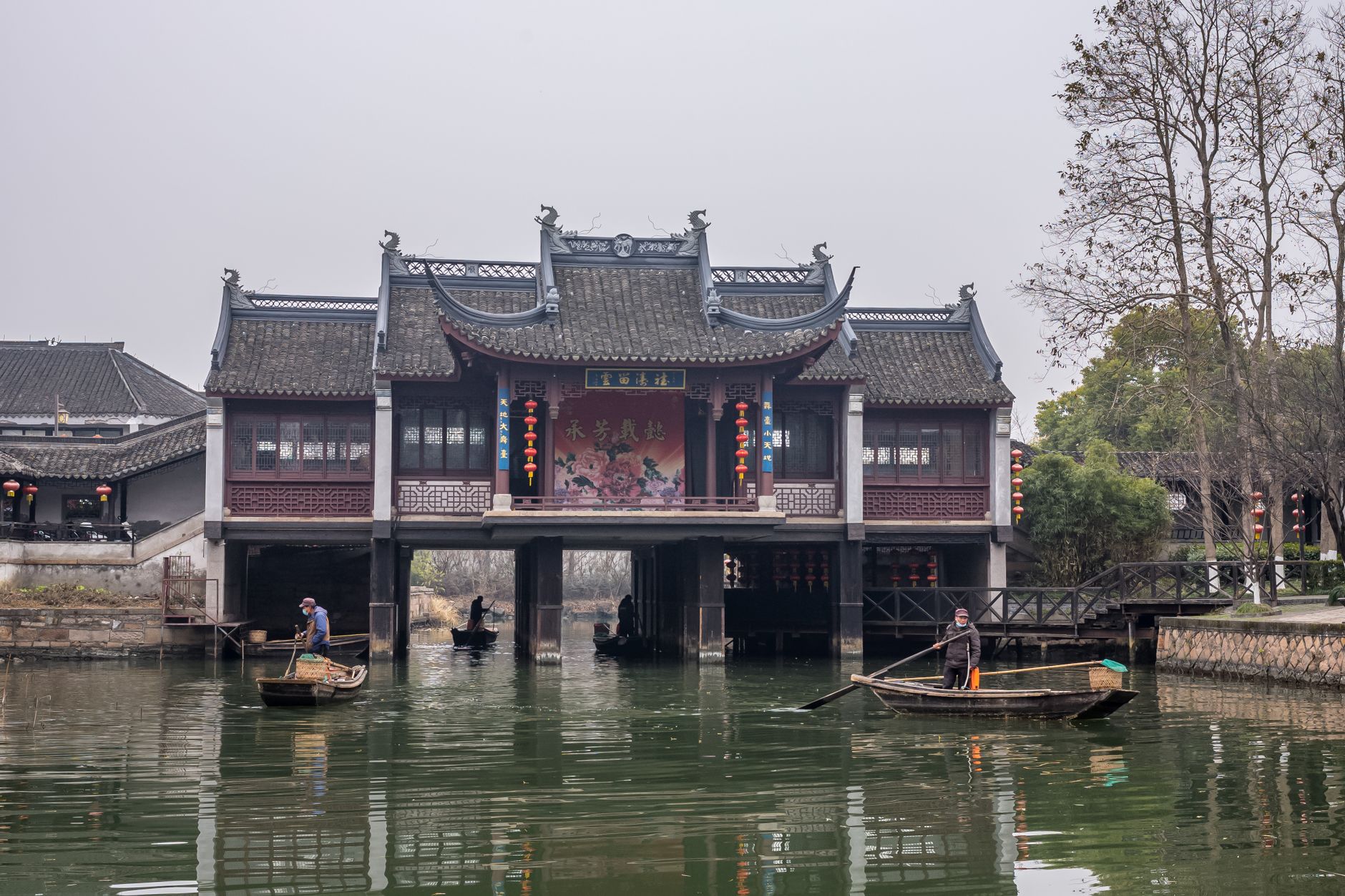
- Old Stage (古戏台) — preserved performance space for Kunqu opera
- Embroidery and craft workshops — Suzhou silk embroidery demonstrations
Add one more that rarely makes the lists: Fu’an Bridge (富安桥), built in 1355 under the Yuan dynasty. It is the only surviving bridge in the region that still has its four original corner towers — buildings sitting directly on the bridge abutments. Structurally it is more interesting than the Double Bridge, and because everyone is queuing for the famous shot elsewhere, you can usually stand on it alone.
The Double Bridge
Shuangqiao (双桥) — “Double Bridge” — comprises two stone bridges (Shi De Bridge and Yong’an Bridge) over crossing canals in the middle of the old town. Built in the Ming dynasty, the asymmetric pair has appeared in countless Chinese landscape paintings.
The two are deliberately different: Shide runs east-west with a round arch, Yong’an runs north-south with a square one, and the combination is said to resemble an old Chinese key. Both date from the Wanli era (1573–1619).
The Double Bridge gained international fame through the painter Chen Yifei, whose “Memory of Hometown” showed it in oils. The work was exhibited in New York in 1984, bought by the industrialist Armand Hammer, and presented by him to Deng Xiaoping — after which the United Nations used the image on a stamp in 1985. That sequence, more than anything else, triggered the town’s tourism boom. Best photographed: early morning (07:30–09:00) before crowds; late afternoon for golden side-light. The classic angle is from the canal bank on the eastern side, low, with both arches in frame.
Shen’s Residence & Mansions
Shen’s Residence (沈厅) is Zhouzhuang’s largest and most ornate Ming-era merchant home. Built 1742 by the Shen family (descendants of a famously wealthy Ming entrepreneur), the residence spans 100+ rooms across 7 main courtyards. Highlights:
- The ornate entrance gate and main hall
- The “Tea Hall” — where ladies of the household gathered
- The kitchen complex with original wood-fired stoves
- Family graves and ancestral altar
- The internal canals running through the residence (rare for inland houses)
The neighbouring Zhang’s Residence is smaller but earlier (Yuan-Ming hybrid), with very fine carved wooden screens.
Some numbers for scale: Shen House covers around 2,000 square metres; Zhang House, built in the Zhengtong era (1436–1449) and later bought by the Zhang family, has about 70 rooms over 1,800 square metres. The ancestor in question is Shen Wansan, remembered as the first great merchant fortune of the Jiangnan region and, according to local legend, the man who part-funded the Ming city walls of Nanjing before falling out with the emperor. He is why the local dish is a pork knuckle named after him. Allow 40 minutes for Shen House and 20 for Zhang House. Neither has much English signage — download an audio guide or accept that you are looking at the architecture rather than reading about it. Our language guide covers translation apps that work offline.
Boat Rides
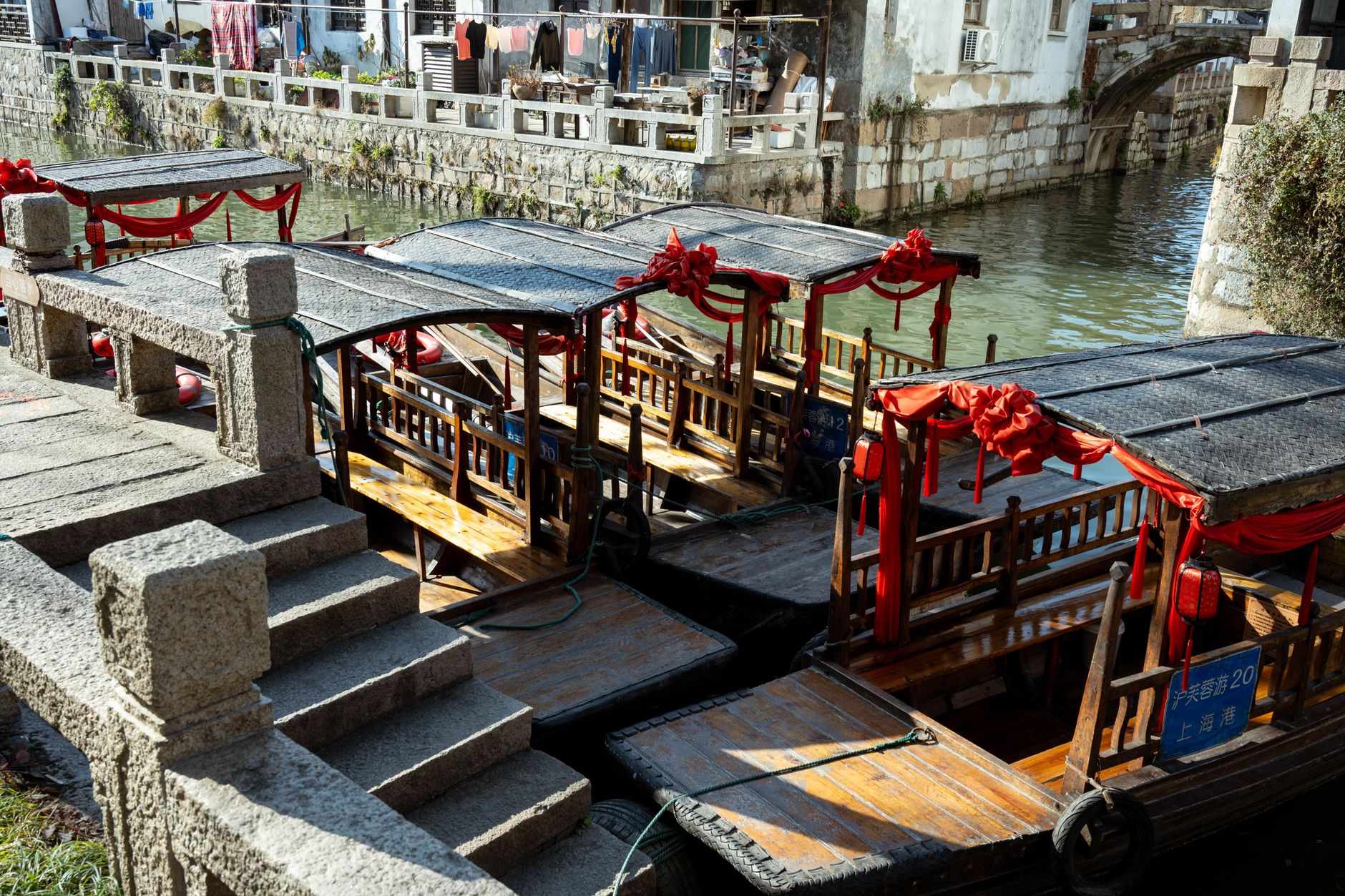
A 25-minute boat ride is essential — the canals are what define Zhouzhuang. Boats depart from the main pier:
- Shared boat — 8 people max; ¥80–150 per seat depending on season
- Private boat — ¥350; 1–6 passengers; lets you stop for photography
- Night boat — additional ¥50; departs at sunset (best in autumn). The lit lanterns and reflections are extraordinary
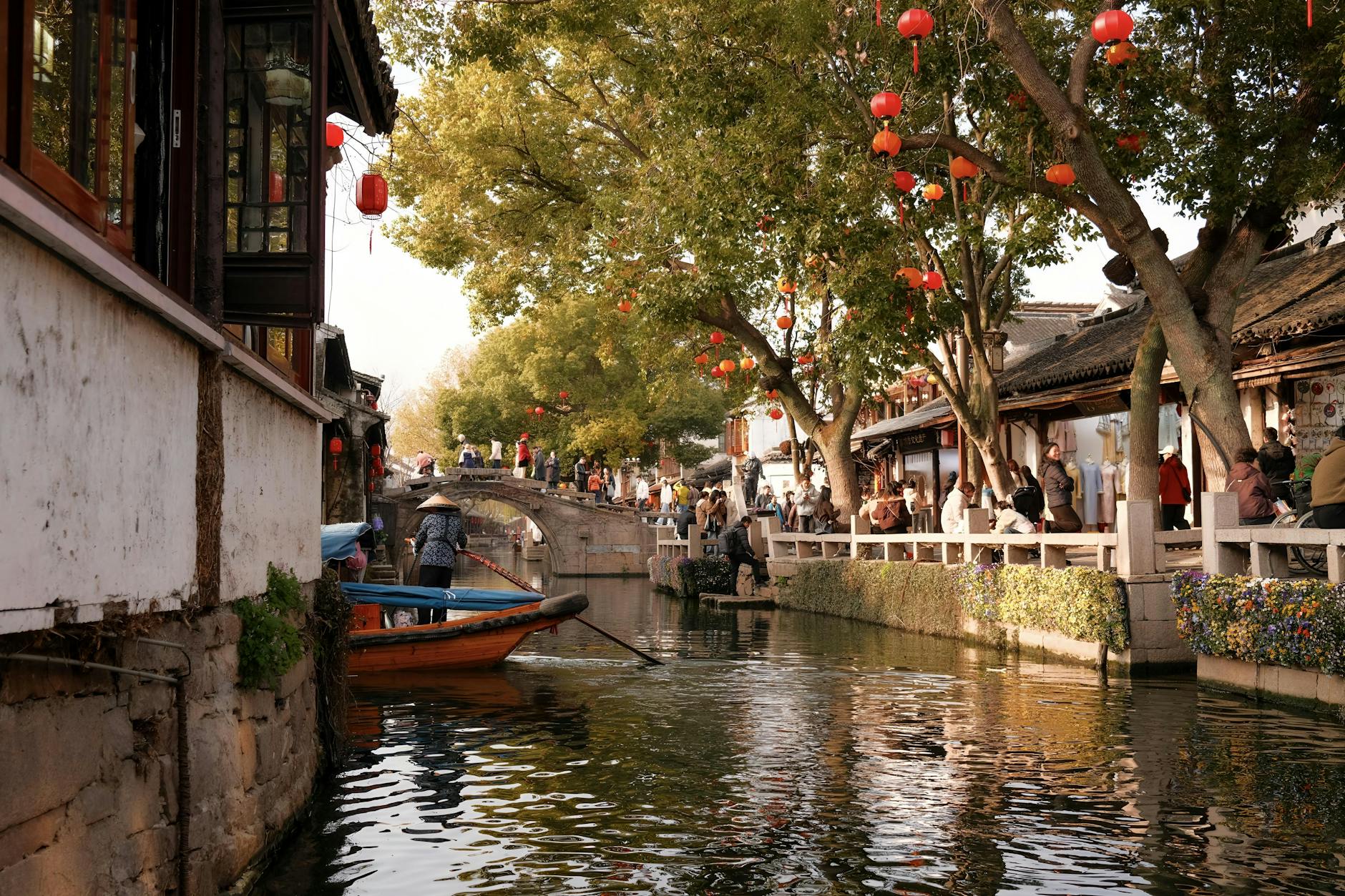
Most boats are poled by local women in traditional dress who sing folk songs as they row. Photogenic; bring small change for tipping (¥10–20 appreciated though not expected).
Two practical points. First, the standard route is a loop, not a transfer — you return to the pier you left from, so do not plan to be dropped at the far end of town. Second, the queue at the main pier is worst between 11:00 and 14:00; there are secondary boarding points and they are quieter. If the water level is low after a dry spell the boats sit deeper in the channel, which is actually better for photographs — you are shooting up at the bridges rather than down at the water.
Zhouzhuang After Dark
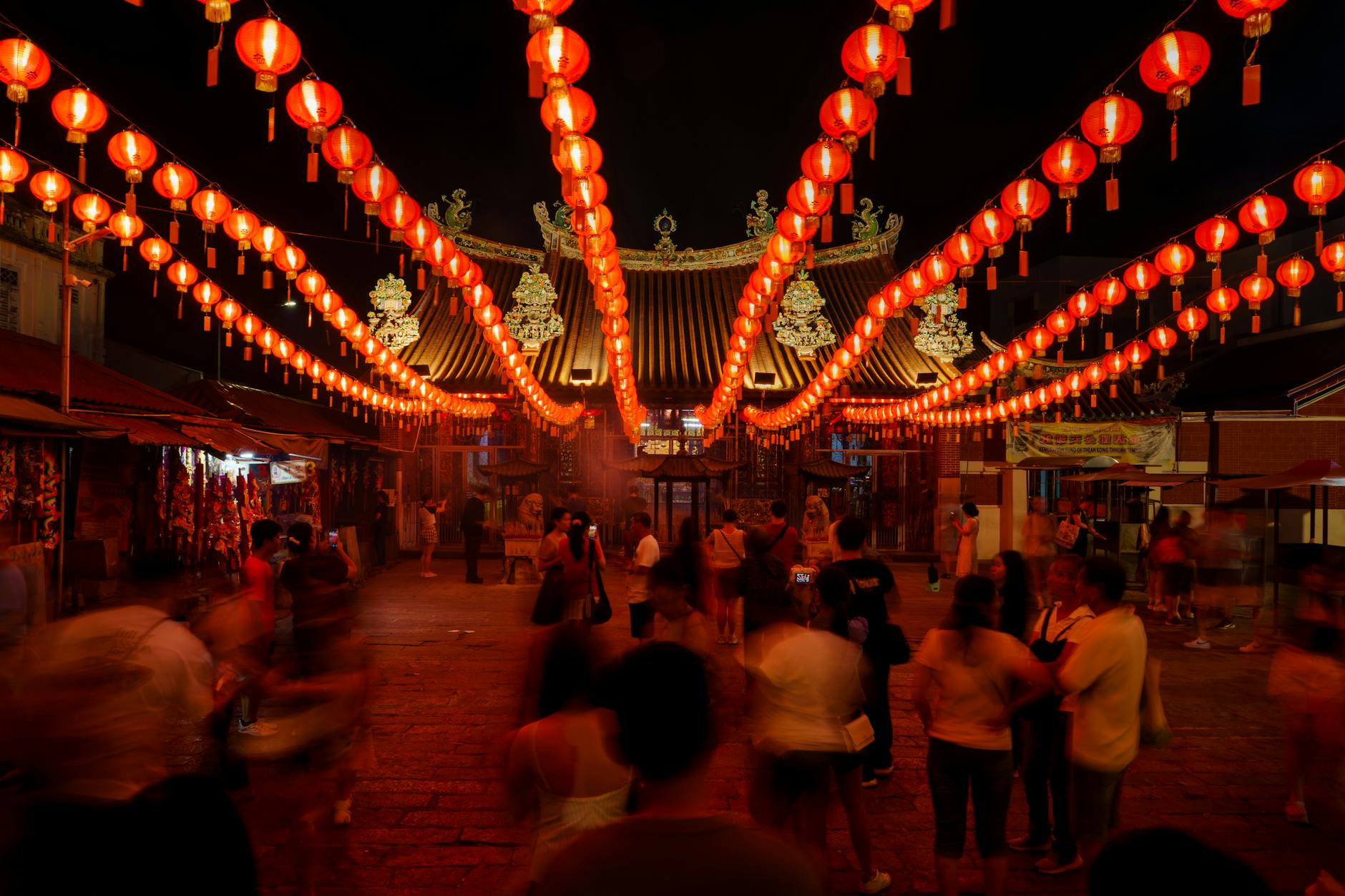
The single biggest change to how Zhouzhuang works is that the town now trades hard on its evenings. Day-trippers leave from about 16:30, the coaches empty out, and by 18:00 the lanes belong to overnight guests and locals.
The scenic area programmes a run of night events: an immersive theatre production staged around the town’s own streets and waterways, evening music performances on the water in summer, and extended lantern lighting through the main holiday periods. Schedules shift, so check the official site the week you travel rather than trusting a blog. A reduced-price evening admission (around ¥80) exists precisely for this.
Is the night show worth it? If you are staying over, yes — it uses the actual bridges and canals as the set, which no theatre can match. If you are day-tripping and would have to eat a late dinner and pay ¥400 for a Didi back to Shanghai at 21:30, probably not. The lanterns alone, seen for an hour before you catch the last bus, are the cheaper version of the same pleasure.
Local Food & Specialties
- Wansan Trotter (万三蹄) — slow-braised pork knuckle named after the Ming-era Shen family ancestor; sweet, melting, ¥80–120 a portion
- Wansan Cake (万三糕) — sweet glutinous rice cake with sweet bean paste
- White-bait omelette (银鱼炒蛋) — tiny river silverfish stirred with egg
- Soused snails (酱螺) — small river snails in soy and rice wine
- Lotus root in osmanthus syrup — sweet, refreshing
- Steamed bream with rice wine — local Yangtze freshwater fish
- Tea egg snacks — eaten while walking
Best restaurants: Shenting Cuisine, Zhouzhuang Mansion Restaurant, Yi Pin Xiang. Expect ¥80–150 per person for sit-down meals.
Two warnings. The pork knuckle is enormous and very sweet — one between three people is plenty, and the vacuum-packed souvenir version sold on every corner is not the same thing as the freshly braised one in a restaurant. And the “local” snack stalls on the main lane sell largely the same industrial products you will find in every water town in Jiangsu. If you want something genuinely of the place, eat the silverfish omelette and the river snails in a sit-down restaurant, in season, and skip the street stalls entirely.
Zhouzhuang vs Other Water Towns
- Zhouzhuang — most famous and most touristed; the Double Bridge is the classic image; Shen’s Residence stands out
- Tongli — quietest and most authentic feel; UNESCO Tuisi Garden. See our Tongli guide
- Wuzhen — most polished and most beautiful at night; overnight in Xizha. See our Wuzhen guide
- Zhujiajiao — closest to Shanghai, accessible by metro. See our Zhujiajiao guide
- Xitang — famous for the “Mission Impossible 3” scene; smaller and quieter than Zhouzhuang
| Town | From Shanghai | Entry | Crowds | Best for |
|---|---|---|---|---|
| Zhouzhuang | 1.5–2 hrs | ¥100 | Heaviest | The famous view, Ming merchant houses |
| Zhujiajiao | 1 hr (Metro 17) | Free to enter | Heavy but short visit | Half-day trips, no planning needed |
| Tongli | 1.5–2 hrs | ~¥100 | Moderate | Gardens, quiet lanes, staying over |
| Wuzhen | 2 hrs | ~¥150 (Xizha) | Managed | Night lighting, an overnight in the old town |
| Xitang | 2 hrs | ~¥95 | Lighter | Covered walkways, evening drinking |
For a single day trip with the most famous water-town image: Zhouzhuang. For depth and quiet: Tongli. For best evening atmosphere: Wuzhen. For the shortest trip: Zhujiajiao. And if you want the honest advice — go to one, properly, rather than two in a day. They look similar enough that a second one on the same afternoon adds very little.
When to Go: Season, Day and Hour
The hour matters more than the season. Get through the gate by 08:00 and you have roughly ninety minutes of near-empty lanes before the first coaches arrive around 09:30. After 16:30 the day-trippers leave and it empties again. The four hours in between are the ones everyone complains about.
| Season | What it’s like | Verdict |
|---|---|---|
| March–May | 10–24°C, canal-side willows out, occasional rain | Best overall |
| June–early July | Plum rain season — humid, grey, wet stone | Atmospheric for photos, unpleasant to walk |
| Mid-July–August | 33–38°C and very humid; little shade on the bridges | Go at opening or not at all |
| September–November | Clear, mild, best light of the year | Excellent, but avoid 1–7 October |
| December–February | 2–10°C, damp cold, thin crowds | Quietest; the mist is worth the cold |
Avoid the first week of October and the Chinese New Year period entirely — these are the two windows when the capacity caps come into play. Weekdays are dramatically better than weekends. For the wider picture, see the best time to visit Shanghai and our autumn guide.
A Day Plan That Beats the Crowds
- 06:20 — leave central Shanghai. Metro to Hongqiao, bullet train to Kunshan South.
- 07:40 — Tourist Bus 109 from Kunshan South towards Zhouzhuang.
- 08:20 — through the gate. Head straight past the shops to the Double Bridge while it is still empty.
- 08:45 — Shen House, then Zhang House. Both open early and are quiet before 10:00.
- 10:00 — boat ride, before the pier queue builds.
- 10:45 — Fu’an Bridge, Quanfu Temple, and the back lanes on the northern side, which almost nobody walks.
- 12:00 — early lunch. Silverfish omelette, a shared pork knuckle, rice. ¥100–150 a head.
- 13:30 — the crowd peak. Either accept it and shop, or take the bus out and be back in Shanghai by 16:00.
That is roughly five hours in town, which is the right amount. Fit it into the wider list in our day trips from Shanghai pillar, or pair a water town with Hangzhou across two days.
Staying Overnight
Staying inside the old town is the single best upgrade to a Zhouzhuang visit. Guesthouses run roughly ¥250–600 a night, more during holidays, and most are converted courtyard houses with six to twelve rooms. Expect small rooms, thin walls, steep wooden stairs and a good breakfast; do not expect a lift or a bathtub.
The practical benefits: you are inside the gate before the day tickets are sold, you see the lanterns without watching the clock, and the 07:00 view of the canal with nobody in it is the reason to come. The trade-off is that you commit an evening to a small town with limited food options after 21:00. Book the room with a canal view if it is available — it is usually only ¥50–100 more and it is the whole point.
Mistakes and Things That Have Changed
- Arriving at 11:00. The most common error. You get the crowd and none of the light.
- Assuming the boat price is per person. It is generally per boat. Groups of four or six get much better value; solo travellers should ask to share.
- Buying the vacuum-packed pork knuckle as a souvenir. It is a different product from the restaurant version and it will leak in your bag.
- Trying to do Zhouzhuang and Tongli in one day. Possible, exhausting, and you will remember neither.
- Relying on cash. Alipay and WeChat are standard; some stalls no longer keep change.
- Missing the last bus. Departures back towards Shanghai thin out sharply after 17:00 and there is no late service. Confirm the last departure when you arrive, not when you want to leave.
- Turning up on 1–7 October. Golden Week here is genuinely unpleasant, capacity caps and all.
- Expecting English. Signage and menus are largely Chinese, and staff outside the ticket office rarely speak English. It is very manageable with a translation app, but it surprises people.
Tips for Visiting
- Arrive by 8am opening — Zhouzhuang is the most-crowded water town. Mid-day weekends are uncomfortable
- Stay 1.5 hours minimum, 4 hours ideal
- Avoid Chinese national holidays — October 1–7 sees stadium-level crowds
- Buy entry ticket online — Trip.com offers slight discounts
- Cash + Alipay accepted at all tourist stalls
- Wear flat shoes — uneven cobblestones and bridge steps
- Bring umbrella — sun protection in summer; rain in plum-rain season
- Photography: tripods discouraged on busy bridges; daytime is fine. Sunset 30 min photography is gold
- Combining with Tongli: both possible in a long day from Shanghai (12+ hours); only experienced solo travelers should attempt
- Overnight Zhouzhuang: small but pleasant; the town transforms after day-trippers leave at 17:00
- Keep your ticket — it is scanned again at each inner residence, not just the main gate
- Bring your passport — needed for the child and senior discount, and for booking a guesthouse
Frequently Asked Questions
Is Zhouzhuang water town worth visiting?
Yes, if you go early or stay overnight. Zhouzhuang is the most internationally famous water town near Shanghai, the Double Bridge is the classic image, and Shen’s Residence is the best-preserved Ming-era merchant home of any of them. At midday on a weekend it is a very different and much less appealing place.
How do I get to Zhouzhuang from Shanghai?
Direct bus from Shanghai South Bus Station (90 minutes, ¥35); or bullet train to Kunshan South + Tourist Bus 109 (75 minutes total, ¥40); or organised day tour (¥400–600). Since Metro Line 17’s extension to Xicen opened in November 2024, you can also ride the metro west and take a short taxi across the border.
How much does a Zhouzhuang water town day trip cost?
¥100 entry ticket (includes 16 inner sights). Boat rides ¥150–250 per boat rather than per person. Lunch ¥80–150. Total day excluding transport: ¥300–400 per person, or less if you share a boat.
How long does it take to see Zhouzhuang?
3–4 hours for the highlights; 5–6 hours for a full visit with multiple residences, a boat and a meal. Overnight allows the post-17:00 quieter atmosphere, which is the best part.
What time does Zhouzhuang open and close?
Gates open around 07:30 and the streets stay open until about 21:00. Most inner sights close between 16:30 and 17:00, though Shen House, Zhang House and the museum run later. A cheaper evening ticket is sold from late afternoon.
Zhouzhuang vs Tongli — which is better?
Zhouzhuang for the famous photography and the merchant houses. Tongli for a quieter, more lived-in atmosphere and the UNESCO-listed Tuisi Garden. If crowds bother you more than fame appeals, choose Tongli.
Can you stay overnight in Zhouzhuang?
Yes — multiple small guesthouses (¥250–600/night) within the old town. The town empties at 17:00 and transforms; overnight is significantly more atmospheric. Book a canal-view room if one is available.
When is the best time to visit Zhouzhuang?
Spring (April–May) and autumn (September–October) for ideal weather. Weekdays are far less crowded than weekends. Avoid Golden Week (Oct 1–7) and Chinese New Year, when the scenic area approaches its 40,000-visitor instantaneous cap.
Is the Zhouzhuang night show worth it?
If you are staying the night, yes — it is staged on the town’s real bridges and waterways rather than in a theatre. As a day-tripper it commits you to a late and expensive journey back to Shanghai, and the lanterns alone give you most of the atmosphere.
Is photography permitted in Zhouzhuang?
Yes — outdoors and in most residences. Tripods are restricted on busy bridges and inside small interiors. No flash near old artwork. The best light is the first hour after opening and the half hour before sunset.
Do I need to book Zhouzhuang tickets in advance?
Not usually on a weekday, when you can buy at the gate. For weekends and holidays, book through the official scenic area site or a reseller — the town operates published capacity limits and entry can be paused when they are reached.
Plan More Water Town Trips
Compare with our guides on Tongli, Wuzhen, Zhujiajiao, and our day trips from Shanghai pillar. For background, see Zhouzhuang on Wikipedia.