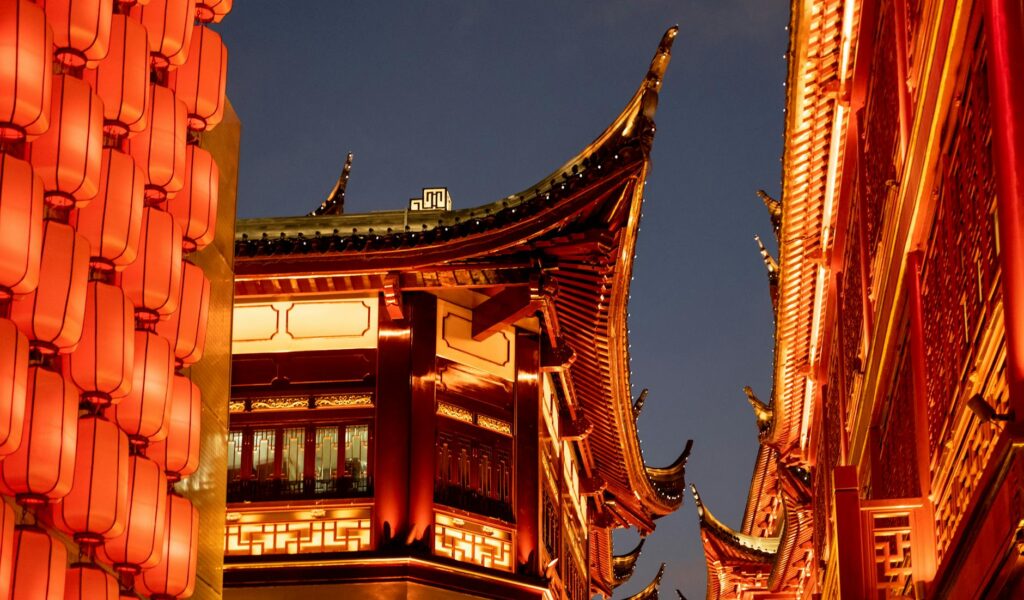
Yu Garden Shanghai is the oldest surviving Ming-dynasty classical garden in the city centre, and it is the easiest way any traveller can step out of modern Shanghai and into four hundred years of Chinese garden craft. Laid out between 1559 and the 1570s as a private retreat for the family of a retired official, the walled garden has outlasted dynasty changes, the Opium Wars, the Taiping Rebellion, foreign occupation and the Cultural Revolution to reach us more or less intact. This guide walks through the garden’s history, the specific halls and rockeries worth slowing down for, how tickets and opening hours actually work, the surrounding Yuyuan Bazaar and its century-old restaurants, the Huxinting Teahouse, the best times to go, and how to fold the visit into a wider Shanghai trip.
One thing to settle up front: the garden is a single ticketed attraction inside a much larger free-to-roam district. The walled garden takes 60 to 90 minutes to walk properly. Around it spread the lanes of Yuyuan Bazaar, the City God Temple, several restaurants old enough to predate the People’s Republic, and the lake-island teahouse and zigzag bridge that form one of the most photographed scenes in Shanghai. Most first-time visitors simply call the whole area the Old City and treat the garden as its centrepiece.

Table of Contents
- What Is Yu Garden?
- A Brief History of Yu Garden
- Garden Highlights: What to See Inside
- Yuyuan Bazaar: Shopping Around the Garden
- Tickets, Opening Hours and How to Visit
- A Suggested Walking Route
- The Huxinting Teahouse
- Where to Eat in the Old City
- Best Time to Visit Yu Garden
- How Long to Spend
- Getting There
- Tips and Common Mistakes
- What to Combine With Yu Garden
- Frequently Asked Questions
What Is Yu Garden?
Yu Garden (豫園, Yùyuán in Mandarin) is a five-acre private classical Chinese garden in central Shanghai’s Old City, a short walk south of the Bund. The character yù carries a sense of ease, comfort and contentment, which is fitting: the garden was built as a place to please an ageing parent, not to impress the public. It belongs to the Jiangnan school of garden design, the southern tradition centred on Suzhou and the lower Yangtze, where the art lies in arranging water, rock, plants and small buildings so a confined plot feels boundless. Walls vanish behind rockeries, ponds reflect pavilions, and framed sight lines borrow distant rooftops and sky into the composition.
The garden is organised into six main scenic areas: Sansui Hall, the Wanhua Chamber, Dianchun Hall, Huijing Hall, Yuhua Hall and the Inner Garden. Each pairs a hall or pavilion with its own pond, rockery and planting. The Great Rockery, finished in the 1570s, is the largest Ming-era rock mountain still standing in southern China. For all its fame the garden is not large, which is exactly why it repays slow, attentive walking rather than a quick lap.
It helps to keep two things separate in your head. Yu Garden is the walled, ticketed historical garden. Yuyuan Bazaar is the surrounding shopping and temple district, which is free and open at all hours. They are physically joined and people use the names loosely, but only one of them charges admission and closes at night. For wider context on the city’s past, our history of Shanghai guide sets the scene.
A Brief History of Yu Garden
The garden was commissioned in 1559 by Pan Yunduan, an official from Sichuan, as a retreat for his elderly father, Pan En. Work proceeded in fits and starts across nearly twenty years, slowed by cost, and was completed around 1577 (some sources put the finishing touches as late as 1590). For a few generations the Pan family enjoyed the garden privately. After Pan Yunduan’s death the family declined, the grounds were neglected, and the property changed hands more than once.
By 1760 the garden had fallen into such disrepair that a group of local merchants and gentry pooled money to buy it and attached it to the neighbouring City God Temple. Because the temple already had an “East Garden,” the newly restored grounds became its “West Garden.” Restoration ran for roughly two decades, rebuilding pavilions and adding rockeries. The commercial bustle of the temple fair gradually pressed up against the garden’s quiet courtyards, the beginning of the split personality the area still has today.
The nineteenth century was hard on the garden. It was occupied and damaged during the First Opium War in the 1840s, when British forces used it as a base, and again during the Taiping Rebellion and the Small Sword Society uprising of the 1850s and 1860s. Dianchun Hall, in fact, served as a headquarters for the Small Sword Society in 1853 during their rising against the Qing. Further damage followed through the Republican era and the Cultural Revolution.
Serious restoration began under the Shanghai government in the 1950s and ran into the 1980s. The City God Temple’s old “East Garden” was renamed the Inner Garden and folded back in, and the grounds reopened to the public in 1961. Today the garden is a nationally protected monument and one of the busiest attractions in Shanghai — a tribute to the restoration, and the visitor’s single biggest practical challenge: crowds.
Garden Highlights: What to See Inside
Yu Garden packs more than forty named scenic spots into a small footprint, but a handful of features carry the visit. Knowing what to look for turns a pretty walk into a far richer one.

Sansui Hall (Three Corn Ears Hall)
The first major hall inside the garden, Sansui Hall is the most spacious structure on the grounds, standing about nine metres tall across five bays. Pan Yunduan originally named it Leshou, meaning joy and longevity, and used it to receive guests. It was later renamed Sansui, a name tied to wishes for good harvests and favourable weather, and over the years it hosted official ceremonies and gatherings of local notables. Look up at the carved beams above the doorways and at the heavy Ming-style hardwood furniture.
The Great Rockery
This is the architectural anchor of the whole garden and usually the first thing visitors meet after the entrance halls. Built from thousands of tonnes of yellow stone by the noted Ming rockery artist Zhang Nanyang, it rises about 14 metres and is the largest surviving Ming-era rockery south of the Yangtze. Narrow stone paths and a small summit pavilion let you climb to the top, where you get a clear view back across the garden’s tiled roofs. It is a short scramble, not a hike, and well worth it.
Wanhua Chamber
A delicate two-storey building wrapped in winding cloisters, the Wanhua Chamber once served as a study and reading room. The carved window traceries are among the finest surviving Ming woodwork in Shanghai, the four ground-floor corners carrying plum, orchid, bamboo and chrysanthemum motifs, one for each season. In the courtyard stands a ginkgo said to have been planted by Pan Yunduan himself more than four centuries ago.
Dianchun Hall and the Dragon Wall
Built later, in the Qing dynasty, Dianchun Hall was where the family gathered for feasts on festival days, and it carries real historical weight as the 1853 headquarters of the Small Sword Society; a small display upstairs covers that period. In front of the hall sits a water-facing opera stage. To the west runs the Cloud-Piercing Dragon Wall, a curving wall topped with a clay dragon head and a tiled, scaled body, a flourish rarely seen in southern gardens. Yu Garden has several of these dragon-topped walls dividing the grounds into separate scenes; the dragons technically have only four claws, a careful sidestep of the five-clawed dragon reserved for the emperor.
Yuhua Hall and the Exquisite Jade Rock
Yuhua Hall, the “Jade Magnificence Hall,” was Pan Yunduan’s study, furnished in top-grade rosewood; you can still see the scholar’s desk and the Four Treasures of the Study laid out inside. The hall was positioned specifically to admire the garden’s single greatest treasure, which stands opposite it: the Exquisite Jade Rock (Yulinglong). This 3.3-metre pierced Taihu limestone is reckoned one of the three most famous scholar’s rocks in southern China. It is riddled with 72 holes, and the classic demonstration is to burn a stick of incense at the base, whereupon smoke threads out of every opening, or pour water in at the top and watch it stream from the holes at once.
The Inner Garden
Tucked into the southern end, the Inner Garden is a garden-within-a-garden, long, narrow and exquisitely detailed, dating in its current form to the early Qing. The Hall of Serenity looks across a cluster of strange peaks; the Pavilion for Watching Waves once gave a view east toward the Huangpu River before the modern city blocked it. Its showpiece is an ancient covered opera stage, its ceiling of interlocking circles and arcs designed to throw the singers’ voices outward. Many visitors find this the most photogenic corner of the garden, so save some patience for it.
Beyond these set pieces, the garden rewards a slow eye. Watch how doorways and lattice windows frame a single rock or branch like a hung scroll, and how the path never lets you see everything at once. That deliberate withholding of the full view is the core trick of Jiangnan garden design.
Yuyuan Bazaar: Shopping Around the Garden
Step outside the garden walls and you are in Yuyuan Bazaar, a dense grid of stone-paved lanes and curving-eaved shops grown up from the markets that once served the City God Temple. It is free, open around the clock, and worth time on its own terms even if the architecture is more restored than ancient. Hundreds of shops sell silk, tea, fans, calligraphy supplies, jade, seals and every grade of souvenir, alongside busy snack counters.

At the centre of the district sits the City God Temple itself, a working Taoist temple with its own modest admission (around ¥10) and a long history tied to the garden’s fortunes. Nearby are the Huxinting Teahouse on its lake island and the zigzag Nine-Turn Bridge, the most-photographed corner of the bazaar. The lanes are at their most striking during the annual Yuyuan Lantern Festival, which runs for several weeks around the Lunar New Year (the 2026 edition ran from late January into early March) and drapes the entire complex in themed lanterns; on the busiest evenings the bazaar charges a separate ticket to enter the lantern zone.
A word of caution. The bazaar is one of the more aggressive pickpocketing and scam areas in Shanghai. Keep valuables in front pockets or a zipped bag, and politely brush off the friendly strangers who invite you to a teahouse or an art exhibition — both are long-running tourist traps. Our guide to common Shanghai scams explains exactly how the teahouse and art-student routines work. If you plan to actually buy something, prices start high and bargaining is expected; you can read more in our wider things to do in Shanghai pillar.
Tickets, Opening Hours and How to Visit
Prices and hours at Chinese attractions shift, sometimes seasonally and sometimes without much warning, so treat the figures below as a recent guide and confirm on the day. As a rule the garden keeps the following pattern:
- Opening hours: roughly 9:00 AM to 4:30 PM, with last entry and ticket sales stopping around 4:00 PM. Closed on Mondays (with occasional exceptions during major national holidays).
- Admission: about ¥40 in the high seasons (April to June and September to November) and around ¥30 in the quieter months. Seniors over 60 and students or minors typically pay roughly half, and small children under about 1.3 metres usually enter free.
- Combined ticket: a joint Yu Garden plus City God Temple ticket has at times been sold for around ¥60, which can make sense if you intend to do both.
You can buy at the ticket window beside the entrance or in advance. Booking ahead through Trip.com or Klook is simplest for foreign visitors, since both take overseas cards and English; the official WeChat mini-program is cheaper but Chinese-only and asks for a passport number. Advance booking is not essential on a normal weekday, but it saves real queueing on weekends, public holidays and during the lantern festival. The bazaar costs nothing to wander, the City God Temple is ticketed separately, and the Huxinting charges by the pot rather than by entry.
A Suggested Walking Route
The garden is a maze by design, and it is easy to double back or miss a hall. This focused loop of about 75 minutes hits every major feature in a sensible order.
- Enter at the main (north) gate and pass through Sansui Hall, taking a moment for the carved beams and Ming furniture.
- Climb the Great Rockery. Follow the stone paths up to the summit pavilion for the view back over the rooftops.
- Wanhua Chamber. Stop at the seasonal carved windows and the old ginkgo in the courtyard.
- Dianchun Hall and the Dragon Wall. See the opera stage out front, the Cloud-Piercing Dragon Wall to the side, and the Small Sword Society display upstairs.
- Yuhua Hall and the Exquisite Jade Rock. Find the 72 holes in the pierced stone and the scholar’s desk inside the hall.
- Inner Garden. Allow extra time here for the opera stage and the most photogenic courtyards.
- Exit south into the bazaar near the Huxinting Teahouse and the Nine-Turn Bridge.
- Optional: a pot of tea upstairs at the Huxinting, 30 to 45 minutes.
The Huxinting Teahouse
The Huxinting (“Mid-Lake Pavilion”) is one of the oldest and most photographed teahouses in central Shanghai. The current teahouse dates to 1855, built on a small wooden island in an ornamental lake and reached by the Nine-Turn Bridge. The bridge’s many sharp zigzags are not just decorative: folk belief holds that evil spirits can only travel in straight lines, so the crooked path keeps them off the island.
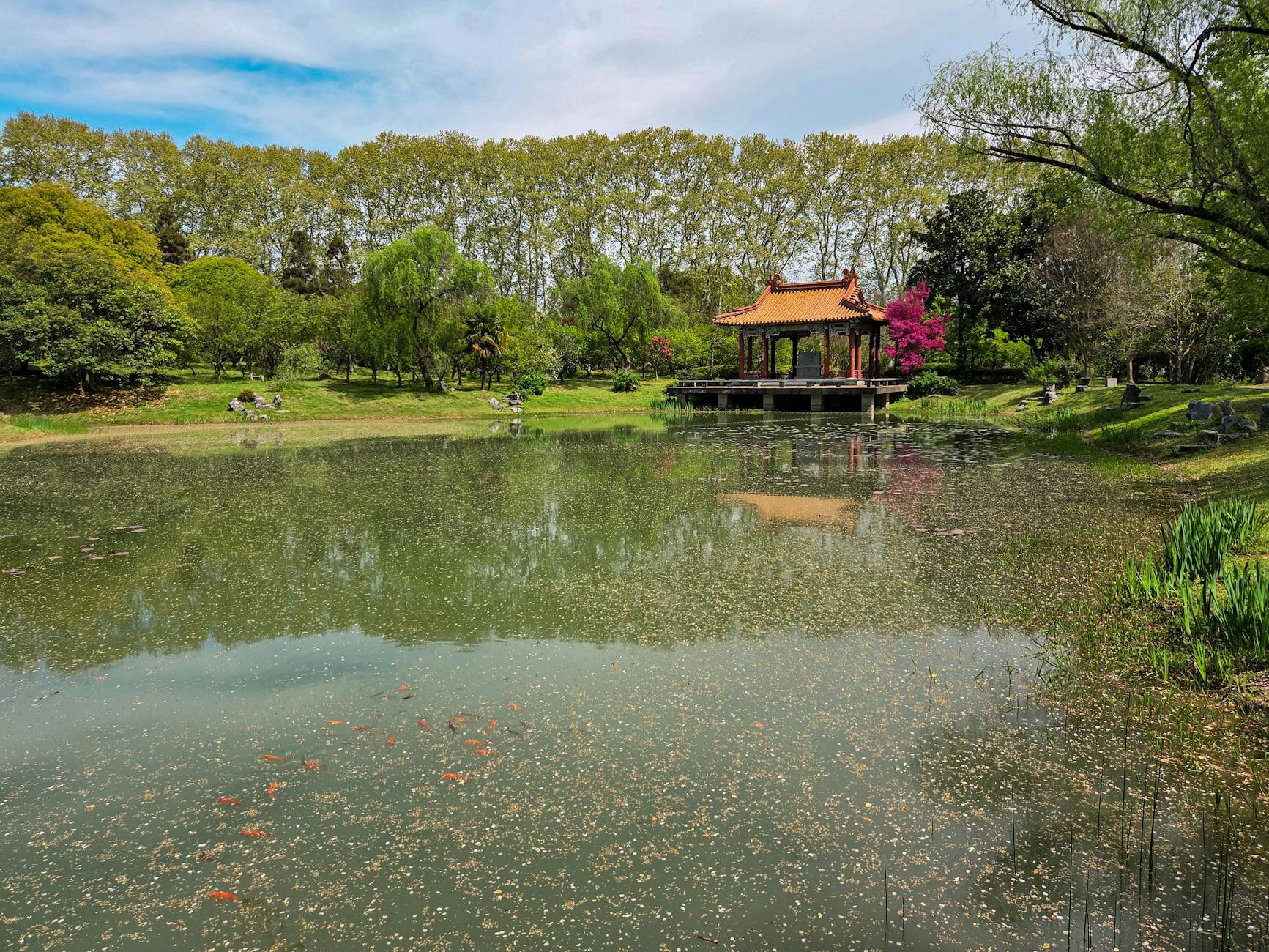
Inside, the teahouse serves tea in the traditional way: a pot of your chosen leaf (anywhere from about ¥60 to ¥200 depending on grade), some small snacks, and an unhurried hour. The ground floor is the casual room; the upper floor is quieter and more refined. The teahouse has long drawn visiting dignitaries — Queen Elizabeth II took tea here in 1986, Bill Clinton in 1998 — and even a ten-minute pot upstairs is a pleasant counterpoint to the crush below.
Where to Eat in the Old City
The lanes around Yu Garden hold some of Shanghai’s most famous traditional restaurants, several more than a century old. It is one of the best places in the city to eat through classic Shanghainese cooking in one compact area.
- Nanxiang Steamed Bun. Founded in 1900 and the most famous xiaolongbao house in Shanghai, sitting right by the garden bridge. The ground-floor takeaway counter is cheapest and has the longest line; the upper floors are sit-down. Standard pork soup dumplings run around ¥30, crab-roe versions roughly ¥60.
- Lubolang. A classic benbang (local Shanghai) restaurant facing the garden, dating to the Qing, known for red-braised pork, lion’s-head meatballs and delicate pastries. Expect roughly ¥200 to ¥400 per person.
- Songyuelou. Founded in 1922 and one of the oldest vegetarian restaurants in Shanghai, serving Buddhist-style dishes that use tofu, wheat gluten and mushrooms to mimic meat. Around ¥150 to ¥300 per person.
- Casual snacks. Throughout the bazaar you will find pan-fried shengjianbao, candied-hawthorn skewers, sticky-rice cakes and sweet-bean treats, mostly in the ¥5 to ¥25 range.
For a fuller tour of what to eat in the city, including where else to chase the perfect soup dumpling, see our Shanghai food guide.
Best Time to Visit Yu Garden
The single most useful tip in this guide: arrive at opening, 9:00 AM, on a weekday. The garden’s paths are narrow, and by around 11:00 AM the tour groups arrive and the pinch points clog. Early light in spring and autumn is also kindest for photographs. The second-best window is the last hour, from about 3:30 PM, when crowds thin again, though with last entry at 4:00 PM you have to move with purpose.
Across the year, late spring (April and May) and autumn (September through November) are the loveliest, when the planting and the weather both cooperate. Winter brings the spectacular lantern festival around the Lunar New Year. The times to avoid, if you can, are the big domestic holiday blocks — the May Day break (roughly 1 to 5 May) and the National Day “Golden Week” (1 to 7 October) — when the garden and bazaar are swamped. For a month-by-month view of weather and events, our Shanghai itinerary planner is a good companion. Remember the garden is shut on Mondays even though the surrounding bazaar stays open all week.
How Long to Spend
Most visitors spend 60 to 90 minutes inside the garden itself, plus another hour or so in the bazaar, and longer if a meal is involved. A full Yu Garden and Old City visit is comfortably a half day.
If time is tight, budget about 45 minutes in the garden, 30 in the bazaar and a quick lunch at Nanxiang, two hours total. If your schedule is loose, make it a leisurely half-day: the garden, lunch at Lubolang, tea at the Huxinting, and an unhurried wander through the lanes.
Getting There
Yu Garden sits in central Shanghai and is easy to reach by metro, on foot from the Bund, or by taxi.
- By metro: Yuyuan Garden Station is an interchange on Line 10 and Line 14. From Line 10 take Exit 1; from Line 14 take Exit 7. Either way it is a walk of about five minutes through the bazaar to the garden’s main gate.
- From the Bund: roughly a 15-minute walk south. Cross Yan’an East Road and enter the Old City through one of the pedestrian lanes.
- By bus: several routes (including the 11, 26, 64, 736, 920, 926 and 930) stop at Xinbeimen, a four-minute walk along Anren Street from the garden.
- By taxi or Didi: say or show “Yuyuan” (豫園). Cars set you down at the bazaar’s main entrance.
For tickets, payment apps and the wider transport picture, see our getting around Shanghai guide.
Tips and Common Mistakes
A few practical notes can save time, money and a pickpocketed wallet.
- Arrive at opening. 9:00 AM on a weekday is the magic slot for thin crowds and good light.
- Book ahead for weekends. Advance tickets through Trip.com or Klook skip the window queue when it matters.
- Wear comfortable shoes. The bazaar’s pavers are uneven and the garden’s paths include steps and the rockery climb.
- Mind your pockets. The crowded bazaar lanes are prime pickpocket territory; use front pockets or a zipped bag.
- Decline the teahouse and art invitations. A polite no is all it takes; the “come see my exhibition” and “join us for tea” approaches are scams.
- Carry water. Especially in summer; shop prices inside the bazaar carry a tourist mark-up.
- Try at least one classic snack. A soup dumpling, a sticky-rice cake or a candied-hawthorn skewer is part of the experience.
- Save energy for the Inner Garden. It is the photographic highlight, and it comes near the end of the loop.
What to Combine With Yu Garden
Yu Garden sits within easy reach of several other Old City and downtown sights, a natural anchor for a half or full day.
- The Bund, about 15 minutes’ walk north. The classic pairing for a first day in Shanghai — garden in the morning, waterfront in the late afternoon.
- Nanjing Road, about 15 minutes northwest. The Old City links via Henan Road to the East Nanjing Road pedestrian shopping street.
- City God Temple, inside the bazaar. A small Taoist temple with a separate ticket, woven into the garden’s own history.
- The French Concession, a short ride west. Plane-tree lanes and 1920s villas for a completely different slice of Shanghai history.
- Xintiandi, a few stops south. Restored shikumen lane houses turned into a dining and shopping quarter.
For ready-made day-by-day plans that string these together, see our 3-day Shanghai itinerary and the broader Shanghai itinerary planner.
Frequently Asked Questions
Is Yu Garden worth visiting?
Yes, particularly on a first trip to Shanghai. It is the best surviving example of Ming-era classical garden design in the city centre and the most accessible introduction to the Chinese garden tradition without leaving the city. With the adjoining bazaar it easily fills a morning.
How much does Yu Garden cost?
Admission is usually around ¥40 in the high seasons (April to June, September to November) and about ¥30 the rest of the year, with roughly half-price tickets for seniors, students and minors. Prices change, so confirm at the gate. The surrounding bazaar is free.
What are Yu Garden’s opening hours?
Generally 9:00 AM to 4:30 PM, with last entry around 4:00 PM, and closed on Mondays apart from some national-holiday exceptions. The bazaar outside the walls stays open every day, around the clock.
How long do I need at Yu Garden?
Plan on 60 to 90 minutes inside the garden, plus about an hour for the bazaar. With a meal and tea, the whole Old City visit runs to a comfortable half day.
What is the difference between Yu Garden and Yuyuan Bazaar?
Yu Garden is the walled, ticketed classical garden. Yuyuan Bazaar is the free, surrounding district of shops, snack stalls and old restaurants. They sit together and share a name in casual speech, but only the garden charges admission and closes at night.
How do I get to Yu Garden by metro?
Take Metro Line 10 or Line 14 to Yuyuan Garden Station (Exit 1 for Line 10, Exit 7 for Line 14), then walk about five minutes through the bazaar to the garden’s main gate.
Is Yu Garden good for children?
Yes. Children tend to enjoy the rockery paths, the zigzag Nine-Turn Bridge and the carp ponds. Strollers can manage most paths but will need lifting over the occasional step.
When is the best time of day to visit Yu Garden?
Right at opening, 9:00 AM, ideally on a weekday, before the tour groups arrive around 11:00 AM. The last hour from about 3:30 PM is the next-best window.
Should I pre-book Yu Garden tickets?
It is helpful on weekends, public holidays and during the lantern festival, and not strictly necessary on an ordinary weekday. Booking through Trip.com or Klook is the easiest route for foreign cards and English.
Is the food around Yu Garden any good?
Yes, especially the long-established names: Nanxiang for soup dumplings, Lubolang for traditional Shanghainese, and Songyuelou for vegetarian. Smaller snack stalls are more hit-and-miss, so follow the local queues.
Plan Your Visit
The route in this Yu Garden Shanghai guide is built for a focused half-day: arrive at 9:00 AM, walk the garden in about 75 minutes, browse the bazaar, eat soup dumplings at Nanxiang, and finish with a pot of tea at the Huxinting. Add a stroll along the Bund in the late afternoon and you have the canonical first day of almost any Shanghai trip.
For more sightseeing ideas, see our pillar guide to things to do in Shanghai; for day-by-day plans, the Shanghai itinerary planner; and for trains, metro and taxis, our getting around Shanghai guide. Yu Garden has been doing what it does for some 450 years. Walk it slowly and with attention, and it gives back far more than a quick lap suggests.
For further background, see Yu Garden on Wikipedia.