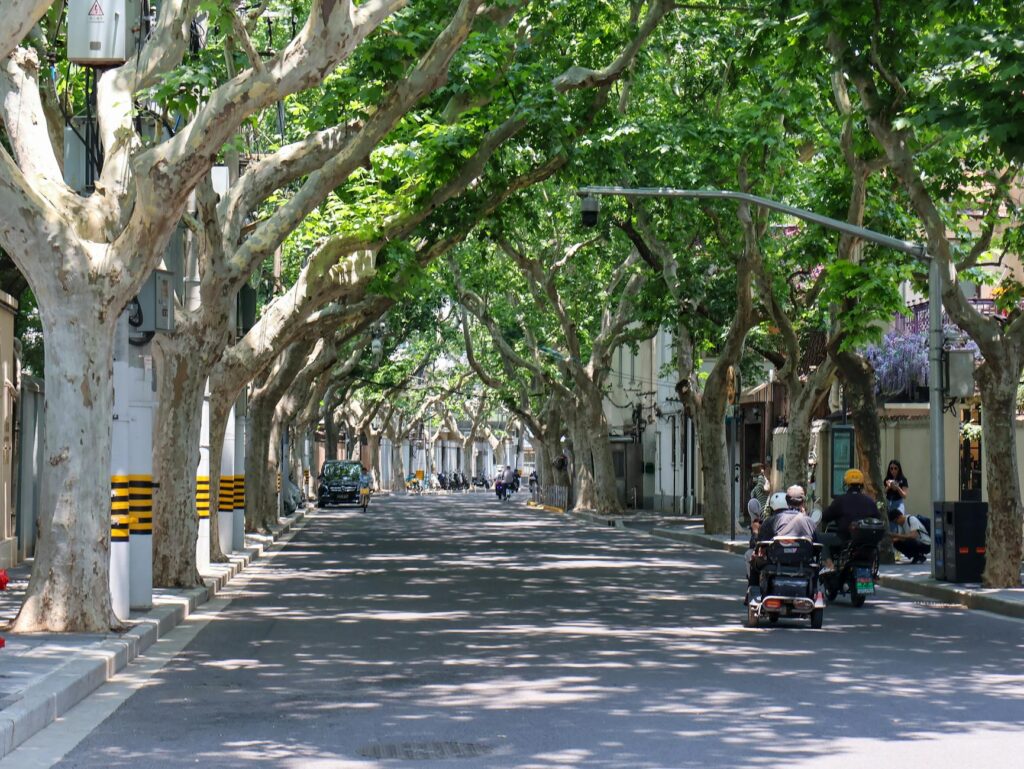
The former French Concession is the part of Shanghai people fall for slowly. There are no ticket gates and no single headline sight – just London plane trees arching over quiet avenues, restored shikumen lane houses, 1920s Art Deco apartments, and a coffee shop every fifty paces. The best way to take it in is on foot, at your own pace, with room to turn down a side lane when a doorway catches your eye. This French Concession walking tour lays out an ordered, walkable route – 12 stops, from Wukang Mansion to Tianzifang – with street-by-street directions, realistic timings, café stops, and the historical background that makes each corner read differently.
You can follow the whole loop as a relaxed half-day, or treat it as a menu and cherry-pick the stretches that suit your pace. Either way, the district rewards curiosity more than box-ticking, so leave a little slack in your schedule.

Table of Contents
- Tour Overview at a Glance
- Where to Start & How to Get There
- Before You Set Off: Navigation, Money & Timing
- The Walking Tour Route (12 Stops)
- Optional Detours for Extra Time
- Where to Eat & Drink Along the Way
- A Short History of the French Concession
- Reading the Architecture
- Practical Tips for the Walk
- Self-Guided vs Guided Tours
- Frequently Asked Questions
- Plan the Rest of Your Day
Tour Overview at a Glance
- Distance: a few kilometres end to end, from Wukang Mansion across to Tianzifang
- Duration: a relaxed half-day with stops; less if you walk it briskly without breaks; a full day if you linger in cafés and shops
- Difficulty: easy – flat, paved, no hills; sidewalks are occasionally uneven
- Start: Wukang Mansion, at Wukang Road and Huaihai Middle Road (Metro Line 10/11)
- Finish: Tianzifang, off Taikang Road (Metro Line 9, Dapuqiao)
- Cost: free to walk; budget for optional coffee, lunch, and a couple of minor admissions
- Best time: a weekday morning or late afternoon for softer light and thinner crowds
- What you’ll see: Wukang Mansion, plane-tree streets, historic villas, Fuxing Park, Sinan Mansions, Xintiandi, Tianzifang
Where to Start & How to Get There
Begin at Wukang Mansion (武康大楼), the wedge-shaped apartment block where Wukang Road meets Huaihai Middle Road. It is the unofficial gateway to the district and an easy landmark to find. Two metro approaches work well:
- Line 10 or Line 11 to Jiaotong University Station (上海交通大学) – then a short walk to the mansion.
- Line 10 to Shanghai Library Station (上海图书馆) – a similar short walk in from the other side.
If you would rather work the route in reverse – ending near the Bund side of the city – you can flip it and start at Tianzifang via Line 9 (Dapuqiao Station), though the Wukang-to-Tianzifang direction flows more naturally from leafy and residential toward livelier and more commercial.
Before You Set Off: Navigation, Money & Timing
A few practicalities will save you some friction, especially if this is your first walk in a Chinese city.
Maps that actually work
Google Maps is unreliable inside mainland China and will often send you to the wrong block. Download Amap (Gaode Maps) before you go, or use Apple Maps, which pulls its China data from Amap and labels these streets correctly. Either will keep you on track through the grid of lookalike tree-lined lanes.
Paying for coffee and snacks
Small cafés, bakeries, and street vendors here rarely take cash or foreign cards. Link your international card to Alipay or WeChat Pay on your phone before arriving, and carry a little cash only as a backstop for the occasional market stall.
Picking your hours
The most pleasant windows are a weekday morning or late afternoon: the light is kinder for photos, and the photogenic corners are far less crowded. Spring and autumn are the prettiest seasons, when the plane trees are either in fresh leaf or turning gold.
A word on the sidewalks
Wear comfortable shoes; the pavement is flat but uneven in places, with the occasional raised root. Stay alert for near-silent electric scooters, which share the sidewalks and corners.
The French Concession Walking Tour Route: 12 Stops
The stops below run in walking order. Times are loose – treat them as a rhythm rather than a schedule.
Stop 1 – Wukang Mansion (武康大楼)
Built in 1924 by the Hungarian-Slovak architect László Hudec – also known by its old name, the Normandie Apartments – this triangular, ship-shaped building is one of the most popular photo spots in the district. Its prow seems to slice down Huaihai Road, and from the right angle it really does look like the bow of a liner. For the cleanest shot, cross to the south side of Huaihai Middle Road rather than standing in the street; traffic police here are strict, and the road is busy. Come early in the day if you want the frame to yourself. The ground-floor cafés are a pleasant place to start with a coffee before you walk.

Time here: 15-20 minutes for photos and a look around.
Stop 2 – Wukang Road (武康路)
From the mansion, walk the length of Wukang Road – an open-air museum of architecture about 1.17 kilometres long. You’ll pass Spanish-style villas, English country-cottage façades, and the former homes of Republican-era officials and writers, all heavily shaded by plane trees planted more than a hundred years ago. It is noticeably quieter than the main avenues.
Time here: 20-30 minutes, more if you duck into Ferguson Lane.
Stop 3 – Soong Ching-ling’s Former Residence (宋庆龄故居)
A short way along sits the beautifully preserved 1920s villa where Soong Ching-ling (Madame Sun Yat-sen) lived from 1948 to 1963. It opens Tuesday to Sunday, 9:00-17:00 (last entry 16:30), and closes on Mondays apart from some holidays; check the admission fee on the residence’s official site before you go. Even a quick visit gives you grounded 20th-century context – the garden and the period interiors. If you’d rather keep moving, the exterior and grounds read well from the street.
Time here: 30 minutes inside, or a few minutes from the gate.
Stop 4 – Wulumuqi Middle Road (乌鲁木齐中路)
Cut across to Wulumuqi Middle Road, where the mood shifts from grand to lived-in. This is the Shanghai locals actually inhabit: corner fruit stands, small markets, bakeries, and cafés tucked behind the trees. It’s a natural spot to slow down, and the fruit stands are handy for a cold drink or something to eat on the walk. Regulars may look for the “Avocado Lady”, the imported-grocery shop that made this road famous with expats, but it closed in January 2026.
Time here: 15-20 minutes, plus a snack break.
Stop 5 – Anfu Road (安福路)
Anfu Road is the trendiest stretch of the Concession – design boutiques, photogenic cafés, and contemporary galleries strung along a short, leafy run. It has become the center of the city’s younger fashion scene, and on a good day you’ll see street-style photographers at work and outfits ranging from traditional hanfu robes to avant-garde streetwear. Coffee here runs to big-city prices, but the quality is high. Give it at least 30 minutes, and avoid weekends if crowds aren’t your thing.

Time here: 30-45 minutes.
Stop 6 – Wuyuan Road (五原路)
Quieter than Anfu but every bit as charming, Wuyuan Road rewards a slow amble past low-rise residences, small bakeries, and design studios. It’s the kind of street where the appeal is the texture rather than any single address – worn brick, iron balconies, laundry strung between windows, the odd Art Deco façade. Architecture enthusiasts can look out for some of the distinctive houses associated with Hudec’s era nearby.
Time here: 15-20 minutes.
Stop 7 – Changle Road & Donghu Road (长乐路 / 东湖路)
Loop east toward Changle Road and Donghu Road, two streets thick with cafés, vintage shops, and small restaurants. Changle Road is a reliable place to find a hole-in-the-wall noodle shop – if you spot a line of locals around lunchtime, that’s your signal to join it. Donghu Road has one of the higher café densities on the walk, good for a mid-route latte and some people-watching.
Time here: 20-30 minutes.
Stop 8 – Cathay Cinema & Maoming South Road (国泰电影院)
Make your way toward the corner of Huaihai Middle Road and Maoming South Road, where the Cathay Cinema (国泰电影院) has stood since 1932. The building is a historic Art Deco cinema – clean lines, bold curves, a glow of old-Shanghai glamour. You don’t need to go in; pause outside, look up at the façade, and you get the picture. The surrounding stretch of Maoming South Road is one of the more stylish shopping runs in the area.
Time here: 10-15 minutes.
Stop 9 – Fuxing Park (复兴公园)
Fuxing Park is the green heart of the Concession, originally laid out in 1909 in a formal French style with radiating paths and flower beds. Entry is free. This is where the district’s contrast comes alive: depending on when you pass through, you may find tai chi and ballroom-dancing groups, or elderly residents writing calligraphy on the pavement with water brushes, playing cards, and dancing. It’s a fine place to sit for ten minutes and let the walk catch up with you.
Time here: 20-30 minutes.
Stop 10 – Sinan Mansions & Sinan Road (思南公馆 / 思南路)
Just south of the park, Sinan Road (思南路) and the restored Sinan Mansions (思南公馆) complex gather some of the finest garden villas in the district – around twenty homes representing nearly every residential style of early-20th-century Shanghai, now housing restaurants, bars, and boutique hotels. The streets here are textbook plane-tree avenues, and the small Sinan-area museums add historical depth. It’s an easy, shaded place to break for a drink.
Time here: 20-30 minutes.
Stop 11 – Xintiandi (新天地)
Xintiandi is where the Concession dresses up for the evening: a block of restored shikumen stone-gate houses converted into a polished retail and dining quarter. It is more curated than the residential lanes – some find it touristy – but the restoration is well done, and the architecture is worth the detour. For historical weight, step into the Memorial of the First National Congress of the Chinese Communist Party nearby, whose original site is a shikumen house built in 1920 at 76 Xingye Road. If you time the end of your walk for dusk, Xintiandi is at its best as the lights come on.

Time here: 30-45 minutes.
Stop 12 – Tianzifang (田子坊)
Finish at Tianzifang (田子坊), off Taikang Road in the Dapuqiao area – a labyrinth of preserved shikumen alleys turned into studios, boutiques, craft shops, and small restaurants. The pleasure here is the wandering: turn left on a whim, then right again, and let the narrow lanes pull you along. It is one of the easier places to pick up small souvenirs (prints, postcards, pins), and a good spot to sit with a drink and rest your feet. Be warned that the lanes get busy and a little commercial; if you want quieter shikumen architecture, see the detours below. End your walk with a long lunch or dinner – Lost Heaven, serving Yunnan cuisine, is a local favourite for a sit-down meal.

Time here: 30-60 minutes. Nearest metro out: Line 9, Dapuqiao Station.

Optional Detours for Extra Time
If you have an extra hour or two, any of these slot neatly into the route:
- Cité Bourgogne (Jianye Li): a quieter pocket of traditional shikumen architecture, good if Tianzifang felt too commercial and you want the lane-house form without the souvenir stalls.
- Julu Road (巨鹿路): a calm street known for independent coffee roasters – a peaceful detour for a serious flat white.
- Architecture walk: László Hudec, the architect behind Wukang Mansion, is a good thread to follow; architecture obsessives can look up his other Shanghai buildings and build a walk around them.
- Bookshops: the design-led bookstores scattered through the district (Sinan-area shops among them) make pleasant air-conditioned breaks.
- Galleries: small contemporary spaces dot Anfu and Wukang roads if you want to slow the pace with some art.
Where to Eat & Drink Along the Way
You are never far from a good coffee or a cheap, excellent bowl of noodles. A few pointers rather than a rigid list, since openings here change quickly:
- Coffee: Anfu Road, Donghu Road, and Julu Road are dense with independent cafés – Shanghai has one of the largest concentrations of coffee shops of any city, and the Concession is its epicenter.
- Scallion oil noodles (cong you ban mian): look for small, busy shops along Changle Road for a cheap, filling bowl.
- Quick local snacks: the Wulumuqi Middle Road stretch and Tianzifang lanes are good for street-style bites.
- Sit-down lunch or dinner: Lost Heaven (Yunnan cuisine) near the Tianzifang end is a reliable choice to cap the walk.
- An evening drink: the Concession has some of the city’s best cocktail bars and speakeasies if you carry on after dark. See our guide to Shanghai cocktail bars and speakeasies for where to head.
For a fuller sit-down meal in the neighbourhood and beyond, our roundup of the best restaurants in Shanghai covers options across price points.
A Short History of the French Concession
The French Concession was a foreign-administered territory from 1849 until 1943, when it was returned to Chinese sovereignty during the Second World War. London plane trees were planted along Avenue Joffre, today’s Huaihai Road, from 1902; the concession expanded substantially in 1914, and by the 1920s it had become an international residential district – home to a large Russian émigré community, French traders, and a long roster of Republican-era figures. Sun Yat-sen, Zhou Enlai, Soong Ching-ling, and Lu Xun all lived within these streets at one time or another. When you walk here, you are essentially walking through that layered history: the villas, the cinema, the parks, and the lane houses are the physical record of it. For the wider story of the city, see our history of Shanghai.
Reading the Architecture
Part of what makes this walk absorbing is learning to read the buildings. Three threads run through the district:
- Art Deco: the dominant style of 1920s-30s Shanghai – clean lines, stepped forms, bold curves. Wukang Mansion and the Cathay Cinema are prime examples, and apartment blocks across the Concession carry Deco detailing.
- Garden villas: Spanish, English, and French-influenced homes set behind walls and gardens, especially around Wukang, Sinan, and Wuyuan roads.
- Shikumen and lilong: the stone-gate row houses and the lane communities (lilong) built around them – the everyday architecture of old Shanghai, seen polished at Xintiandi and lived-in throughout the side streets.
If the Deco buildings catch your eye, our guide to Shanghai Art Deco architecture goes deeper on the style and where to find the best of it.
Practical Tips for the Walk
- Wear comfortable walking shoes – the route is flat but the pavement is uneven in places.
- Carry water; cafés rarely hand out free water, and there’s little shade-free stretch where you’ll want it.
- Set up Alipay or WeChat Pay before you arrive; keep small cash for the occasional vendor.
- Use Amap or Apple Maps rather than Google Maps to navigate the grid of similar streets.
- Public restrooms are available at Fuxing Park, the Xintiandi mall, the Tianzifang main entrance, and most larger cafés.
- Most cafés have Wi-Fi, useful if you don’t have a working overseas eSIM – though a data connection makes navigation far easier.
- Spring (March-May) and autumn (September-November) are the best seasons, for blossom or golden leaves and mild walking weather.
- The Concession is among the safest evening areas in the city: well-lit streets, plentiful taxis, and cafés open late. Keep ordinary city awareness in quieter lanes at night.
Self-Guided vs Guided Tours
This route is easy to do alone with a phone map, and self-guiding lets you set your own pace and detour at will. If you’d rather have a guide put the history in order, a few formats are common in the district:
- Academic-led walks – small-group, history-focused tours of around three hours, the most in-depth option.
- Food-focused walks – relaxed routes built around tastings and café stops.
- Donation-based group walks – pay-what-you-want introductions that hit the headline streets.
Prices and operators change, so check current listings before booking. For most visitors, the self-guided loop above is more than enough.
Frequently Asked Questions
How long does a French Concession walking tour take?
Plan on half a day if you walk at an easy pace and stop along the way. A brisk walk without breaks covers the core route in a good deal less, while long café stops, shopping, and a sit-down meal can stretch it to a full day.
Where should I start a French Concession walk?
Start at Wukang Mansion, where Wukang Road meets Huaihai Middle Road. It’s an easy landmark to find and reach: Jiaotong University Station (Lines 10 and 11) and Shanghai Library Station (Line 10) are both within walking distance.
Is the French Concession walking tour free?
Yes. The streets, parks, and lanes are free to walk. You only pay for optional extras – coffee, lunch, souvenirs, and the odd admission, such as Soong Ching-ling’s Former Residence.
What is the best time of day for the walk?
A weekday morning or late afternoon. Early morning gives you quiet streets and Fuxing Park’s exercise groups; late afternoon brings softer, leaf-dappled light for photos.
Can I use Google Maps to navigate the French Concession?
Not reliably – Google Maps is inaccurate in mainland China. Download Amap (Gaode Maps), or use Apple Maps, which sources its China data from Amap and labels these streets correctly.
Do cafés and shops accept cash or foreign cards?
Small cafés, bakeries, and vendors usually don’t. Link your international card to Alipay or WeChat Pay before you travel, and keep a little cash as a backup for street stalls.
Is Tianzifang worth visiting?
It’s lively and good for souvenirs, but it has become commercial and crowded. It still makes an easy, atmospheric finish to the walk. If you want quieter, more authentic shikumen architecture, detour to the Cité Bourgogne (Jianye Li) area instead.
Is the French Concession safe at night?
Yes – it’s among the safest evening areas in Shanghai. Streets are well-lit, taxis are easy to find, and many cafés stay open late. Use normal city sense in quieter lanes after dark.
What’s the best season for the walk?
Late March to mid-May for plane-tree blossom, or late September to early November for golden-leaf autumn. Both bring mild weather ideal for walking.
Is the walk suitable for kids or strollers?
Mostly, yes – the pace is flexible and sidewalks are generally fine. Tianzifang’s lanes are narrow and get crowded, so a carrier can be easier than a stroller there.
Can I combine the French Concession with other Shanghai sights?
Easily. A classic pairing is the French Concession in the afternoon followed by sunset on the Bund – old charm and big skyline in one day. It also works well as a Day 2 or 3 after a first day of Yu Garden and the classic sights.
Plan the Rest of Your Day
Use the French Concession walk as one piece of a larger Shanghai plan. Browse more ideas in our pillar guide to things to do in Shanghai, decide where to base yourself with our best neighborhoods guide, and if you want to stay in the district itself, see our roundup of French Concession hotels.
Further reading: Wikipedia’s overview of the Shanghai French Concession.