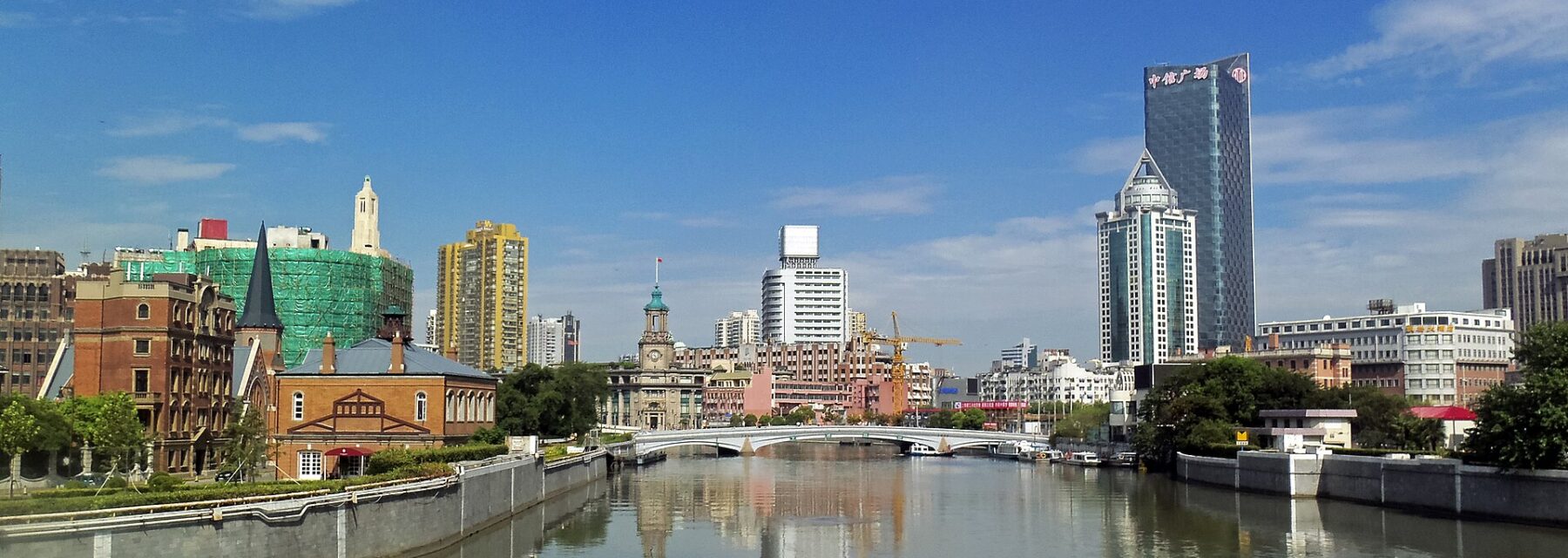
Stand at the north end of the Bund and most people turn around and walk back the way they came. Don’t. Cross the old steel bridge and go left, and you’re on Suzhou Creek, Shanghai’s other waterway, a narrow, slow river that runs west through the city past old warehouses, art galleries and a deeply moving war memorial. It’s far quieter than the Bund, and it tells you a good deal more about how Shanghai was made.
This guide walks it from Waibaidu Bridge to M50, a half-day on foot: the bridge and Broadway Mansions, the old General Post Office, the Sihang Warehouse where 420-odd soldiers held out in 1937, Fotografiska’s photography galleries, the tree-covered hill of 1000 Trees and the M50 art district. Along the way it covers what’s free, what costs, which days things close (several places have unusual weeks) and the metro stations that let you start or stop wherever you like.
Table of Contents
- Why Walk Suzhou Creek?
- Suzhou Creek at a Glance: the Route
- Waibaidu Bridge and Broadway Mansions
- The Old Post Office and the Postal Museum
- Sihang Warehouse: Where the Creek Was the Front Line
- Fotografiska Shanghai
- 1000 Trees
- M50: Shanghai’s Original Art District
- From Wusong River to Walkway: the Creek’s History
- A Half-Day Suzhou Creek Walk, Step by Step
- A Shorter Walk, or an Evening One
- Where to Eat and Rest
- When to Walk It
- Tips for the Walk
- Boats on the Creek
- Getting There and Away
- Common Mistakes
- Frequently Asked Questions
Why Walk Suzhou Creek?
Because it’s the part of Shanghai the tour buses skip. The Huangpu is the city’s grand stage, all bank headquarters and floodlit towers. The creek is the working back room: this is where the barges came in, where the warehouses and flour mills stood, and where the city’s industry grew up. For much of the last century it was also badly polluted, and locals didn’t walk here for pleasure. Today a riverside walking path runs along much of both banks, and the old industrial buildings have become museums, galleries and offices.
It suits people who’ve done the Bund and want something with more texture, anyone interested in the wartime history of the city, and anyone who likes art. It suits less well if you want a single spectacular sight. This is a walk of small discoveries, and most of its pleasure is in the gaps between the stops.
Suzhou Creek at a Glance: the Route
The stops run from east to west. Hours and prices are from each venue’s own site or the city’s official listings in November 2026.
| Stop | What it is | Nearest metro | Cost | Closed |
|---|---|---|---|---|
| Waibaidu Bridge | The 1908 steel bridge at the mouth of the creek | East Nanjing Road or Tiantong Road | Free | Open public bridge |
| Shanghai Postal Museum | Postal history in the 1924 General Post Office | Tiantong Road, Exit 3 | Free | Mon, Tue, Fri |
| Sihang Warehouse Battle Memorial | The 1937 defence, beside the original warehouse | Qufu Road or Xinzha Road | Check when booking | Mondays |
| Fotografiska Shanghai | Photography museum with a café and restaurant | Qufu Road | ¥80 weekdays, ¥100 weekends | Open daily |
| 1000 Trees | Tree-covered mall beside the creek | Zhongtan Road | Free to browse | Check the mall |
| M50 | Art district in a former textile mill | Zhongtan Road | Free to wander | Varies by gallery |
Waibaidu Bridge and Broadway Mansions
Start at Waibaidu Bridge, also known as the Garden Bridge, where the creek meets the Huangpu. It opened on 20 January 1908, and its grey steel trusses are one of the city’s best-known sights. In 2008 the whole bridge was lifted off and taken away for restoration, then brought back and reopened to pedestrians on 8 April 2009 and to vehicles three days later. Walk across it slowly: the view back along the Bund and across to Lujiazui costs nothing and takes some beating.
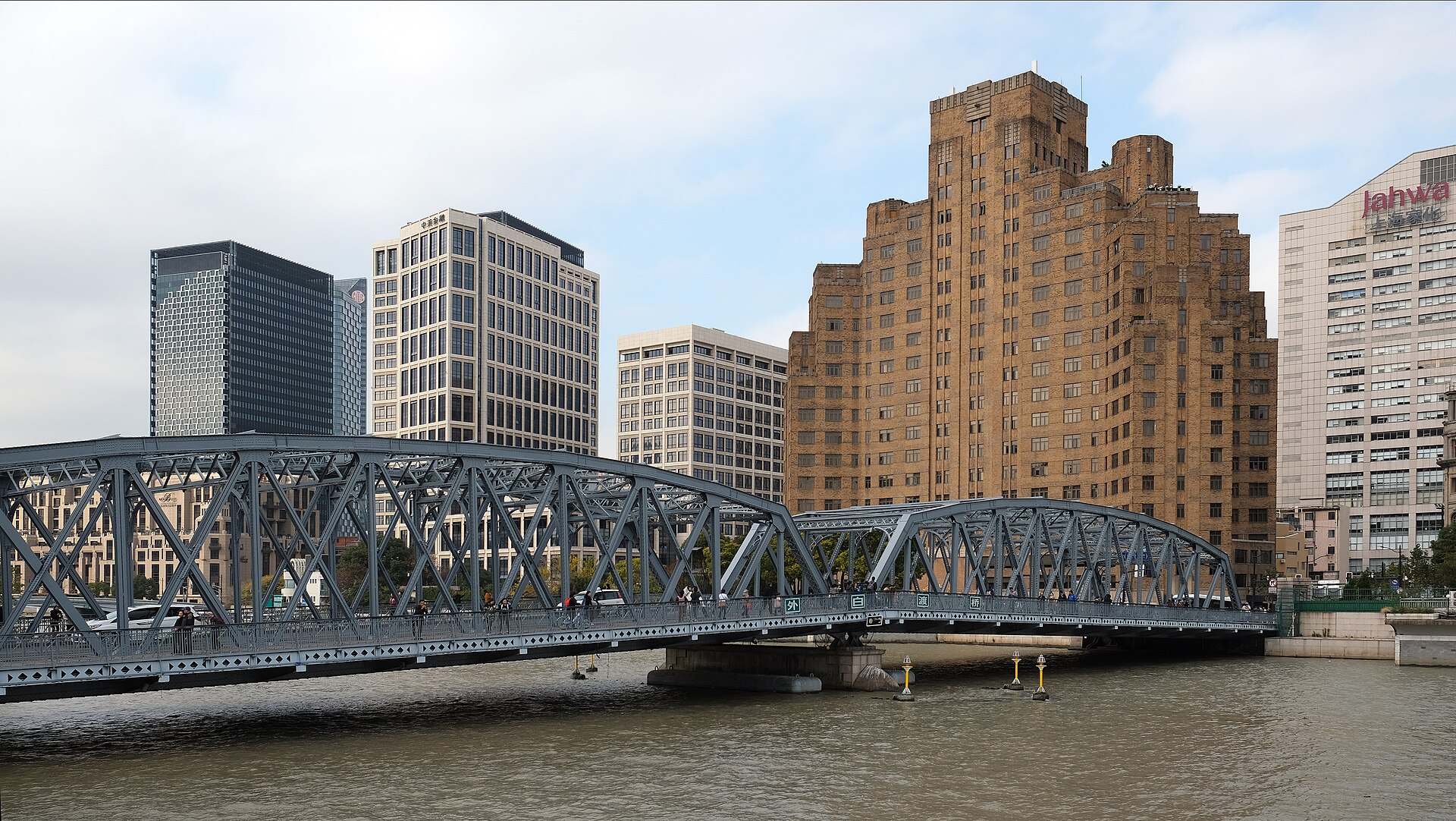
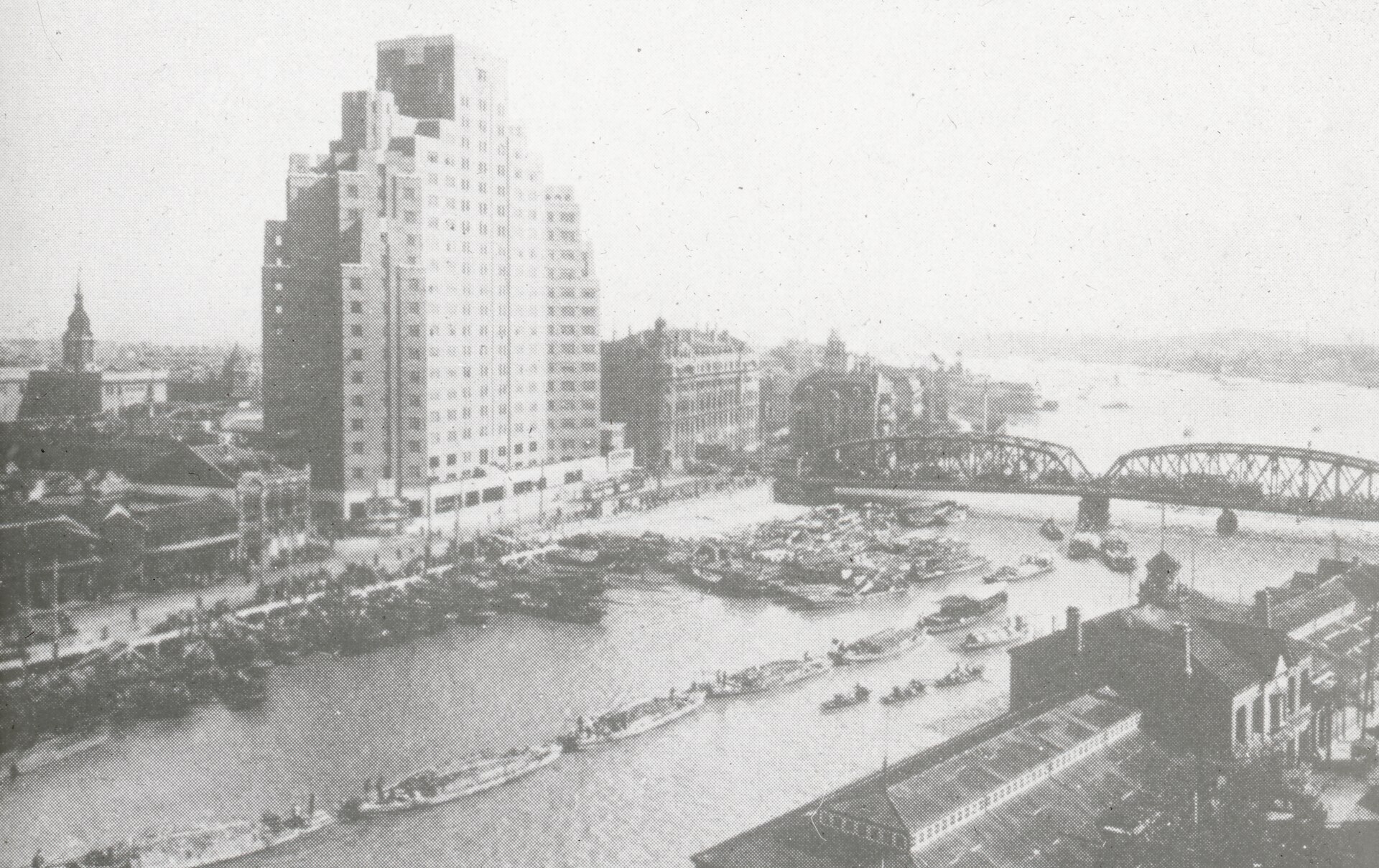
On the north bank, the stepped brick tower of Broadway Mansions has dominated this corner since it was completed in 1934. It’s a fine piece of Art Deco. Look at it from the bridge, where the full stepped silhouette is clearest. Just beyond the northern end of the bridge is the old Astor House Hotel, founded in 1846 as Richards’ Hotel. It was one of the great hotels of the treaty-port era; it closed in January 2018 and reopened that December as the China Securities Museum. Our guide to Shanghai’s Art Deco architecture has more buildings from those years, and the Bund architecture guide covers the waterfront around the corner.
The Old Post Office and the Postal Museum
Walk west along the north bank and you soon reach the General Post Office Building, finished in 1924, with its clock tower and long classical front facing the water. It’s still a working postal centre. The second floor holds the Shanghai Postal Museum, which reopened on 1 December 2024 after renovation.
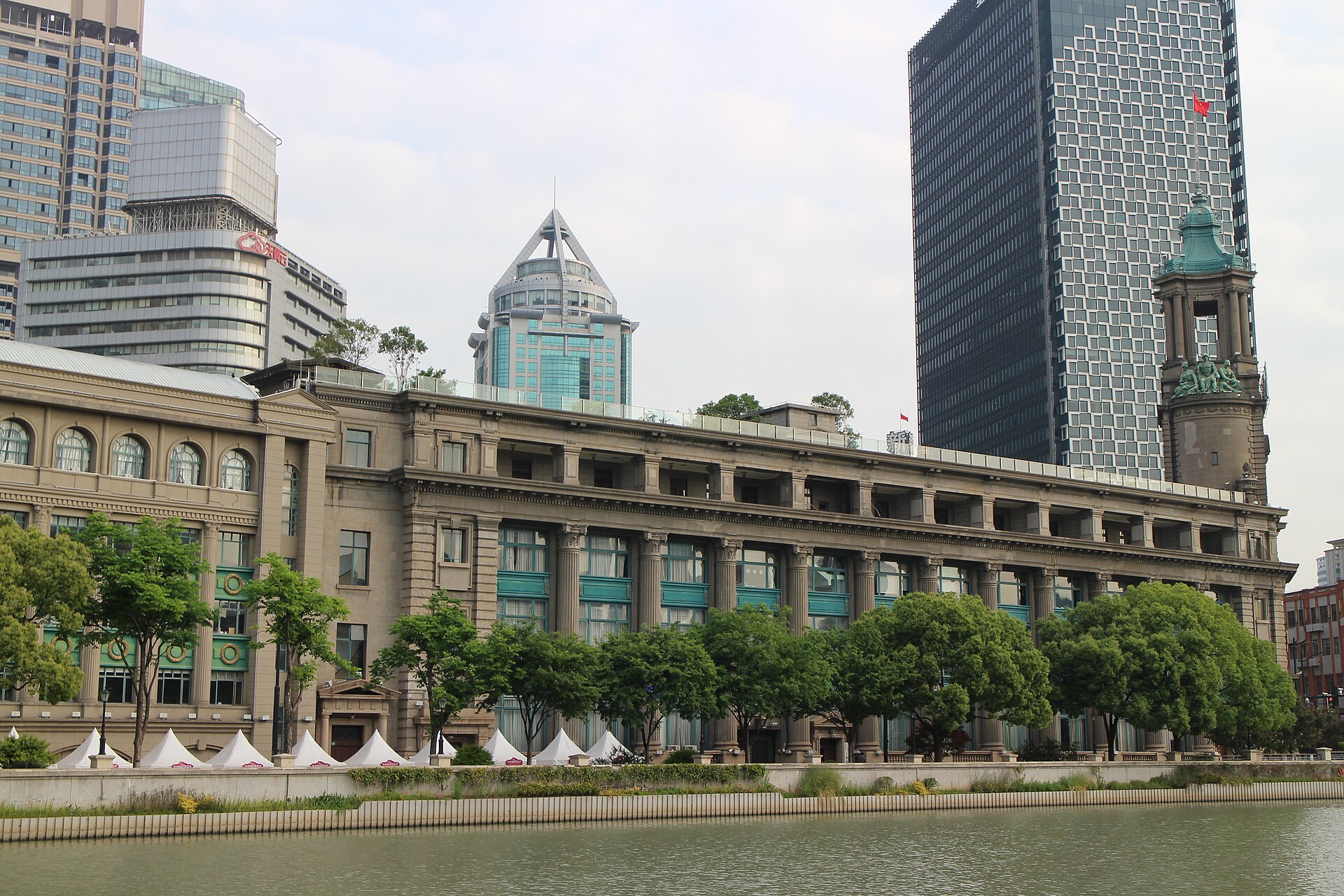
It’s free and needs no reservation, but its week is unusual: it opens only on Wednesdays, Thursdays, Saturdays and Sundays, from 09:00 to 17:00, with last entry at 16:00. The entrance moves too: 258 North Suzhou Road on Wednesdays, Thursdays and Saturdays, and 395 Tiantong Road on Sundays (the city’s museum listing). Tiantong Road station on Lines 10 and 12 is about 400 metres away from Exit 3. Check for holiday changes before you make a special trip.
Sihang Warehouse: Where the Creek Was the Front Line
Keep walking and the mood changes. The Sihang Warehouse, on the north bank at 21 Guangfu Road, is the most important stop on the walk. In the last days of the Battle of Shanghai in 1937, more than 420 soldiers of the 88th Division under Xie Jinyuan held this reinforced concrete warehouse against the Japanese army, in full view of the International Settlement across the creek. They became known as the “Eight Hundred Heroes”.
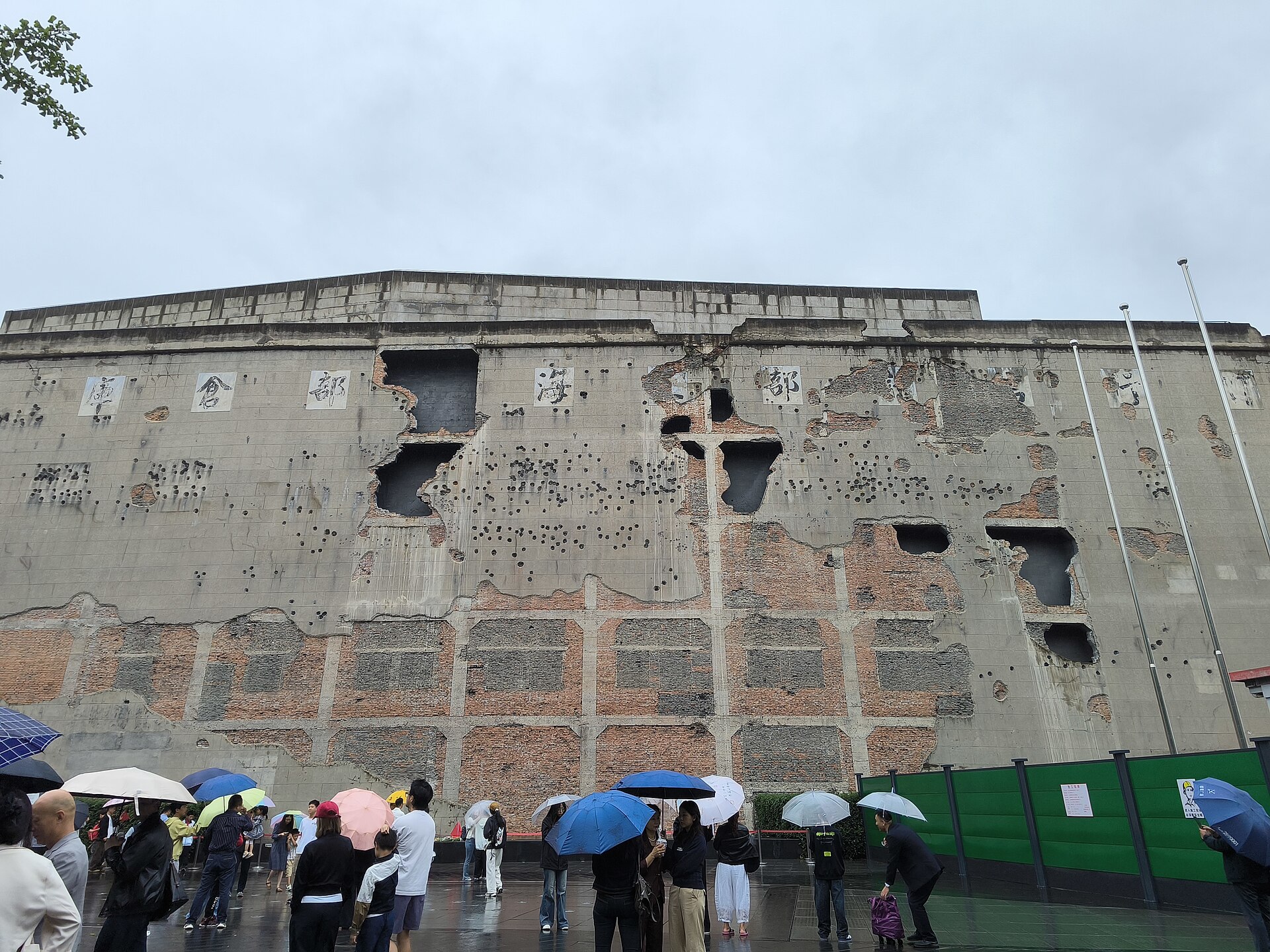
Beside it stands the Sihang Warehouse Battle Memorial, about 3,800 square metres on three floors, with permanent exhibitions on the first two. Go round to the west side first and look at the wall: the shell holes have been kept exactly where they were, and it does more than any display inside to make you understand what happened here. It’s open from 09:00 to 16:30, Tuesday to Sunday, with last entry at 16:00, and closed on Mondays except national holidays (the city’s listing). Check the memorial’s official channels for the current booking rule before you go. Metro Line 1 stops at Xinzha Road and Lines 8 and 12 at Qufu Road. Our history of Shanghai puts the battle in context.
The story that made the siege famous happened on the roof. A young Girl Guide, Yang Huimin, carried a large Republic of China flag to the warehouse wrapped around her body, crossing the lines after dark, and on the morning of 29 October the defenders raised it, four metres wide, in plain sight of the foreign settlements. A crowd of roughly 30,000 gathered on the far bank to watch. The garrison held out for days before withdrawing into the International Settlement. The name “Eight Hundred” came from the original strength of the battalion, which the defenders gave out to hide how few of them there really were. If you want the dramatised version before you go, the 2020 Chinese war film The Eight Hundred, directed by Guan Hu, tells the story.
Fotografiska Shanghai
A few minutes further along Guangfu Road is Fotografiska Shanghai, the local branch of the Swedish photography museum. It’s the most polished stop on the walk and the easiest one for a rest: it opens every day from 10:30 to 23:00, so you can visit after dinner, and there’s a café and the MONA restaurant in the building.
Tickets are ¥80 on weekdays and ¥100 at weekends and on public holidays, with discounts for visitors aged 25 and under or 65 and over (¥50 and ¥65) and free entry for children under seven or under 1.2 metres (Fotografiska’s visitor page). Exhibitions change through the year, so look at what’s on before you go. In late 2026 the programme includes Candida Höfer and Hong Kong Reframed, both until 21 February 2027, and Tan Yingjie until 10 January 2027.
1000 Trees
You’ll see it long before you reach it. 1000 Trees, on the creek next to M50, is a shopping complex built as a stepped hill, with a forest of concrete pillars each carrying a tree or planted terrace. It was designed by Heatherwick Studio, and it’s one of the strangest and most photogenic buildings in the city.
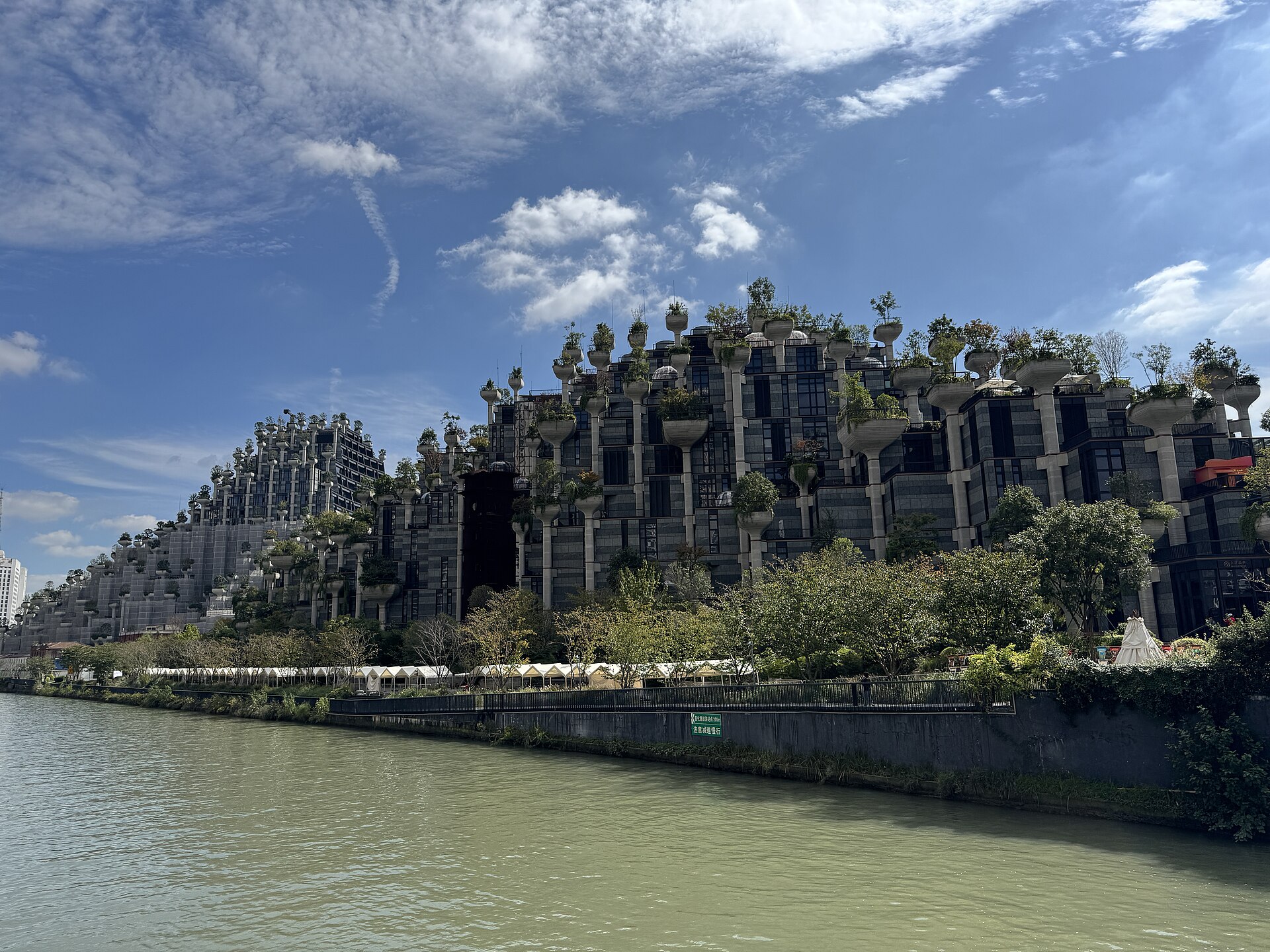
The best view is from the opposite bank or from the riverside path, where you can take in the whole hill at once. Inside, it’s a fairly standard mall of shops and restaurants, useful for lunch and a toilet stop rather than a destination in itself. Don’t spend long indoors: the building is better from outside.
M50: Shanghai’s Original Art District
The walk ends at M50, at 50 Moganshan Road on the south bank, an art district that grew up inside a former textile mill after the factory closed in 1999. The site has around 50 historic buildings, and the city’s listing describes free exhibitions across its galleries and studios (the city’s listing).
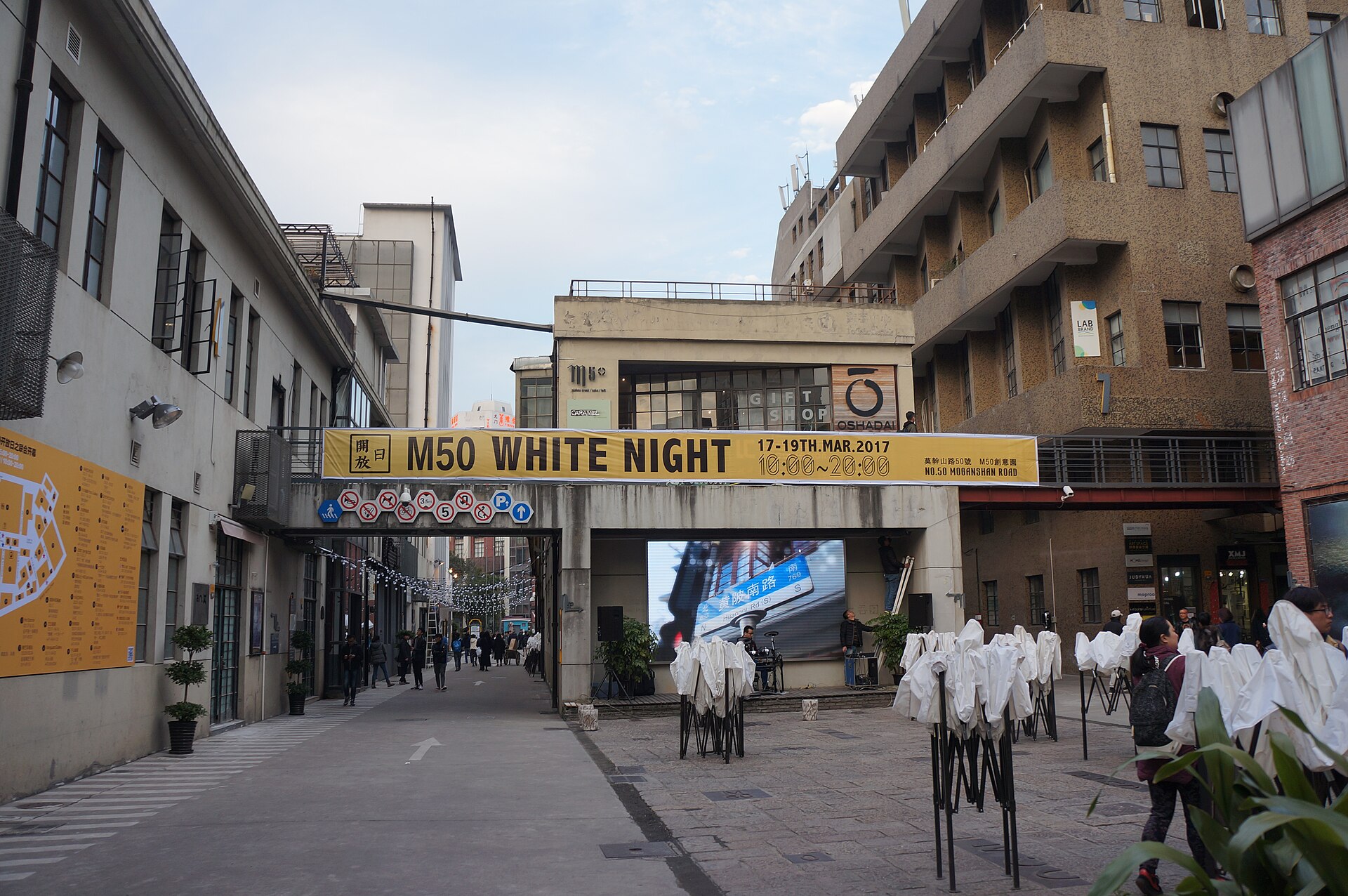
Don’t go looking for one specific gallery without checking it first. Rosters change, and galleries here open, close and move more often than any list keeps up with; each sets its own hours too, so if there’s a gallery you want to see, check it before you go. The better approach is to wander the lanes and walk into whatever’s open. Graffiti walls, small studios and the old factory buildings themselves are half the point. The big institutional money has moved on to the museums of the West Bund, which leaves M50 feeling more like a working studio district than a showcase, and it’s the better for it. Our guide to the Shanghai art scene explains how M50 fits with the rest of the city, and our contemporary art guide covers the big museums.
If you like this kind of walk, the West Bund is the natural next one: another riverside industrial zone turned into an art district, on a much grander scale.
From Wusong River to Walkway: the Creek’s History
Suzhou Creek’s proper name is the Wusong River. It runs for about 125 km from Lake Tai, with 54 km inside Shanghai. Foreigners called it Soochow Creek because it was the waterway to Suzhou, and the name stuck in English.
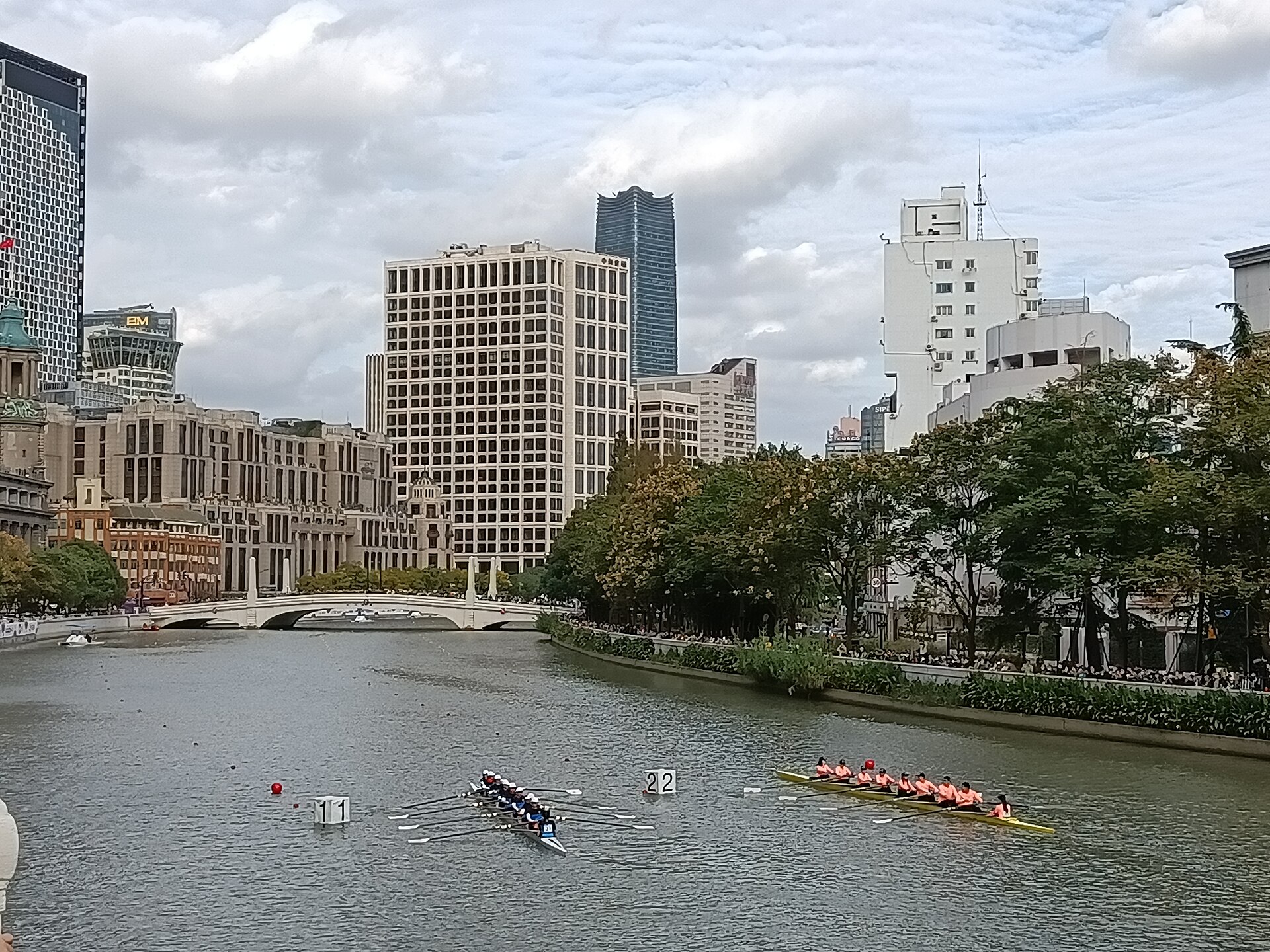
For the treaty-port city, the creek was the boundary between districts and the main route for goods coming in from the Yangtze delta. Its banks filled with warehouses, flour mills and textile factories, and it became heavily used and badly polluted. In 1937 it became a front line, with the Japanese army on one bank and the International Settlement looking on from the other.
Locals called it the smelly river. The turnaround came late: in 1998 the authorities launched a 12-year rehabilitation project to clean up the water and revive the neglected land along its banks. The factories moved out, and in December 2020 a 42-kilometre pedestrian path along the banks was completed through the central city (China Daily’s report). The creek now hosts rowing competitions, which would have seemed unthinkable a generation ago. It’s a long way from the water people used to hold their noses beside.
A Half-Day Suzhou Creek Walk, Step by Step
The whole route from the Bund to M50 is a comfortable half-day if you stop at two or three places. Allow longer if you want to see everything.
- 09:30, Waibaidu Bridge. Start early, while the light is good and the crowds are thin, and cross to the north bank.
- 10:00, the General Post Office. If it’s a Wednesday, Thursday, Saturday or Sunday, give the Postal Museum 45 minutes.
- 11:00, Sihang Warehouse. Walk the north bank to Guangfu Road, see the west wall first, and allow an hour inside. Closed on Mondays.
- 12:30, lunch. Fotografiska’s café is the easy choice, or carry on to the restaurants in 1000 Trees.
- 13:30, Fotografiska. Give it an hour or so, depending on what’s showing.
- 15:00, 1000 Trees and M50. Both are on the south bank, so cross at the nearest bridge. Photograph the hill from the path, then lose yourself in M50 for the rest of the afternoon.
Leave from Zhongtan Road station on Lines 3 and 4, or walk on to Shanghai Railway Station if you want more connections. On a Monday, swap Sihang and the Postal Museum for a longer stay at Fotografiska and M50.
A Shorter Walk, or an Evening One
You don’t have to do the whole thing. Three shorter versions work well:
- The history walk (two hours). Start at Tiantong Road station, see the old Post Office from the water, and walk west along the north bank to Sihang Warehouse. Leave from Qufu Road station.
- The art walk (two to three hours). Start at Zhongtan Road station for M50 and 1000 Trees, then cross to Fotografiska on Guangfu Road if you have the energy.
- The evening walk. Fotografiska stays open until 23:00, which makes the creek a good place to spend an evening in a museum. Walk the path at dusk, see the show, have dinner at MONA, and take the metro home. Waibaidu Bridge is at its best after dark, with the towers of Lujiazui lit up behind it.
Where to Eat and Rest
The route has fewer restaurants than the Bund, so it helps to plan your stop. Fotografiska’s Café Bar is open from 10:00 to 22:00, and the MONA restaurant in the same building serves lunch and dinner (Fotografiska’s site has the sittings). 1000 Trees is the other reliable choice, with restaurants and cafés of every kind inside the mall, and M50 has a scattering of small cafés among the studios.
Between stops, the riverside path has benches and shade in places, but not much in the way of shops, so carry water, especially in summer. Convenience stores are easier to find one or two blocks back from the creek than on the path itself.
When to Walk It
Spring and autumn are the best seasons. On the 1991 to 2020 averages for Xujiahui, April has highs of 20.9°C and October 23.5°C, and October has only about 7.5 rainy days. July, with an average high of 33.2°C, is hard work on an open riverside path, so go early or leave the walk for the evening. If rain sets in, our guide to Shanghai on a rainy day has indoor alternatives.
The day of the week matters more than usual here. Sihang closes on Mondays, and the Postal Museum opens only on Wednesdays, Thursdays, Saturdays and Sundays, so a Wednesday, a Thursday or a Saturday gives you the full set. Mornings are the quietest time, and the path is busier at weekends with people out running and walking their dogs.
Tips for the Walk
For photographers. The three shots to get are the view east from Waibaidu Bridge towards Lujiazui, the shell-scarred west wall of Sihang, and the whole hill of 1000 Trees from across the water. Late afternoon suits the first and last of those. After dark, the bridge lights up and the reflections on the creek do half the work for you.
With children. The path is largely flat, which makes the walking easy, and 1000 Trees tends to delight children who are bored of museums. Fotografiska lets in children under seven or under 1.2 metres free with a paying adult, though some of its shows are aimed squarely at grown-ups. Sihang deals frankly with a battle, so older children will get more out of it than young ones.
What to carry. Comfortable shoes, water and sun protection in summer, an umbrella in the rainy months, and your passport for museum entry. The path itself is largely level, but the bridges have steps in places, so anyone with a pushchair or wheelchair should plan on using the road crossings at street level.
Boats on the Creek
Sightseeing boats run on the creek, and they’re a fine way to see the bridges from below. The city’s visitor listing of January 2024 names five terminals, including Waitanyuan at 78 South Suzhou Road, near the Bund, and Sihang Warehouse at 1 Guangfu Road, which makes a boat back to the Bund an appealing way to finish the walk. It gives three routes, at ¥60 for 30 minutes, ¥100 for 60 minutes and ¥160 for 90 minutes, with half price for ages 7 to 14 and departures between 10:00 and 18:45 (the city’s listing). Routes, prices and booking arrangements have changed since then, so check the operator’s WeChat channel, which the listing names as Suzhou Creek Tourism, before you plan around one.
Getting There and Away
The metro meets the creek at several points, so you can walk any part of the route rather than the whole of it:
- The Bund end: East Nanjing Road on Lines 2 and 10, then a walk north along the Bund to the bridge. Tiantong Road on Lines 10 and 12 is closer to the Post Office on the north bank.
- The middle: Qufu Road on Lines 8 and 12, or Xinzha Road on Line 1, for Sihang Warehouse and Fotografiska.
- The western end: Zhongtan Road on Lines 3 and 4 for M50 and 1000 Trees.
Wear comfortable shoes, carry water in summer and keep your passport with you for museum entry. The path is largely flat. If you’re staying near the Bund, our guide to the Bund pairs well with this walk, and our Shanghai districts guide shows how the creek’s neighbourhoods fit into the city.
Common Mistakes
- Going on a Monday and expecting everything to be open. Sihang is closed on Mondays, and the Postal Museum is closed on Mondays, Tuesdays and Fridays. Fotografiska is open daily.
- Skipping the west wall at Sihang. It’s the most powerful thing on the route, and it’s outside. Walk round to it.
- Treating M50 as a checklist. Galleries come and go. Wander instead, and check ahead if there’s one you particularly want.
- Staying inside 1000 Trees. The building’s magic is on the outside, and it’s best seen from the path.
- Walking it in the midday heat in July or August. Start early, or save it for spring and autumn.
- Forgetting your passport. Museums here often ask for ID.
Frequently Asked Questions
Is Suzhou Creek worth visiting?
Yes, especially once you’ve done the Bund. It has the Sihang Warehouse memorial, the Fotografiska photography museum, the 1000 Trees building and the M50 art district, all within a walkable stretch of riverside path.
How long does the Suzhou Creek walk take?
From Waibaidu Bridge to M50 is a comfortable half-day with two or three stops, and longer if you want to see every museum.
Where does the Suzhou Creek walk start?
At Waibaidu Bridge at the north end of the Bund. East Nanjing Road station is a walk away, and Tiantong Road station is closer to the north bank.
What is Sihang Warehouse famous for?
In 1937, in the last days of the Battle of Shanghai, more than 420 Chinese soldiers under Xie Jinyuan held the warehouse against the Japanese army. It’s now a memorial, open Tuesday to Sunday from 09:00 to 16:30, and the west wall still shows its shell damage.
How much is Fotografiska Shanghai?
Adult tickets are ¥80 on weekdays and ¥100 at weekends and on public holidays. It’s open every day from 10:30 to 23:00.
Is M50 free?
The city’s listing describes free exhibitions, and walking around the district costs nothing. Individual galleries set their own hours, so check ahead if there’s one you want to see.
What is 1000 Trees in Shanghai?
A shopping complex beside the creek, designed by Heatherwick Studio as a stepped hill with trees planted on top of its columns. It stands next to M50.
Why is it called Suzhou Creek?
Its proper name is the Wusong River. Foreign residents called it Soochow Creek because it led towards Suzhou, and the name stayed in English.
Can you walk the whole Suzhou Creek path?
The riverside path completed in 2020 runs for 42 km through the central city, far more than anyone needs in a day. The stretch from Waibaidu Bridge to M50 is the part with the most to see.
What was the Battle of Sihang Warehouse?
A four-day stand by Chinese troops at the end of the Battle of Shanghai in October 1937, in view of the foreign settlements across the creek. It became a national legend, and the 2020 film The Eight Hundred dramatised it.
Can you take a boat on Suzhou Creek?
Yes. The city’s January 2024 listing gives routes of 30, 60 and 90 minutes from ¥60 to ¥160, leaving from terminals including Waitanyuan near the Bund and Sihang Warehouse. Routes and prices change, so check the operator’s WeChat channel for the current ones.
Is the Shanghai Postal Museum open every day?
No. It opens on Wednesdays, Thursdays, Saturdays and Sundays only, from 09:00 to 17:00, and it’s free.
For more of the city on foot, our French Concession walking tour covers the other side of town. Photographers should take a look at our guide to photography in Shanghai before they set out.
Photo credits.
Suzhou Creek from Waibaidu Bridge: Suzhou Creek from Waibaidu Bridge, Shanghai by Daniel Case, CC BY-SA 3.0, via Wikimedia Commons.
Waibaidu Bridge and Broadway Mansions: Waibaidu Bridge Shanghai by kallerna, CC BY-SA 4.0, via Wikimedia Commons.
Broadway Mansions and the bridge, early 20th century: 0964.a.0860 by Unknown author Unknown author, CC0, via Wikimedia Commons.
General Post Office Building: General Post Office Building, Shanghai 20250501-1 by Suicasmo, CC0, via Wikimedia Commons.
Sihang Warehouse west wall: 2026-10-04 Sihang Warehouse 四行仓库 05 by 源義信, CC BY 4.0, via Wikimedia Commons.
1000 Trees: 1000 Trees 03 by Codas, CC BY-SA 4.0, via Wikimedia Commons.
M50: 201703 M50 Creative Park by MNXANL, CC BY-SA 4.0, via Wikimedia Commons.
Rowing on Suzhou Creek: 2022 Shanghai Rowing Competition on Suzhou Creek by Nanhuajiaren, CC BY-SA 4.0, via Wikimedia Commons.