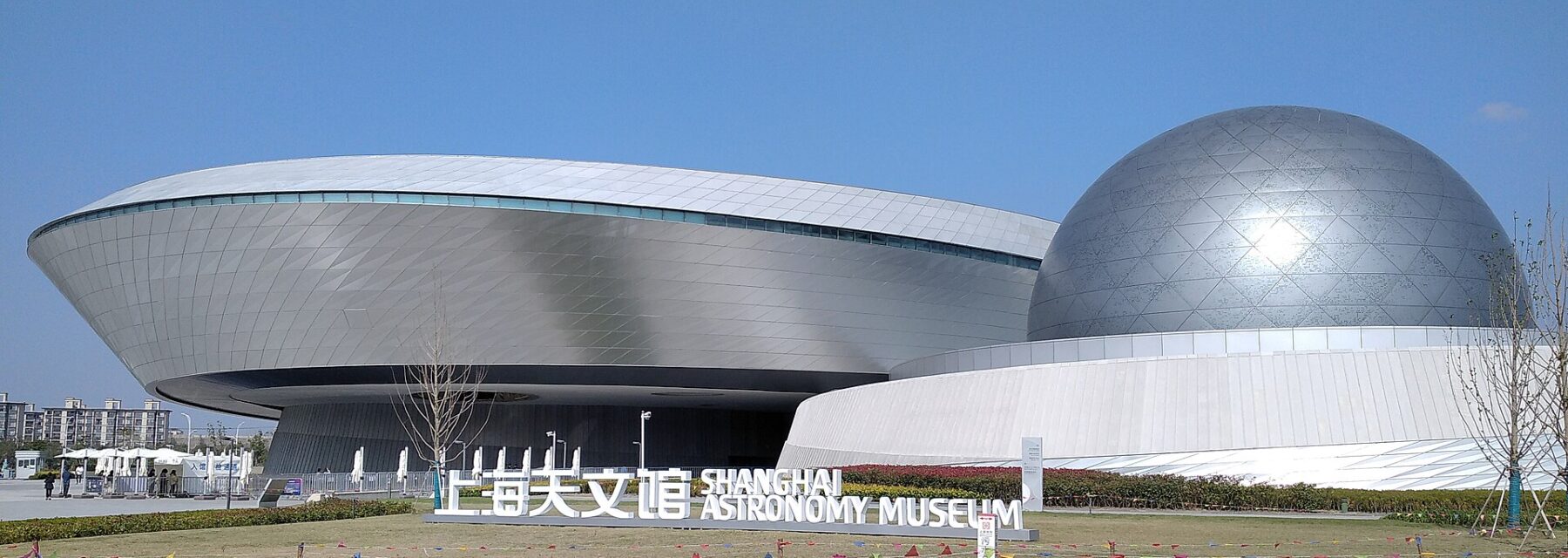
The Shanghai Astronomy Museum is the best thing in the city that most visitors never get to. It sits at the far south-eastern edge of Shanghai in Lingang, near the end of Metro Line 16, close to where the land runs out at the East China Sea. For many visitors it’s the reason to make the trip at all. The building alone justifies it: a spiral of white concrete with a giant sphere half-sunk into the roof and an upside-down dome you can stand inside and look straight up at the sky. The museum describes itself as the world’s largest planetarium.
Inside, it’s a serious science museum built for curious people of any age, not a children’s play centre with a few planets hung from the ceiling. Tickets are cheap at 30 yuan for adults, but they’re real-name and booked online, a week ahead, and the good days go. This guide covers how booking works with a foreign passport, what’s inside and what to skip, whether the dome film is worth the extra, and how to get out there and back without wasting half a day.
Table of Contents
- The museum at a glance
- What the Shanghai Astronomy Museum is
- How to see the building
- Tickets and prices
- How to book with a foreign passport
- What’s inside
- The dome cinema: is the film worth it?
- Seeing the real sky
- Getting there
- Planning the day
- Going with children
- Is it worth the trip?
- What people get wrong
- Frequently Asked Questions
The museum at a glance
| What | Detail |
|---|---|
| Address | 380 Lingang Avenue, Pudong (临港大道380号) |
| Hours | 09:30–17:00, last entry 16:00 |
| Closed | Mondays, except national holidays |
| Adult ticket | 30 yuan |
| Dome film | 40 yuan extra per person, everyone pays |
| Booking | Real-name online booking for everyone, including free tickets; foreigners book and enter with their own passport |
| Tickets released | 7 days ahead, from 09:30 for visits and 10:00 for films |
| Metro | Line 16 to Dishui Lake, Exit 3 or 4, then about 15 minutes on foot |
| Time to allow | Three to four hours inside, plus the journey |
What the Shanghai Astronomy Museum is
The museum is a branch of the Shanghai Science and Technology Museum, which also runs the big science museum in Pudong, and it opened in 2021. The site covers 58,000 square metres and the building 38,000. The museum calls itself the world’s largest planetarium, and its New York architects, Ennead, describe it as the largest museum in the world devoted solely to astronomy. Either way, nothing else in Shanghai comes close.
Ennead designed the building around three forms, and they’re worth knowing before you arrive, because the architecture is half the point:
- The Oculus, a ring suspended over the main entrance that works as a giant sundial, tracking a circle of sunlight across the entry plaza and reflecting pool.
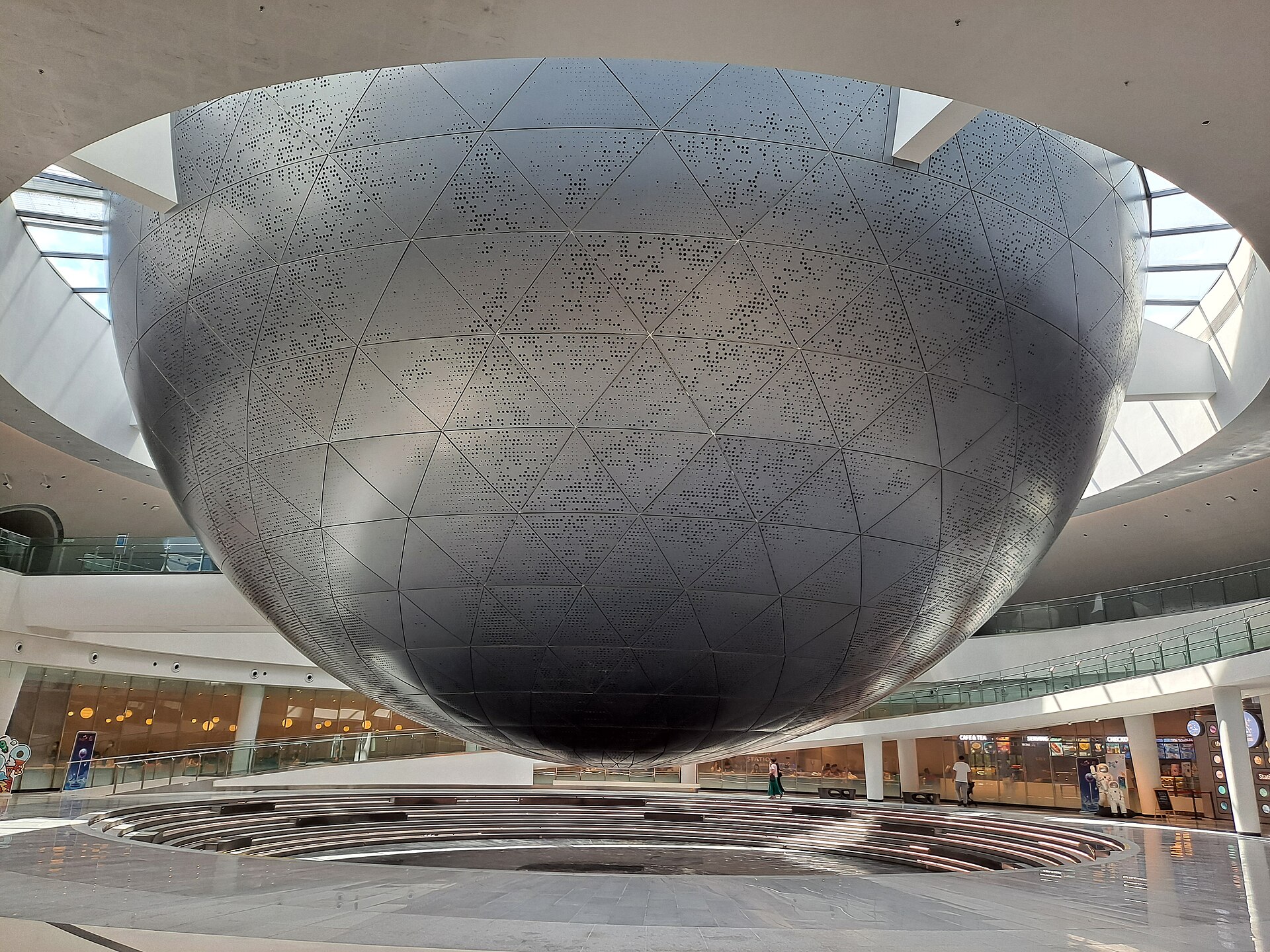
- The Inverted Dome, a glass bowl on the roof above the central atrium. Stand in it and the horizon disappears, leaving only sky.
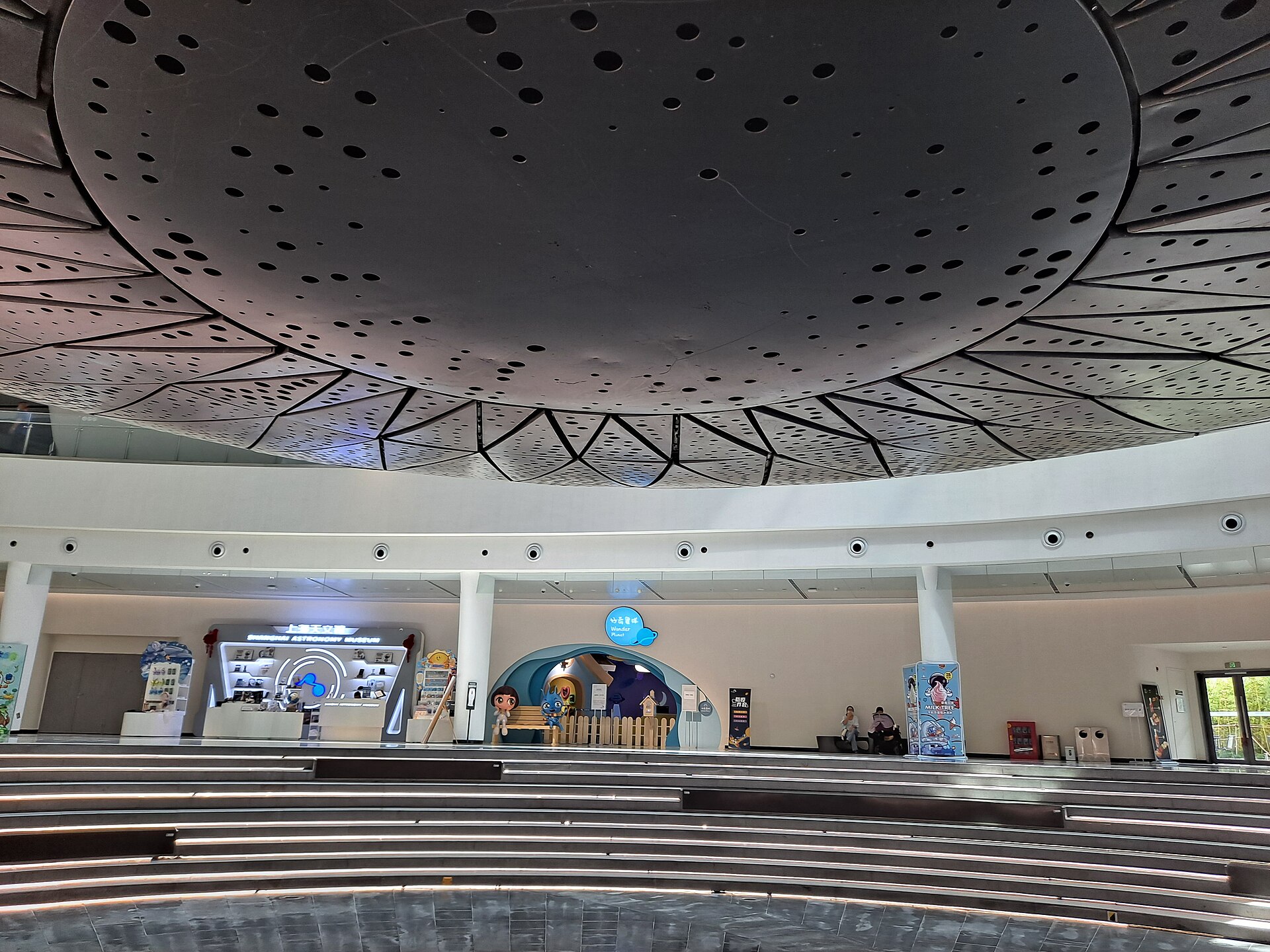
- The Sphere, the silver ball half-sunk into the roof, which holds the planetarium theatre.
The building as a whole spirals, like an orbit, and the route through the exhibitions follows the curve. The museum’s own description is a “three-body” structure: skylight, inverted dome and dome cinema. Even if astronomy leaves you cold, it’s one of the most interesting modern buildings in Shanghai.
How to see the building
Most visitors walk straight in and start on the exhibitions. Give the building twenty minutes first, because Ennead designed each of its three main forms to work as an astronomical instrument, and you only notice that if you look.
Start outside, under the Oculus. The ring suspended over the main entrance throws a circle of sunlight onto the entry plaza and the reflecting pool, and the circle moves as the day goes on, which makes the plaza a working sundial. The architects designed it so that at noon on the summer solstice the circle of light is complete and lines up with a circular platform in the plaza. You won’t be there for that, but on any sunny day you can watch the light creep across the ground. It’s best around the middle of the day, so it suits a morning ticket: arrive, look, then go in.
Walk round to see the Sphere. The planetarium theatre sits half-submerged in the roof of the lower wing, with very little visible support. The architects wanted it to rise into view gradually as you round the building, like a planet seen from one of its moons. From inside the atrium you see it from below, which is when the “weightless” effect works best.
Finish at the top, in the Inverted Dome. The exhibition route climbs a 720-degree spiral ramp through the building and ends under the Inverted Dome, a glass bowl set into the roof over the central atrium. Its rim cuts off the horizon and the surrounding town, so all you see is sky. After two hours of simulated universe, it’s the moment the building hands you back the real one. Go up on a clear afternoon if you can, and leave time to sit.
Tickets and prices
These are the museum’s own prices. The visit ticket and the dome film are separate purchases, and the film has no free category.
| Ticket | Price | Who |
|---|---|---|
| Adult | 30 yuan | Standard ticket |
| Senior | 25 yuan | Aged 60 to 69 |
| Student | 15 yuan | Children over 1.3 m tall, young people over 6 and up to 18, and full-time students up to undergraduate level, with a student card |
| Military family | 25 yuan | As defined by the museum |
| Free | 0 yuan | Children 1.3 m or under or aged 6 or under, with an adult (one adult can bring two); visitors aged 70 and over; disabled visitors; serving military and other listed groups |
| Dome film | 40 yuan | Per person, per film, including young children |
Free tickets still have to be booked online under the visitor’s real name. Turning up with a toddler and no booking doesn’t work. The student rate depends on a student card. A foreign one may or may not be accepted at the gate, so if 15 yuan matters, ask before you rely on it. At these prices, it hardly does.
How to book with a foreign passport
This is the part that trips people up, so it’s worth getting right.
Everyone books in advance, under their own name. The museum sells tickets online only, through its official channels, chiefly its WeChat account and mini program, which its website links to. Each ticket is tied to an ID: mainland Chinese visitors use their ID card, visitors from Hong Kong, Macau and Taiwan use their own travel documents, and foreign visitors use their passport. At the gate you check in with the same passport you booked with. The museum also takes a face record for re-entry on the day, so you can step out and back in.
Tickets go on sale seven days ahead. Visit tickets are released from 09:30, seven days before the visit, not counting the day itself. Dome film tickets are released from 10:00 on the same schedule. When a day sells out, the booking channel for that day simply closes. If you’re set on a weekend or a school-holiday date, be online at 09:30 a week before.
You choose a session. Visit tickets are for the morning, with entry from 09:30 to 12:30, or the afternoon, with entry from 12:30 to 15:00. They’re valid only on the date you pick. Since the last entry to the building is 16:00, an afternoon ticket still gives you a full afternoon, as long as you arrive early in the window.
Refunds now cost money. Since 17 February 2026 the museum has charged refund fees. Cancelling is free until 23:30 two days before your visit. From 00:30 the day before until 09:00 on the day, it costs 10%. From 09:00 on the day, it costs 20%. Film tickets cost 20% to refund the day before and can’t be refunded from 09:00 on the day. Repeated last-minute refunds can also earn you a 60-day ban from booking visit and film tickets at the Science and Technology Museum’s three venues, so book the date you mean to go.
If WeChat is new to you, set it up before you travel. Our guides to essential apps for Shanghai and Alipay and WeChat Pay for tourists cover the set-up with a foreign phone and card.
What’s inside
The permanent exhibition is split into three main zones, which you walk in order along the spiral.
Home
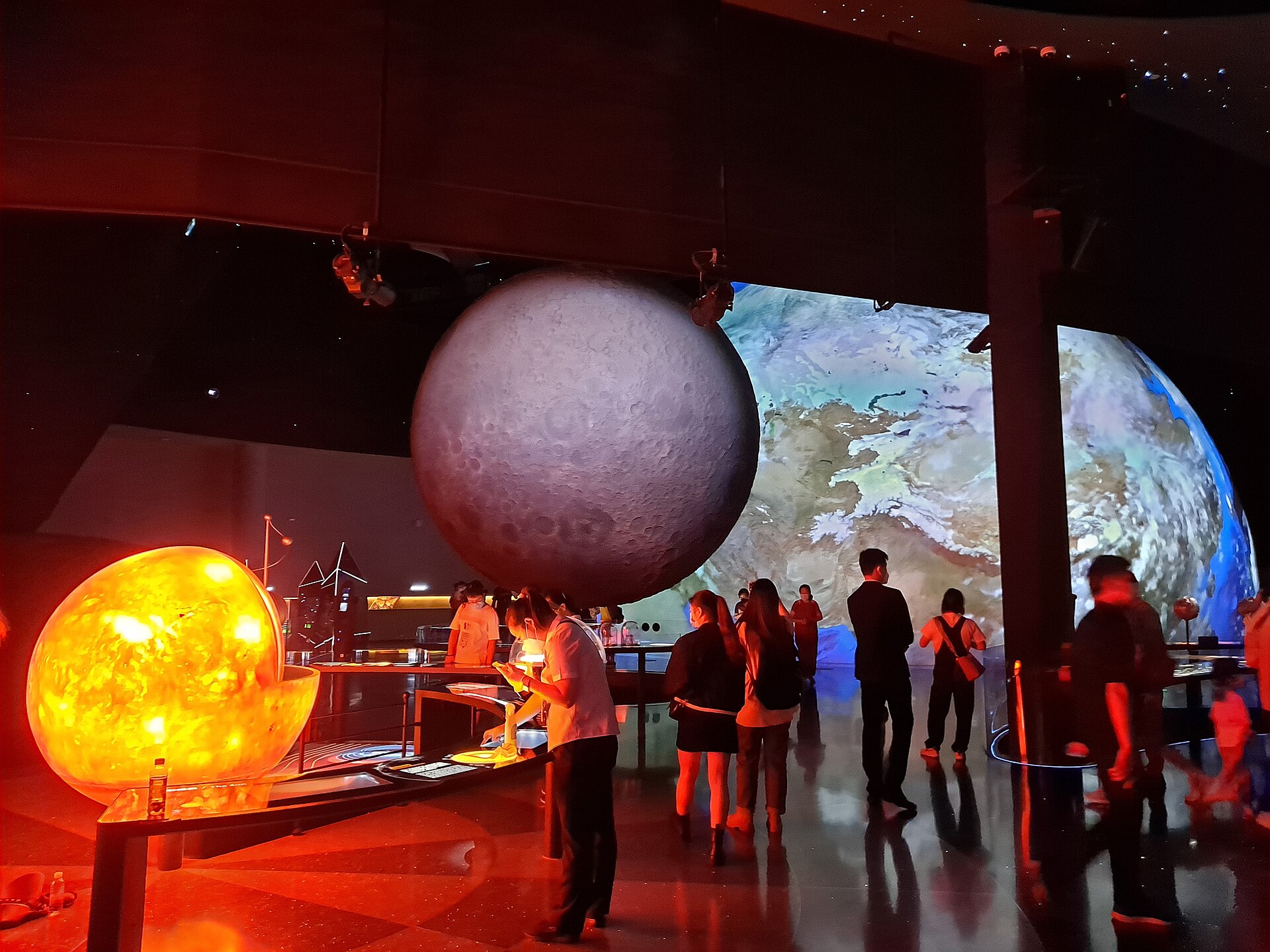
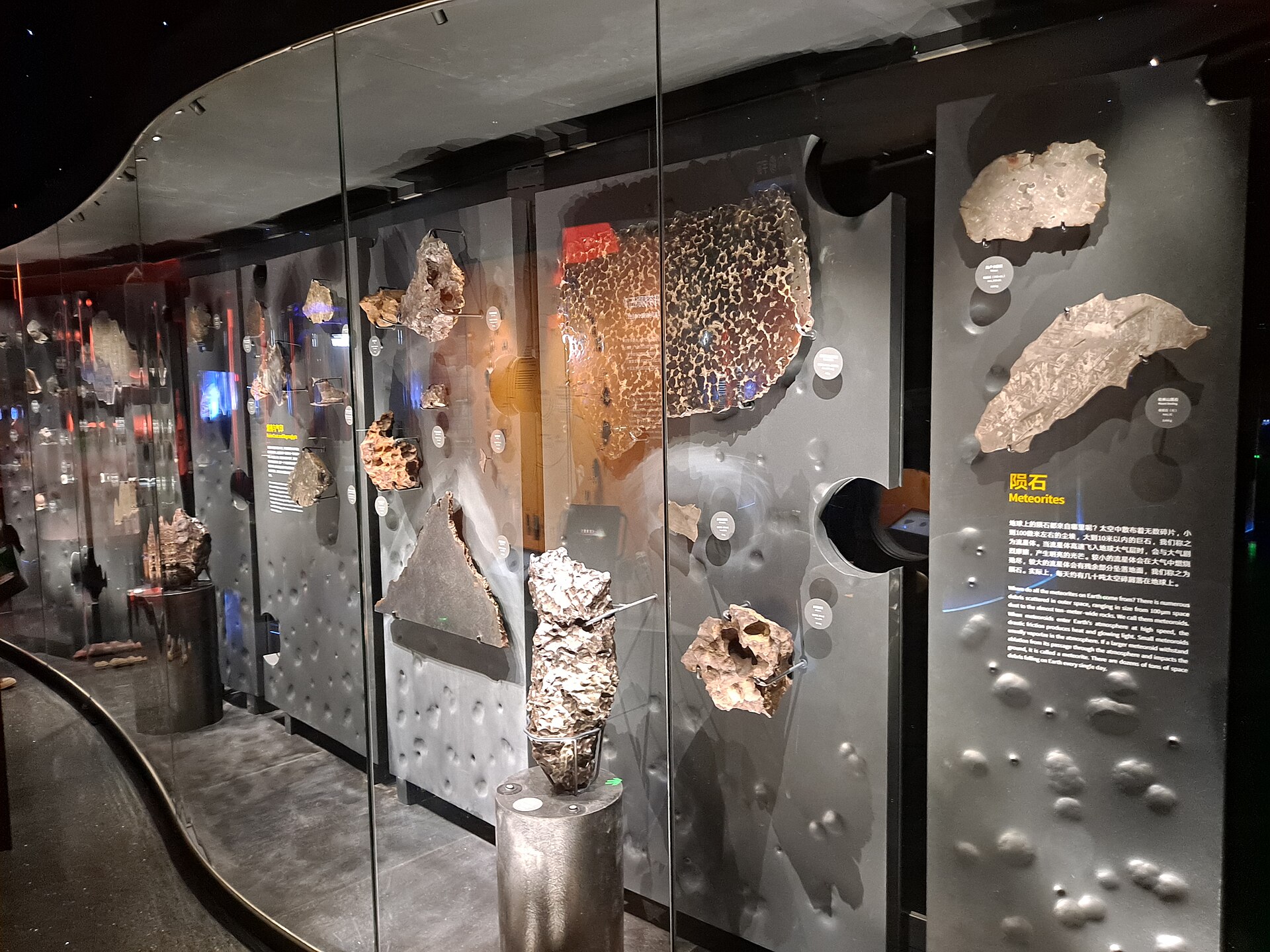
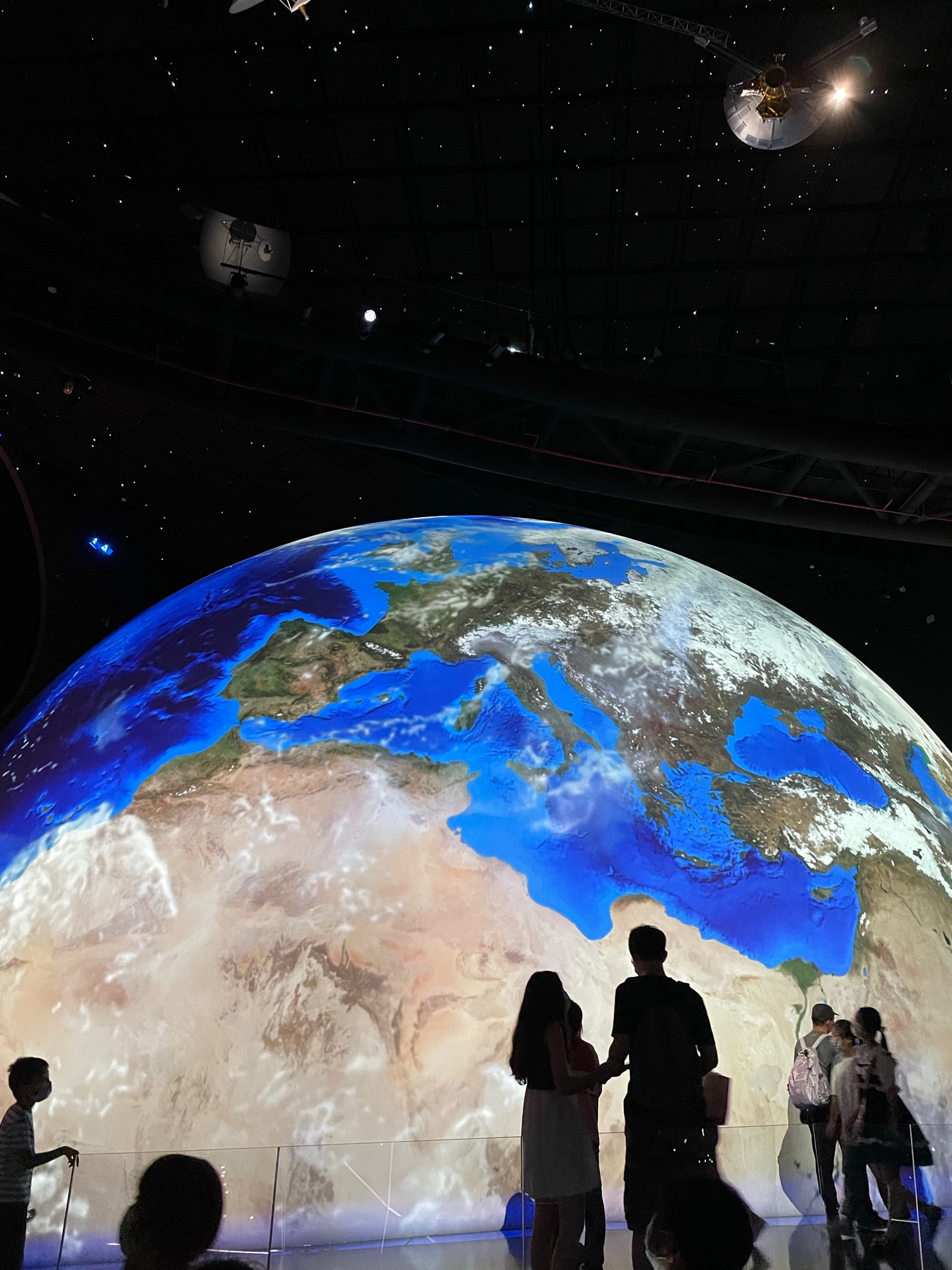
Home is where the tour begins, with our own corner of space before the museum widens out to the universe. Look out for the museum’s huge projected Earth model, where almost everyone takes their first photograph, and the big Sun and Moon models nearby, which younger children love. The meteorite collection is here too: it includes pieces of named falls such as Chelyabinsk, the meteor that exploded over Russia in 2013, and Cape York in Greenland.
Cosmos
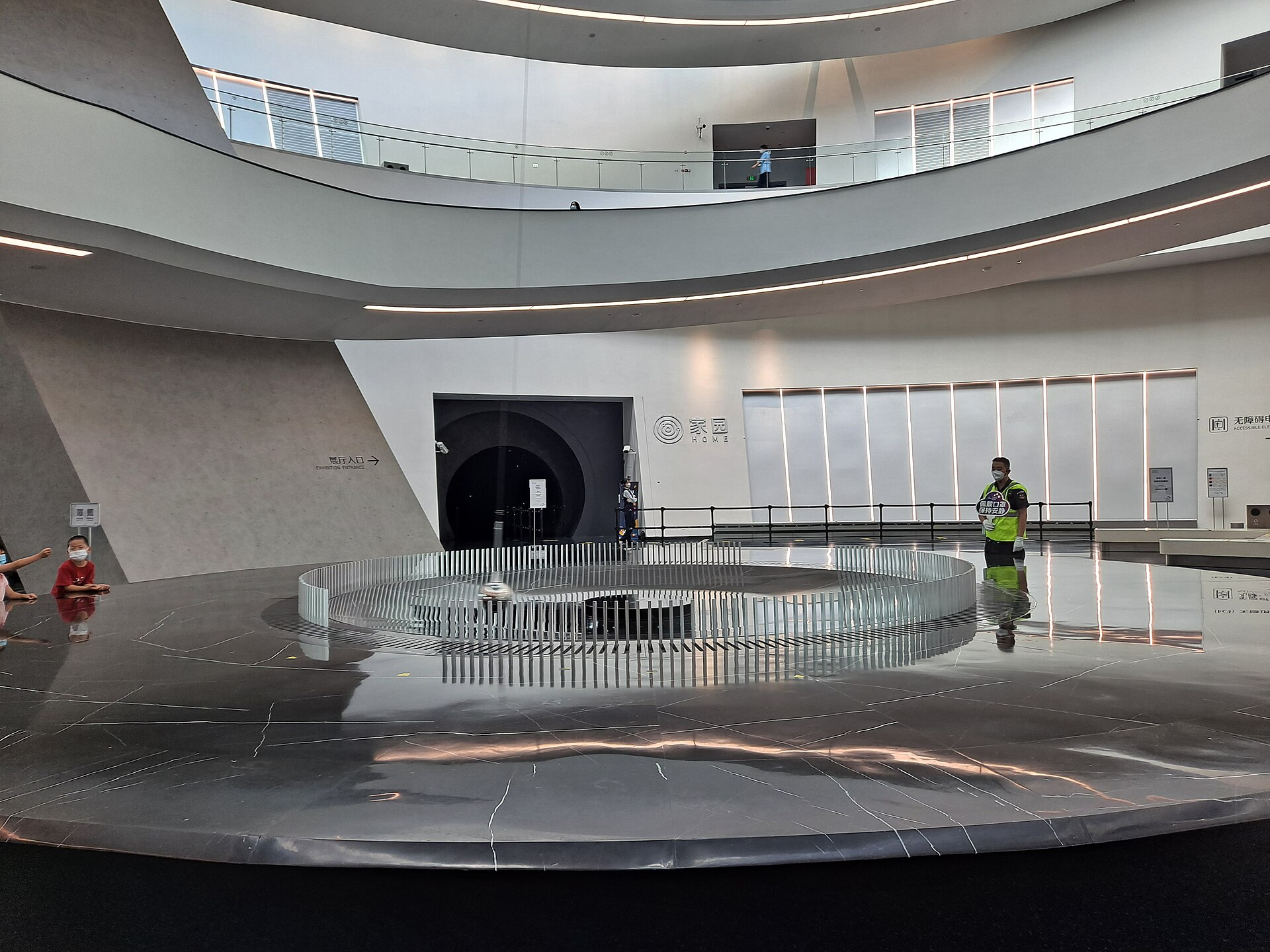
The second zone is the physics: spacetime, gravity, light, the elements and life. This is where the museum earns its seriousness. The exhibits explain why stars shine and how we know what they’re made of, rather than just showing you pretty pictures of nebulae. It suits teenagers and adults better than small children. A Foucault pendulum, the classic demonstration that the Earth rotates, also swings in the museum. Watch long enough and its swing appears to turn as the Earth rotates beneath it.
Odyssey
The third zone covers exploration: how humans have watched the sky and travelled into it, from ancient observatories to space probes.
The special areas
Beyond the three zones, the museum has several themed areas:
- Chinese Astronomy, on the long Chinese tradition of sky-watching. It’s the most distinctive section for a foreign visitor, because it’s the story you won’t get in a planetarium at home.
- Voyage to Mars, on the red planet and how we explore it.
- Curious Planet, the area built for younger children.
Plan on three hours for the exhibitions at an unhurried pace, and four if you add a film and the observation areas.
The dome cinema: is the film worth it?
The dome cinema inside the Sphere has a 23-metre-diameter screen, and the museum lists both an 8K dome projection system and an optical planetarium projector. Films cost 40 yuan per person, children included, on a separate ticket from your visit. The museum lists three:
- Firmament (苍穹), 20 minutes;
- Invisible Universe, 25 minutes;
- Time Travel, 25 minutes.
Is it worth it? If you’ve come all the way out to Lingang, yes. You’re sitting inside the building’s signature form, and lying back under a full dome sky is the experience the building was designed around. One film is enough. Book it at the same time as your visit ticket, since sessions are limited, and check the film listing for the language before you book.
The museum advises against the cinema for pregnant women, people with heart conditions or high blood pressure, and infants. The immersive projection can be intense.
Seeing the real sky
The museum is also a working observatory. It lists a 65 cm adaptive-optics solar telescope and a 1-metre telescope among its equipment, but visitors don’t get to use them on demand. Public observation is run as events: viewing the night sky from the Wangshu observatory, and small telescopes set up in the Starry Sky Park outside on clear nights. If seeing the sky through a telescope matters to you, check the museum’s WeChat account for observation events before you choose your date. They depend on the weather and are announced separately.
Even without an event, the Inverted Dome at the end of the afternoon is a fine place to watch the light change.
Getting there
Lingang is a long way out, and that’s the main cost of the trip.
By metro. Take Line 16 to Dishui Lake, the last station on the line. Use Exit 3 or 4, then it’s about 15 minutes’ walk to the museum. Line 16 runs 59 km from Longyang Road, where you change from Line 2, out to Dishui Lake. It has local, rapid and express services, and the express trains skip most stops, so they’re worth waiting a few minutes for. From central Shanghai you’re looking at well over an hour each way. Check the Shanghai Metro app for the times and the express departures from your station. Our Shanghai metro guide covers tickets and paying by phone.
By bus. Local buses serving the museum include Medium-capacity Lines 1 and 2, Shengang 1 and 3, and routes 1009, 1135, 1043 and 1096. They’re useful for hopping between Lingang’s sights, less so for getting there from the city.
By car or taxi. Ride-hailing works, and it’s the most comfortable option for a family, but it’s a long and expensive ride from Puxi. Our guide to using DiDi in Shanghai explains booking with a foreign phone. The museum has a paid outdoor car park. The first 30 minutes are free, then it costs 10 yuan for the first hour and 5 yuan for each further 30 minutes, capped at 80 yuan for 24 hours.
Planning the day
Because of the journey, treat this as a day out rather than an afternoon. A sensible plan is to leave central Shanghai around 08:30, arrive for the morning session, do the film around midday and the exhibitions either side, then either head back or carry on to a second Lingang sight.
Here’s how that day might run, with a morning visit ticket and one film:
| Time | What |
|---|---|
| 08:30 | Leave central Shanghai on Line 2 and change at Longyang Road for Line 16, taking an express if one is due |
| Around 10:00 | Arrive at Dishui Lake and walk to the museum; look at the Oculus and the plaza before going in |
| 10:30 | Home zone, with its Earth, Moon and Sun models and meteorites, and, with children, Curious Planet while energy is high |
| 12:00 | Lunch or snacks outside the exhibition halls |
| 13:00 | Dome film in the Sphere (book the session in advance) |
| 13:45 | Cosmos and Odyssey zones and the Foucault pendulum |
| 15:30 | Up the spiral ramp to the Inverted Dome to finish |
| 16:30 | Walk to Dishui Lake for a look at the water, then head back into town |
Food. You can’t eat or drink in the exhibition halls or the cinema, only in the designated areas outside them. Bring snacks and water for children, and plan a proper meal before or after.
Facilities. The visitor centre on level 1 handles information, large-luggage storage, lost property and medical help. It lends wheelchairs, strollers and crutches free and rents power banks. A green fast lane is available for visitors aged 70 and over, disabled visitors, pregnant women and military personnel.
Pairing it with something else. The museum lists several sights nearby: the China Maritime Museum, Shanghai Haichang Ocean Park, Dishui Lake, Shanghai Flower Port and Nanhuizui Seaview Park. For families the obvious pairing is Haichang Ocean Park, the marine theme park in Lingang. That’s a full day on its own, so it works best as the second half of a long weekend rather than the same afternoon. Check the park’s own site for hours and prices. For a quieter add-on, the shore of Dishui Lake is a pleasant walk after a morning indoors. Our guide to Shanghai’s aquariums and zoos covers the city’s other animal attractions.
Going with children
The Shanghai Astronomy Museum is one of the best family days in Shanghai, with a few caveats.
- Under-sixes go free, as does any child 1.3 m or under, but they still need a booked real-name ticket. One adult can bring two free children.
- Children up to 18 pay the 15-yuan student price once they’re over 1.3 m and over six.
- Curious Planet is the area built for younger children. Do it early, before they tire.
- The film costs 40 yuan for every child, however small, and the museum advises against it for infants.
- Strollers can be borrowed free at the visitor centre, which is easier than bringing one on Line 16.
Ages roughly 7 to 14 get the most out of it. Toddlers enjoy the models and the space but little else. For more ideas, see Shanghai with kids and, for the science museum that runs this one, our Shanghai Science and Technology Museum guide.
Is the Shanghai Astronomy Museum worth the trip?
For most people with a free day and any interest in space, architecture or science, yes. It’s cheap, the building is remarkable, and the exhibitions are pitched at people who want to understand things rather than just look at them. Families with children aged roughly seven and up will find it one of the best days out in the city.
It’s less obviously worth it in a few cases:
- A first trip to Shanghai of three days or fewer. The journey eats most of a day, and the Bund, the Old Town and the French Concession come first. Save it for a second visit or a longer stay.
- Toddlers only. Under-fours will enjoy the big models and the open spaces for an hour, and the journey is long for that.
- No WeChat and no patience for setting it up. Booking runs through the museum’s WeChat channels, and there’s no walk-up ticket.
- A grey, wet day if the building is the draw. The Oculus needs sun, and the Inverted Dome is at its best under a clear sky. The exhibitions are fine in any weather.
If it’s a choice between this and the Science and Technology Museum in Pudong, which is far easier to reach, pick by interest. The Astronomy Museum is the more focused and more beautiful of the two. The science museum is broader and closer to the centre.
What people get wrong
- Turning up without booking. There’s no walk-up ticket. Everyone, including free children, books online under their own name.
- Going on a Monday. It’s closed, unless a national holiday falls on the Monday.
- Booking with the wrong passport. Each ticket is tied to one ID, and the gate checks the same document.
- Leaving it too late in the day. Last entry is 16:00. Afternoon tickets cover entry from 12:30 to 15:00, and with a long journey each way, a late start leaves you rushing.
- Assuming the film is included. It’s a separate 40-yuan ticket, released at 10:00 rather than 09:30.
- Cancelling casually. Refunds cost 10–20% close to the date, and repeated last-minute refunds can get you banned from booking for 60 days.
- Confusing it with the old observatory. The Sheshan observatory museum in Songjiang is a different, much older place.
- Expecting to look through the big telescopes. Public observation is event-based and weather-dependent. Check the museum’s announcements.
Frequently Asked Questions
Do I need to book the Shanghai Astronomy Museum?
Yes. Every visitor, including children who go free, needs a real-name ticket booked online through the museum’s official WeChat channels. Tickets are released seven days ahead from 09:30.
How much are Shanghai Astronomy Museum tickets?
30 yuan for adults, 25 for seniors aged 60 to 69, and 15 for students and young people. Under-sixes or children 1.3 m or under, and visitors aged 70 and over, go free. The dome film is a separate 40 yuan per person.
Can foreigners visit the Shanghai Astronomy Museum?
Yes. Foreign visitors book and enter with their own passport. The museum’s booking runs through WeChat, so set that up before you travel.
Is the Shanghai Astronomy Museum open on Mondays?
No. It’s closed on Mondays except national holidays, and open 09:30 to 17:00 on other days, with last entry at 16:00.
How do I get to the Shanghai Astronomy Museum?
Take Metro Line 16 to Dishui Lake, the end of the line, and walk about 15 minutes from Exit 3 or 4. Change to Line 16 at Longyang Road from Line 2. Express trains on Line 16 save time.
How long do you need at the Shanghai Astronomy Museum?
Three hours for the exhibitions, four with a film and the observation areas. Add the journey, which is well over an hour each way from central Shanghai.
Is the planetarium show worth it?
If you’ve made the trip, yes. The dome cinema in the Sphere is the building’s signature, and one 20- to 25-minute film is enough. Book it with your visit ticket.
Is the Shanghai Astronomy Museum the largest planetarium in the world?
The museum describes itself as the world’s largest planetarium, and its architects, Ennead, call it the largest museum in the world devoted solely to astronomy.
Can you eat at the Shanghai Astronomy Museum?
Not inside the exhibition halls or the cinema. Food and drink are allowed only in the designated areas outside them, so bring snacks and water, especially with children, and plan a proper meal before or after your visit.
Which is better, the Astronomy Museum or the Science and Technology Museum?
It depends on what you want. The Astronomy Museum is more focused and the building is far more striking, but it’s a long trip to Lingang. The Science and Technology Museum covers more subjects and is much easier to reach from the centre.
Is it good for young children?
Yes, especially the Home zone and the Curious Planet children’s area. Under-sixes go free with a booked ticket. The museum advises against the dome film for infants.
For the rest of a family trip, our Shanghai for families guide is the place to start, and the best museums in Shanghai lists the city’s other collections. Opening hours, ticket releases and observation events are posted by the Shanghai Astronomy Museum itself, and the building’s design story is told by its architects, Ennead.
Photo credits.
Museum exterior: Shanghaitianwenguan by Brookqi, CC BY-SA 4.0, via Wikimedia Commons.
The Sphere: 上海天文馆球幕影院 1 by 钉钉, CC BY-SA 4.0, via Wikimedia Commons.
Sun, Moon and Earth models: Earth, Moon and Sun Models in Shanghai Astronomy Museum by 钉钉, CC BY-SA 4.0, via Wikimedia Commons.
Foucault pendulum: 上海天文馆内的傅科摆 by 钉钉, CC BY-SA 4.0, via Wikimedia Commons.
Meteorites: Meteorites exhibited in Shanghai Astronomy Museum by 钉钉, CC BY-SA 4.0, via Wikimedia Commons.
Underside of the Sphere: 上海天文馆球幕影院 4 by 钉钉, CC BY-SA 4.0, via Wikimedia Commons.
Earth model: Earth model in Shanghai Astronomy Museum 01 by 北纬的星空, CC BY-SA 4.0, via Wikimedia Commons.