Shanghai Hongqiao Airport (airport code SHA) is the smaller, closer-in option of the city’s two airports, sitting about 13 km west of the centre in Changning District. It runs almost entirely domestic flights plus a handful of short regional routes to places like Tokyo, Seoul, Hong Kong and Taipei. What makes it genuinely useful, though, is the thing right next door: Hongqiao Railway Station, the city’s busiest rail hub, is part of the same complex. Arrive here and you can be on a bullet train to Suzhou or Hangzhou without going into the city. This guide walks through both terminals, every realistic way into the city, the train and airport-link connections, layover ideas, the facilities you’ll actually use, and when you should pick Hongqiao over Pudong.
The short version: if you’re flying within China or staying central, Hongqiao usually beats Pudong on time and money. Metro Line 2 runs from Terminal 2 to the area around East Nanjing Road and the Bund for a few yuan, the city government reckons on about 30 minutes for a taxi into the centre, and the rail station shares a hub with Terminal 2, so you can walk across. Below is the detail behind each of those.
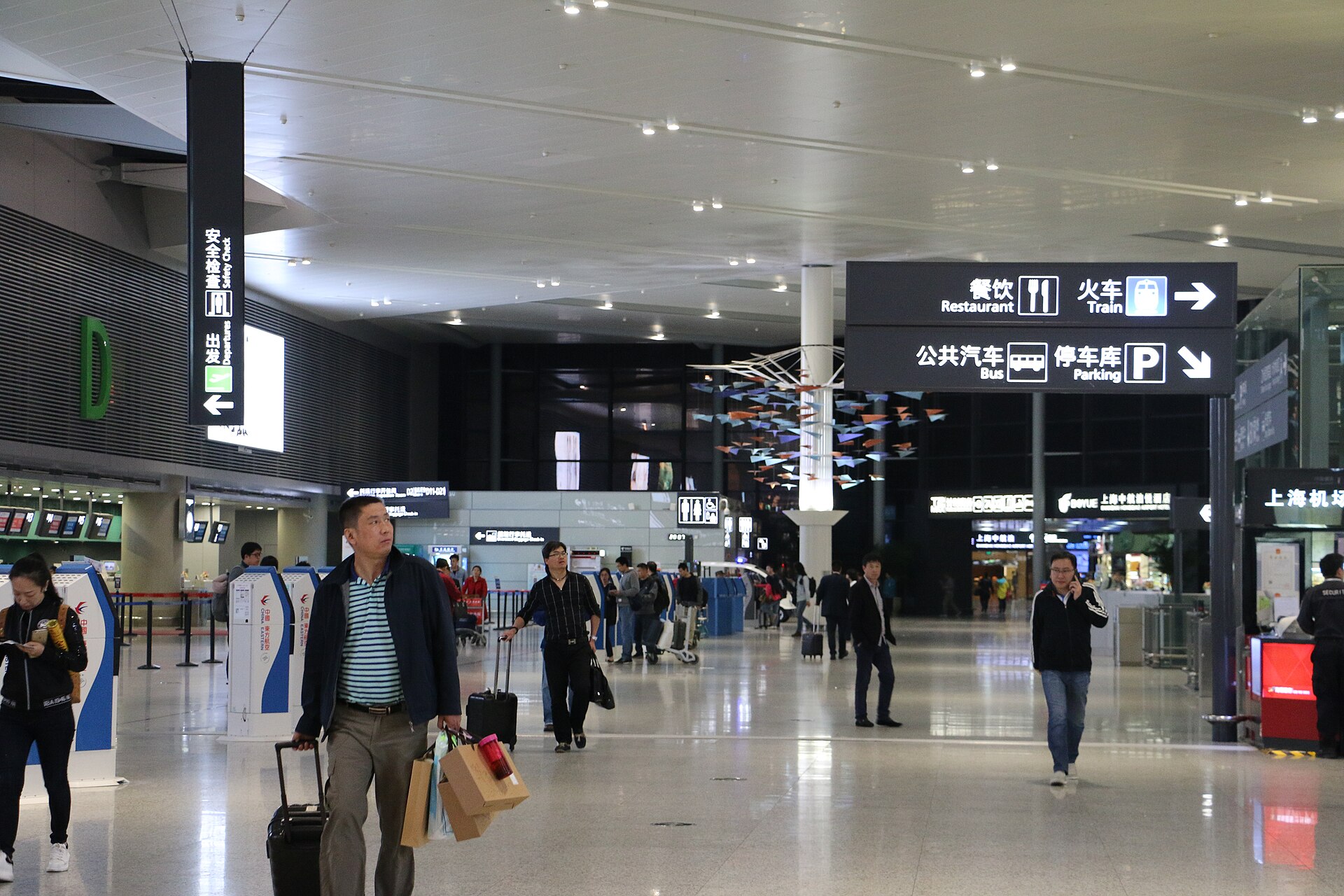
Table of Contents
- Shanghai Hongqiao Airport at a glance
- Terminal 1 and Terminal 2
- Transferring between the terminals
- Getting into the city by metro
- Hongqiao Railway Station and the high-speed network
- The Airport Link Line to Pudong
- Taxi to the city centre
- Didi and ride-hailing
- Airport buses and shuttle lines
- Arriving late at night
- Facilities and services
- How to use a layover
- Hongqiao vs Pudong: which one to use
- Practical tips and common mistakes
- Frequently asked questions
Shanghai Hongqiao Airport at a glance
Hongqiao is the older of Shanghai’s two airports. Pudong opened in 1999 and took over most long-haul international traffic, which left Hongqiao to specialise in domestic routes and the busy short-haul corridor to East Asian cities. It handled more than 50 million passengers in 2025, and the great majority of them were flying to or from somewhere else in China.
The dominant carrier here is China Eastern, which is headquartered in Shanghai. You’ll also see Air China, China Southern, Shanghai Airlines, Juneyao, Spring Airlines and most of the other domestic operators, plus a smaller roster of regional international airlines such as Japan Airlines, Korean Air and EVA Air on the short-haul routes.
For a visitor flying in from Europe, North America or anywhere beyond East Asia, Pudong (PVG) is the airport to expect: it is Shanghai’s main international gateway, while Hongqiao mainly serves domestic and regional East Asian routes. Hongqiao becomes the airport that matters once you’re already in China and connecting onward, when you’re hopping over from Tokyo or Seoul, or when your plan involves the high-speed rail network.
Terminal 1 and Terminal 2
Hongqiao has two terminals, and they are not next to each other. Moving between them means a free shuttle bus or a ride on Metro Line 10, both covered below. Getting this wrong is the single most common mistake travellers make here, so it’s worth being clear about which is which.
Terminal 1 is the older and smaller building. Confusingly for a domestic-focused airport, this is the one that handles the international and Hong Kong, Macau and Taiwan flights, alongside some domestic services. If you’re flying Korean Air, Japan Airlines, a KLM or Delta codeshare, or a regional carrier, check whether you’re at T1. It has departure halls spread across the upper floors and an arrivals hall on the ground floor.
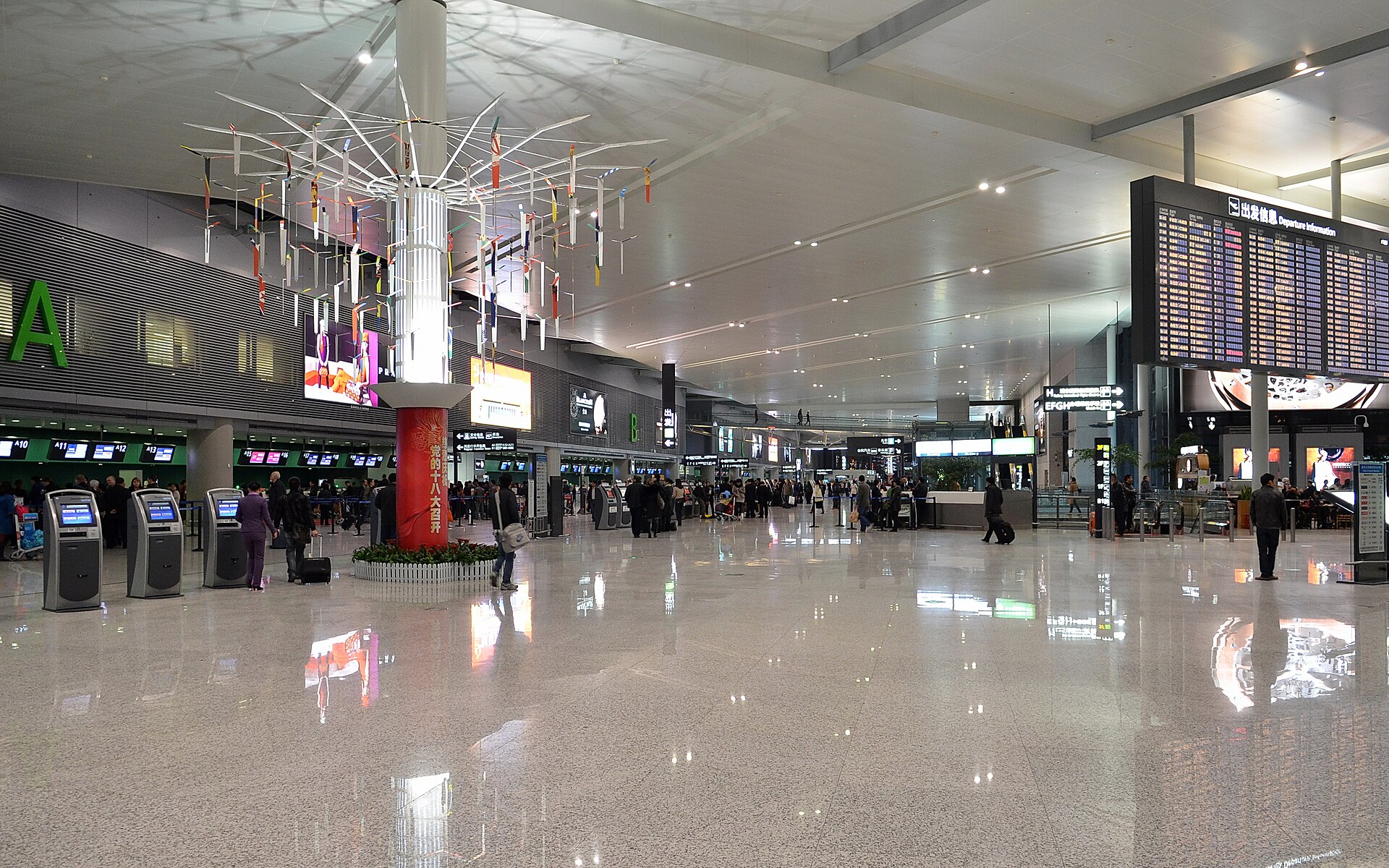
Terminal 2 is the larger, newer building. If you’re on China Eastern, Air China, China Southern, Juneyao, Hainan or one of the other mainland carriers on a domestic route, you’ll almost certainly be at T2. It’s also the terminal physically tied into Hongqiao Railway Station and the main metro interchange, which is why most rail-and-air itineraries revolve around it.
The practical takeaway: a domestic flight on a major Chinese airline points you to Terminal 2; an international or Hong Kong / Macau / Taiwan flight, or a budget regional carrier, more often means Terminal 1. Always confirm against your boarding pass rather than assuming, because arriving at the wrong terminal can cost you the better part of an hour to fix.
Transferring between the terminals
If you do need to move from one terminal to the other, you have two options. A free shuttle bus runs between T1 and T2. Alternatively, Metro Line 10 connects the two terminals directly, which can be quicker if a shuttle has just left.
Budget your time honestly here. The shuttle ride itself is short, but the airport’s official minimum connection times are deliberately generous: roughly an hour for a domestic-to-domestic connection within the same terminal, an hour and a half if international is involved, and considerably more, on the order of two and a half to three hours, when you have to change terminals between T2 and T1. If you’re connecting through Hongqiao, give yourself that cushion rather than the optimistic walking time.
Getting into the city by metro
For most independent travellers, the metro is the best way into Shanghai from Hongqiao. It’s cheap, it’s predictable, the platforms are on basement level B1 right inside the terminals, and the signage is bilingual. Two lines serve the airport, and they behave quite differently.
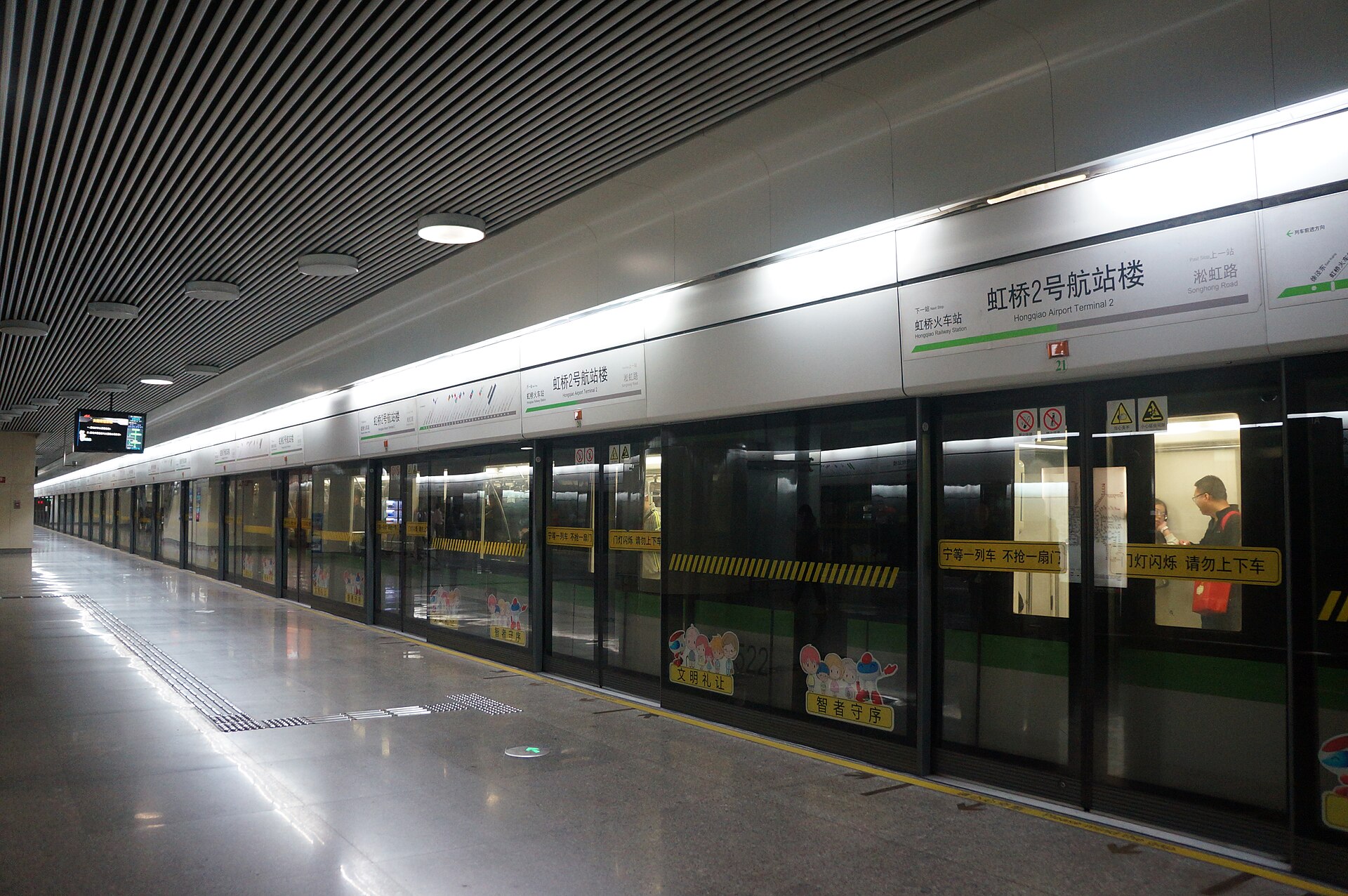
Metro Line 2 (green) is the one most visitors want. Its western end is East Xujing, beyond Hongqiao Railway Station; from Terminal 2 it runs straight through the spine of the city: Jing’an Temple, West Nanjing Road, People’s Square, East Nanjing Road for the Bund, then under the river to Lujiazui and on to Pudong Airport. Fares are distance-based, starting at 3 yuan for the first 6 km and adding 1 yuan for every 10 km after that.
Metro Line 10 (purple) is the only metro option from Terminal 1, and it also stops at Terminal 2. It takes a different, more westerly path into town, calling at Hongqiao Railway Station, South Shaanxi Road, East Nanjing Road and Yuyuan Garden, among others. It’s the direct line for Xintiandi and Yuyuan Garden.
There’s a third line in the picture too. Metro Line 17 terminates at the Hongqiao Railway Station / Hongqiao Hub interchange, but it runs west toward Qingpu rather than into the city centre, so it’s useful for the western suburbs and as part of the hub interchange rather than for reaching downtown. At the railway station, Lines 2, 10 and 17 all meet.
Paying for the metro. You can buy a single-journey ticket from the machines, but if your phone is set up with Alipay or WeChat Pay you can generate a metro QR code and simply scan in and out at the gates, which is faster and avoids fumbling for change. A rechargeable Shanghai Public Transport Card works too.
A few common journeys from Hongqiao and the line for each:
- East Nanjing Road (for the Bund): Line 2.
- People’s Square: Line 2.
- Lujiazui (Pudong skyline): Line 2.
- Xintiandi: Line 10.
- Yuyuan Garden / Old City: Line 10.
- Pudong Airport: Line 2 end to end, the slow way (see the Airport Link Line below).
If you want the full picture of how the network fits together, including transfers and payment, our Shanghai metro guide covers it in detail.
Hongqiao Railway Station and the high-speed network
This is the part of Hongqiao that genuinely sets it apart. The airport’s Terminal 2 and Hongqiao Railway Station, the busiest rail hub in Shanghai, are built into the same complex, officially the Shanghai Hongqiao Transportation Hub. From Terminal 2 you reach the station concourse on foot, without leaving the hub. From Terminal 1 it’s beyond comfortable walking distance, so take Metro Line 10 a couple of stops.
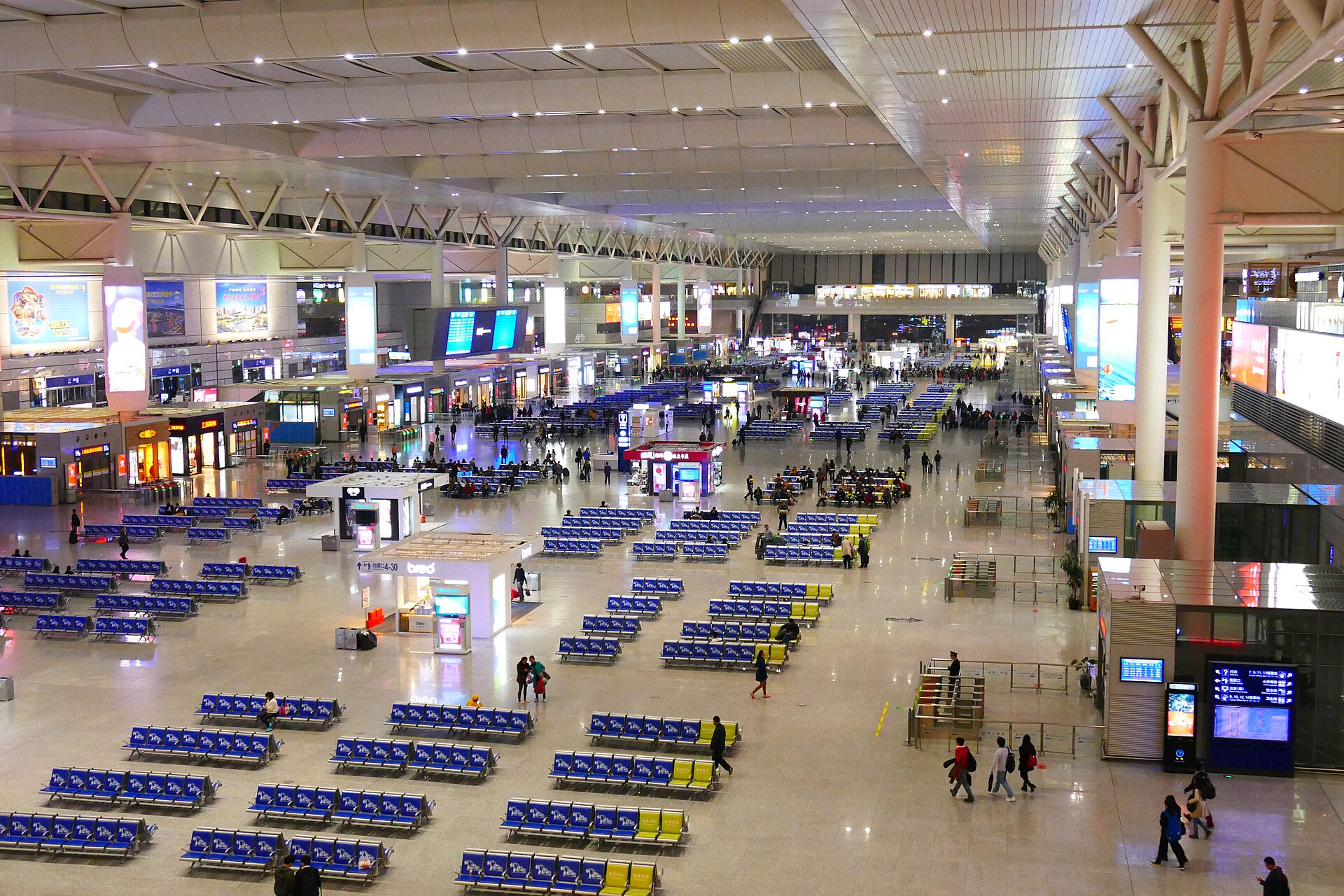
Once you’re at the station, the high-speed network opens up the whole region and a good chunk of the country. A sample of what’s reachable, with each train’s journey time shown on 12306 when you book:
- Suzhou
- Hangzhou
- Nanjing
- Hefei
- Wuhan
- Beijing
- Xi’an
Second-class tickets to the nearby cities are inexpensive, and even the long hauls undercut a domestic flight once you account for getting to and from airports. Allow about half an hour between landing and a rail departure to clear arrivals, walk over and pass through the station’s own security. The Suzhou run in particular is one of the easiest day trips anywhere in China to launch from an airport, and it’s why a lot of people route through Hongqiao deliberately. For the full plan, see our Suzhou day trip from Shanghai guide, and the wider day trips from Shanghai hub for other ideas off the rail map.
The Airport Link Line to Pudong
Connecting between Shanghai’s two airports used to be a genuine chore. The Airport Link Line, part of the suburban railway network and opened at the end of 2024, fixed most of that. It’s a dedicated rail link, separate from the city metro, running between Hongqiao and Pudong airports with a stop at Hongqiao Railway Station.
Journey time is roughly 40 minutes between the two airports, a big improvement on the old combination of metro or Maglev plus interchanges. Trains run at intervals of around 15 to 20 minutes through the day, from early morning until late evening, and Hongqiao Terminal 2 has its own station for the line. If you have a connection that splits across both airports, this is the way to make it. Note that the Maglev itself does not serve Hongqiao at all; it only runs from Pudong, so don’t plan around it here.
For everything specific to the Pudong end of a transfer, including the Maglev and the airport-to-city options over there, our Pudong airport to city centre guide is the companion to this one.
Taxi to the city centre
A metered taxi is the simplest option if you’re tired, travelling with luggage or a group, or arriving outside metro hours. The city government’s visitor guide puts the ride from Hongqiao into central Shanghai at about 30 minutes, longer in rush-hour traffic, and the fare at about 100 to 150 yuan, depending on where you’re headed and how the traffic runs. A modest night surcharge applies between 23:00 and 05:00.
Where to find one: use the official taxi rank, which at Terminal 2 is on the south side of Gate 4 of the arrivals hall; at Terminal 1, follow the taxi signs from arrivals. Only take metered taxis from the rank. Ignore anyone approaching you inside the terminal offering a flat fare or a “private car”; that’s the classic airport overcharge and it’s best avoided everywhere in the city. Payment is by cash or, more commonly now, WeChat Pay or Alipay.
Didi and ride-hailing
Didi is China’s equivalent of Uber and an alternative to the taxi rank; compare its quote with what the meter would cost. Set it up before you arrive, ideally linking a payment method while you still have your home connection, because getting it working from scratch on Chinese mobile data can be fiddly. Set your destination, request the car, and walk to the designated ride-hailing pickup zone, generally outside the terminals at ground level. Waits vary with the time of day, and the app tracks your driver once one accepts.
Airport buses and shuttle lines
Hongqiao is served by a network of airport bus and shuttle routes, which can make sense if your hotel happens to sit on a line or if you’re travelling on a tight budget. A few of the useful ones:
- Line 941 runs to the South Square of Shanghai Railway Station.
- The Night Line (316) heads toward East Yan’an Road and the Bund area and is the one to know about after the metro stops.
- Several Hongqiao Hub shuttle lines fan out to suburban districts such as Jiading and the science parks, which are mainly of interest if you’re staying out that way.
For most visitors heading into the centre, though, the metro is simpler and more predictable than working out a bus route, so the buses are worth knowing about rather than defaulting to.
Arriving late at night
Hongqiao quietens down noticeably after about 23:00. Metro service from the airport ends in the late evening, and last trains differ by line, direction and day, so check the current timetable at the station before you count on one. If you land after the last train, your realistic choices are:
- Taxi: take a car from the official rank.
- Didi: order through the app, though waits for a car vary through the night.
- Night bus 316: runs through the small hours toward the Bund for a fraction of a taxi fare, if the route suits your hotel.
- An airport hotel: sometimes the sensible call for a very late landing and an early onward flight, which brings us to facilities.
Facilities and services
Hongqiao covers the practical bases well, and Terminal 2 in particular has been kept modern.

Food and drink. Both terminals have food courts and familiar chains, with the likes of Starbucks and noodle counters landside and a fuller spread of restaurants once you’re through security. A sit-down meal is reasonably priced by airport standards; a quick noodle or coffee is cheaper still.
Lounges. Terminal 2 has airline lounges, and access rules differ by lounge and ticket, so check with your airline or lounge membership before you fly.
Shopping. There are shops airside in Terminal 2 if you’ve left souvenirs to the last minute.
Wi-Fi. Free airport Wi-Fi covers both terminals. You activate it by scanning your passport at one of the Wi-Fi ticket machines to get a login, a small extra step compared with home but quick once you find a machine.
Money. ATMs are available in both terminals and generally give a better rate than the currency-exchange counters. As elsewhere in China, day-to-day spending leans heavily on mobile payments, so getting Alipay or WeChat Pay working is more useful than a thick wallet of cash.
Left luggage. Staffed left-luggage counters operate in both terminals (broadly daytime hours, with T2 open later than T1), charged by bag size and time, which is handy if you want to dash into the city on a layover without your bags.
Tax refund and visa-free transit. There’s a departure tax-refund service for eligible shopping, and Shanghai’s generous visa-free transit policy applies at Hongqiao as well as Pudong, letting eligible travellers from a long list of countries enter for a set number of hours or days to explore. Check the current rules against your nationality before you count on it.
Hotels. For sleeping close to the airport, the standout for convenience is the Boyue Shanghai Hongqiao Airport Hotel, which connects directly into Terminal 2. A short ride away in the wider Hongqiao business district you’ll also find more full-service hotels. Our guide to hotels near Hongqiao goes through them terminal by terminal, with the exhibition-centre hotels too. If you’d rather base yourself in the city instead and just pass through the airport, our where to stay in Shanghai guide breaks down the neighbourhoods.
How to use a layover
Because Hongqiao is close to the city and wired into the metro and rail, layovers here can be put to good use. Roughly:
Two to three hours: stay airside. Eat, browse, and find a quiet corner or a lounge. Not enough time to leave and come back safely.
Around six hours: a quick foray is feasible. A short metro hop to Jing’an or Xintiandi for a meal and a wander works if you’re disciplined about timing. Budget about 90 minutes round-trip on the train plus an hour on the ground, and watch the clock.
Eight hours or more: you can reasonably get into the centre. Line 2 to the East Nanjing Road area, a walk along the Bund, a proper lunch, and back, comes to roughly four to five hours all in. Leave a comfortable margin for the return and security.
An overnight or 24-hour stop: consider a hotel at or near the airport, sleep, and take a relaxed half-day in the city the next morning, or jump on a bullet train to Suzhou and back. For structured ideas on how to spend the time, our Shanghai itineraries are a good starting point.
Hongqiao vs Pudong: which one to use
When you have a choice of airport, here’s how the decision usually breaks down.
Choose Hongqiao when:
- You’re flying a domestic Chinese route. The bulk of internal flights use Hongqiao.
- You’re connecting to or from the high-speed rail at Hongqiao Railway Station.
- You’re on a short East Asian hop to Tokyo, Seoul, Hong Kong or Taipei.
- Being close to the centre, around 13 km, matters more to you than the breadth of international routes.
Choose Pudong when:
- You’re flying long-haul international to Europe, the Americas, the Middle East or Australia.
- Your airline simply operates out of Pudong, as most international carriers do.
- You specifically want to ride the Maglev, which only runs from Pudong.
One nuance worth flagging: Pudong sits about 30 km from downtown and about 40 km from Hongqiao, so if your itinerary forces a same-day transfer between the two, build in real time and lean on the Airport Link Line. Detailed Pudong-side guidance lives in our Pudong airport to city centre guide.
Practical tips and common mistakes
Confirm your terminal before you set off. T1 and T2 are separate buildings, and getting from one to the other means the free shuttle bus or Metro Line 10, which eats time you may not have.
Default to Metro Line 2 for the central city. It’s the cheapest, most direct route to the Nanjing Road and Bund area.
Give terminal changes more time than you think. The shuttle is quick, but official connection minimums run to a couple of hours when you switch terminals.
Lean on the railway station. A ten-minute walk to a bullet train is the best thing about this airport; the Suzhou day trip is the easy win.
Mind the last metro. Trains stop in the late-evening window. After that it’s taxi, Didi or the night bus.
For Pudong transfers, take the Airport Link Line. It links Hongqiao Terminal 2 and Pudong Airport in about 40 minutes.
Set up mobile payments before you land. A working Alipay or WeChat Pay covers the metro, taxis, Didi and most shops, and saves a lot of friction.
Keep a little cash as backup. A couple of hundred yuan covers anything that won’t take a phone.
Install your apps and a VPN at home. Maps, ride-hailing and messaging apps are far easier to set up before you hit China’s network, and many foreign services need a VPN.
If you’re still shaping the broader trip, our how to plan a trip to Shanghai guide ties the airport choice into visas, timing and budget.
Frequently asked questions
What’s the difference between Hongqiao and Pudong airports?
Hongqiao (SHA) is closer to downtown, about 13 km, smaller, and built around domestic and short regional flights, and it’s attached to the main high-speed rail station. Pudong (PVG) is about 30 km from downtown and is the city’s main international airport, where most long-haul flights land.
How do I get from Hongqiao Airport to central Shanghai?
Metro Line 2 is the most useful, running direct to the East Nanjing Road / Bund area for a few yuan. A metered taxi takes you door to door in about 30 minutes by the city’s estimate, longer in heavy traffic, for a higher fare. Didi is the app-booked alternative to the taxi rank.
How long does Metro Line 2 take to East Nanjing Road?
It’s a single ride with no change of line: board at Hongqiao Terminal 2 and stay on through Jing’an Temple and People’s Square to East Nanjing Road.
Can I take the metro from Terminal 1?
Yes. Terminal 1 is served by Metro Line 10, which also reaches the centre and stops at Hongqiao Railway Station. For Line 2 you’d need to get to Terminal 2 first, which Line 10 does in one ride.
How do I get from Hongqiao Airport to Hongqiao Railway Station?
From Terminal 2 you walk there, since the station is part of the same hub. From Terminal 1 it’s too far to walk comfortably, so ride Metro Line 10 a couple of stops to the station.
How long is a Hongqiao to Pudong airport transfer?
The Airport Link Line covers it in roughly 40 minutes. By road, a taxi or bus runs longer and depends heavily on traffic; the end-to-end city metro is the slow last resort.
Is the Maglev at Hongqiao?
No. The Maglev only runs from Pudong Airport. To move quickly between the two airports, use the Airport Link Line instead.
Can I do a Suzhou day trip from Hongqiao?
Yes, and it’s one of the simplest anywhere. Walk from Terminal 2 to Hongqiao Railway Station, take a high-speed train to Suzhou, and you’re there. It’s a popular reason to route through Hongqiao deliberately.
Are there hotels at Hongqiao Airport?
Yes. The Boyue Shanghai Hongqiao Airport Hotel connects directly into Terminal 2, and the surrounding Hongqiao business district has more choice a short ride away.
What should I do if I arrive late at night?
Take a taxi from the official rank or order a Didi, though waits for a car vary through the night. The night bus 316 heads toward the Bund cheaply if it suits your hotel. For a very late landing before an early flight, an airport hotel can be the easier choice.
Can I check in at Hongqiao for a Pudong flight?
Generally no, unless your airline specifically offers through check-in for a connecting itinerary. Confirm with the carrier; otherwise plan to collect and re-check your bags at whichever airport your onward flight departs from.
Planning around Hongqiao
Used well, Shanghai Hongqiao Airport is one of the most convenient airport-and-railway combinations you’ll come across. Take Metro Line 2 for the central city, walk over to Hongqiao Railway Station for a day trip or onward leg, and use the Airport Link Line whenever a Pudong transfer is unavoidable. For the bigger transport picture, see our pillar guide to getting around Shanghai; for the other airport, our Pudong airport to city centre guide is the companion; and to pull the whole visit together, start with how to plan a trip to Shanghai.
Official reference: Shanghai Airport Authority (SHA).
Photo credits.
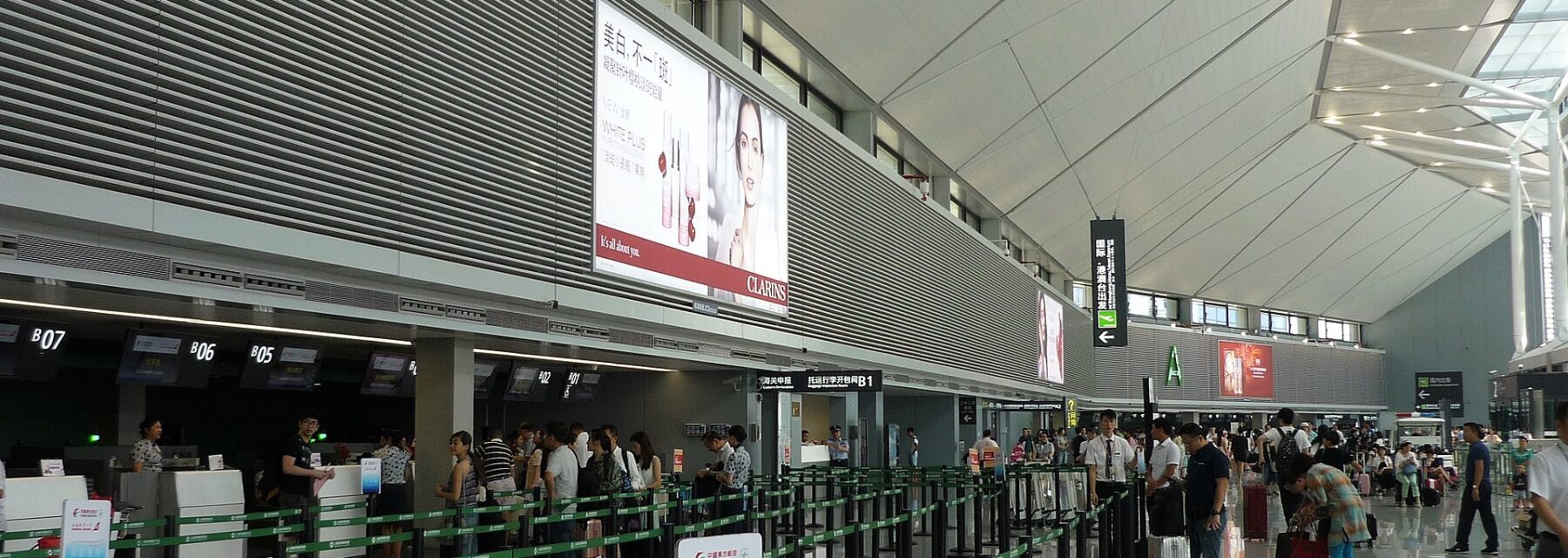
Hongqiao Terminal 1 check-in hall: Shanghai Hongqiao International Airport Terminal 1 Check in Hall 20170722-1 by Suikotei, CC BY-SA 4.0, via Wikimedia Commons.
Hongqiao Terminal 2 check-in concourse: 201604 check-in area at SHA T2 by MNXANL, CC BY-SA 4.0, via Wikimedia Commons.
Hongqiao Terminal 2 departure hall: Shanghai Hongqiao International Airport Terminal 2 Check in Hall 20121117 by Tyg728, CC BY-SA 3.0, via Wikimedia Commons.
Hongqiao departure hall: 2014.11.20.195036 Hongqiao Train Station Shanghai by Hermann Luyken, CC0, via Wikimedia Commons.
Hongqiao Terminal 2 metro platform: 201611 L2 Platform at Hongqiao Airport Terminal 2 Station by MNXANL, CC BY-SA 4.0, via Wikimedia Commons.