There are three working Shanghai train stations, they are twenty kilometres apart, and the ticket does not always make it obvious which one you need. Turning up at the wrong one is not a small mistake: Hongqiao to Shanghai Railway Station is forty minutes on the metro on a good day, and Chinese gates close three to five minutes before departure with no negotiation whatsoever.
The short answer is that if you are catching a high-speed train to almost anywhere — Beijing, Suzhou, Hangzhou, Nanjing, Xi’an, Huangshan, Guangzhou, Hong Kong — you are going to Hongqiao. But there are enough exceptions to be worth five minutes of reading, and once you know which station you want, the second problem starts: these are enormous buildings run on a system that looks like an airport and behaves nothing like one. This guide covers which station serves what, how each is laid out, the exact sequence from the front door to your seat, how early to arrive, and where to leave a suitcase.
Table of Contents
- Which of the Shanghai train stations do you need?
- Hongqiao Railway Station
- Shanghai Railway Station
- Shanghai South — and the one that is not open yet
- The sequence: front door to seat
- What the journey is actually like
- How early to arrive
- Luggage, food and waiting
- Tickets, passports and the gate
- Arriving in Shanghai by train
- What people get wrong at Shanghai train stations
- Frequently Asked Questions
Which of the Shanghai train stations do you need?
Check the three characters on your booking. Hongqiao is 上海虹桥, Shanghai Railway Station is plain 上海, Shanghai South is 上海南. The English on a booking confirmation is usually right but not always complete, and the Chinese never lies.
| Station | Chinese | Metro | Serves | From the Bund |
|---|---|---|---|---|
| Shanghai Hongqiao | 上海虹桥 | Lines 2, 10, 17 | Almost all high-speed: Beijing, Nanjing, Suzhou, Hangzhou, Huangshan, Xi’an, Chengdu, Kunming, Guangzhou, Shenzhen, Hong Kong | 40–50 min on Line 2 |
| Shanghai Railway Station | 上海 | Lines 1, 3, 4 | A mix: around 50 bullet services plus conventional and overnight trains, including Beijing sleepers | 15–20 min on Line 2 then Line 1 |
| Shanghai South | 上海南 | Lines 1, 3, 15 | Mostly conventional services south — Hangzhou, Ningbo, Jiangxi | 35–45 min |
In practice, roughly nine out of ten visitors leaving Shanghai by train leave from Hongqiao. The exceptions worth knowing: some overnight sleeper services to Beijing depart from Shanghai Railway Station, a handful of conventional long-distance trains use it too, and if you have booked an unusually cheap slow train to somewhere southern, check whether it is Shanghai South.
Note also that at the Beijing end, almost everything arrives at Beijing South rather than Beijing Station, and some services now use Beijing Fengtai, which opened in June 2022. Read the arrival station as carefully as the departure one.
Hongqiao Railway Station
Hongqiao is one of the largest railway stations in Asia and it is laid out vertically, which is the thing to understand before you arrive. Five levels:
- 3F — mezzanine with shops, restaurants and extra seating, overlooking the waiting hall.
- 2F — the departure hall. This is where you spend your time: the main waiting area, ticket office, enquiries, and the numbered gates. Toilets and hot-water dispensers run down both sides.
- 1F — the platforms.
- B1 — arrivals hall, metro entrance and exit, taxi rank, the long-distance bus station, restaurants and a second ticket office. The left-luggage office is at the West Entrance on this level.
- B2 — metro platforms.
Arriving by metro on Line 2, 10 or 17, you come up at B1 and take the escalators to 2F. Arriving by taxi, you are dropped at the departure ramp and walk straight into 2F. Both routes hit the security scan on the way in.
Hongqiao is attached to Hongqiao Airport Terminal 2 by an indoor connection, about ten minutes on foot with a suitcase — this is genuinely useful and makes rail-to-air connections in Shanghai unusually painless, though never book a same-day international flight off a domestic train. Our Hongqiao Airport guide covers the terminal side of it.
Getting there from the centre: Line 2 from East Nanjing Road takes 40–50 minutes and is the reliable option; Line 10 from the French Concession is 35–45. A taxi from the Bund is ¥70–100 and 35–60 minutes depending entirely on the expressways, which is a gamble at rush hour. From Pudong Airport, allow 60–75 minutes on Line 2, or the Maglev to Longyang Road and a change — our Maglev guide explains when that is worth it.

Shanghai Railway Station
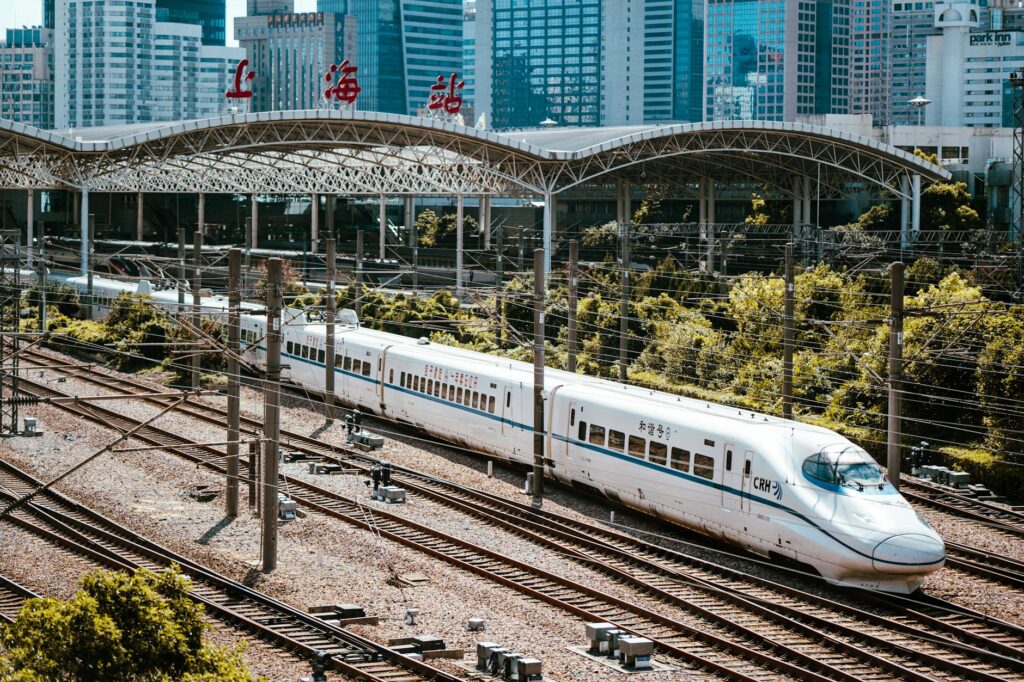
The old main station, and by far the most convenient of the three if it happens to serve your train. It is about ten minutes north of People’s Square, with a north square and a south square, each with buses and taxis.
Its published layout gives two levels: arrivals, ticket windows and some waiting rooms on the ground floor, and the main waiting area with five waiting rooms off a central corridor upstairs. Seven platforms. Red-cap porters will carry a bag for around ¥10 a piece, and left luggage costs about the same per day.
The metro is the thing to get right here, because the entrances are on opposite sides of the building: Lines 3 and 4 are under the north square; Line 1 is under the south square. Coming in on Line 1 and needing the north exit means a walk through or around the station. Give yourself an extra ten minutes if you are changing lines here.
What it serves: about fifty bullet-train services a day plus a substantial number of conventional and overnight trains. If you have booked a soft-sleeper to Beijing — the D-train departures that leave in the evening and arrive early the next morning — there is a good chance it goes from here rather than Hongqiao.
Shanghai South — and the one that is not open yet
Shanghai South Railway Station sits in Xuhui, on Metro Lines 1, 3 and 15, under a distinctive circular roof that makes it the most architecturally interesting of the three and the least useful. It handles mostly conventional services running south — Hangzhou, Ningbo, Jiangxi — plus some regional trains. Very few visitors need it, and if your ticket says 上海南 it is worth double-checking that you have not booked a four-hour slow train to Hangzhou when a forty-five-minute high-speed service leaves from Hongqiao for not much more money.
One more thing, because it appears in an increasing number of out-of-date articles: Shanghai East Railway Station is not open. It is under construction at Zhuqiao in Pudong, about five kilometres from Pudong Airport Terminal 1, with fifteen platforms and thirty tracks planned, and the Shanghai government’s announcement puts public opening in 2027. You cannot catch a train from it and you should not plan around it.

The sequence: front door to seat
Chinese railway stations look like airports and work differently. The whole sequence, in order:
- Bag scan at the entrance. Everything goes through an X-ray, you walk through a metal detector, and a member of staff may wand you. Liquids are fine; the thing that gets confiscated is a power bank over 100 Wh.
- Passport check into the departure hall. A separate desk from the security scan. Your passport is your ticket.
- Find your gate on the departure board. Boards show train number, destination, departure time and gate number (检票口). Watch the train number, not the destination — several trains an hour go to the same city.
- Wait. This is where the hour goes. Seats near your gate fill up first.
- The gate opens about fifteen minutes before departure. A queue forms instantly.
- Scan your passport at the gate and descend to the platform.
- Find your carriage number, marked on the platform floor. Board.
The one rule that matters: the gate closes three to five minutes before the train leaves, and it is enforced absolutely. There is no running down the platform and no sympathetic guard. If you are ten minutes late for a Chinese train you have missed it, and your ticket is worth a partial refund at best.

What the journey is actually like
Worth knowing before your first Chinese high-speed train, because it is not much like a European one.
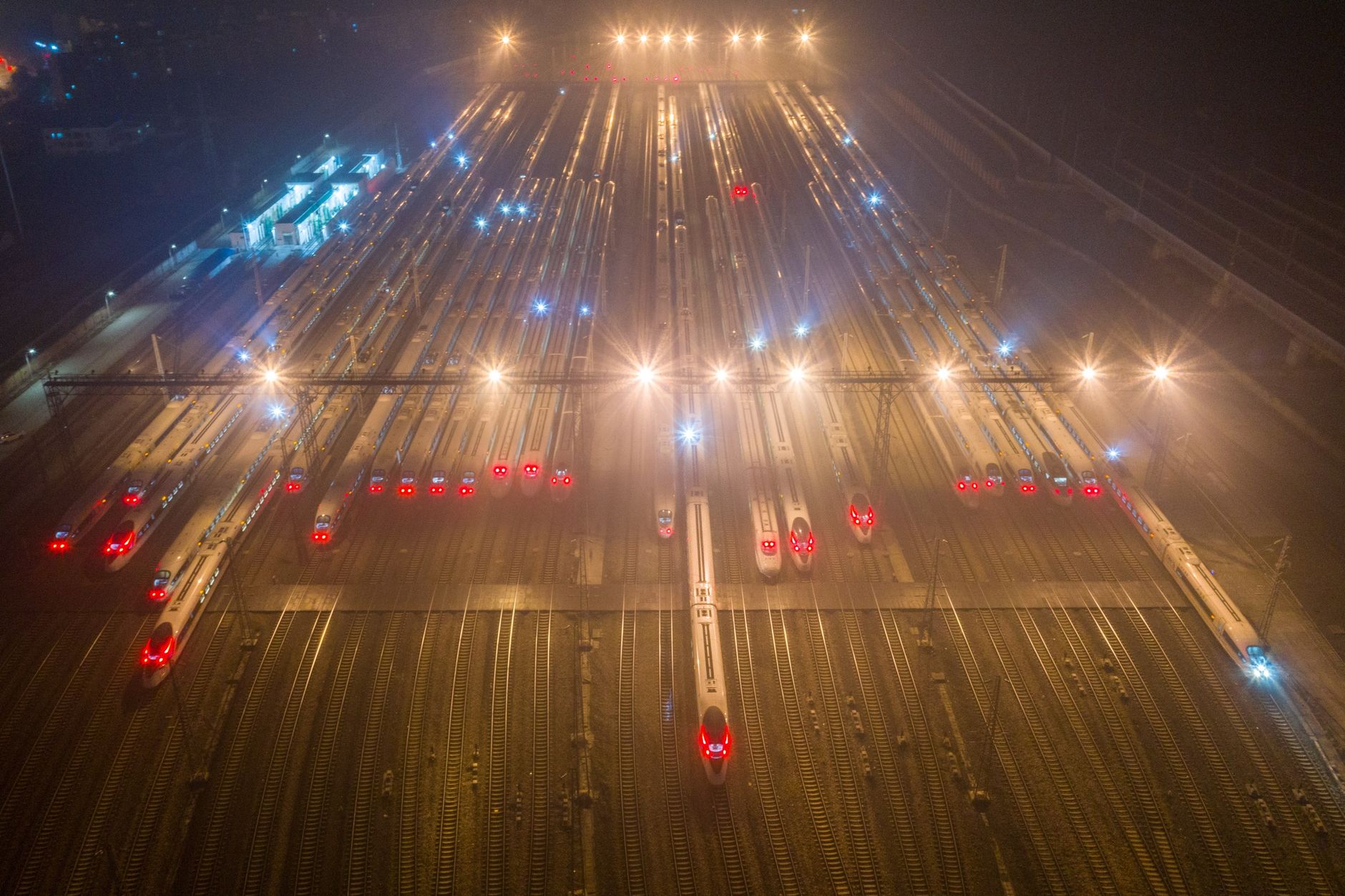
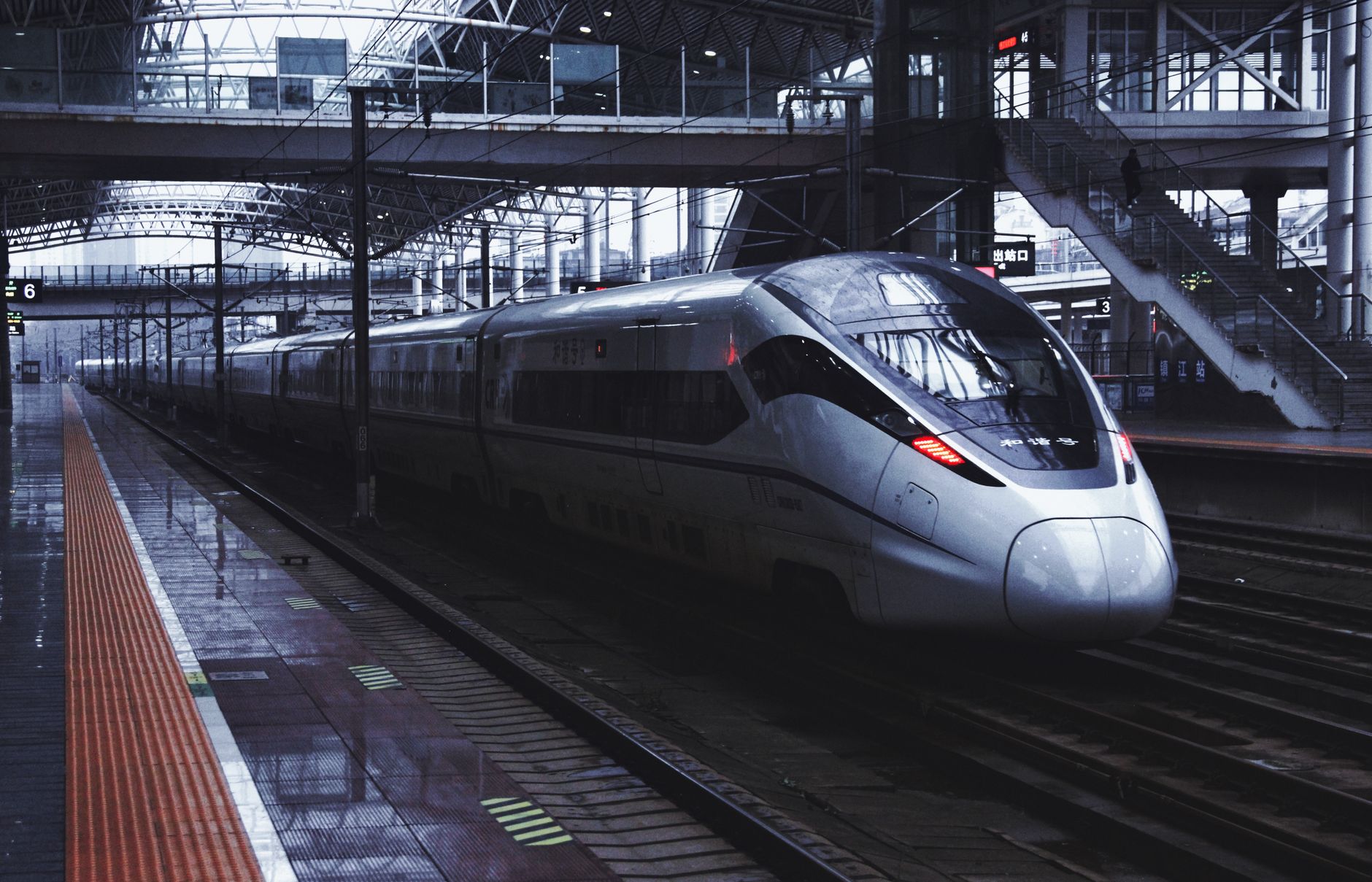
The trains are CR400AF and CR400BF Fuxing sets on the main routes, running at 350 km/h on through sections. They are quiet, extremely smooth and almost always on time — punctuality on the Beijing–Shanghai corridor is better than most European operators manage. Intermediate stops are often exactly two minutes, so if you are getting off somewhere in the middle, be standing by the door with your bag a stop early.
Carriages are announced in Mandarin and English on the main intercity routes. Speakerphone use, video calls and children running the length of the aisle are all normal and nobody minds; some Beijing–Shanghai services have a designated quiet carriage, which is worth paying attention to when booking if that matters to you. Smoking is banned throughout and the trains have smoke detectors that will stop the service — people have been fined heavily for lighting up in the vestibule.
Overnight D-trains to Beijing use CR200J stock with lockable four-berth soft sleepers and open six-berth hard sleepers. The soft sleeper at ¥642–711 is a genuinely comfortable way to cover the distance and saves a hotel night, though it is slower than the day service by seven hours.
How early to arrive
Official advice for Hongqiao, per published station guidance, is 45 to 60 minutes before departure. In practice:
- Hongqiao: 40 minutes minimum, 60 if you have luggage or it is a holiday. The building is huge and the walk from the metro at B1 to a far gate on 2F can take twelve minutes on its own.
- Shanghai Railway Station or Shanghai South: 25–30 minutes. Smaller, simpler, quicker.
- Golden Week, Chinese New Year and Friday evenings: add half an hour to all of the above. Queues at the entrance scanners are the bottleneck, not the gates.
And build the journey time in generously. Shanghai traffic does not respect schedules, and a taxi to Hongqiao at 17:30 on a Friday can take ninety minutes. The metro is slower on paper and far more predictable — which is why locals take it to the station and taxis home from it. Our guide to getting around Shanghai covers the wider network, and the metro guide has the interchange detail.
Luggage, food and waiting
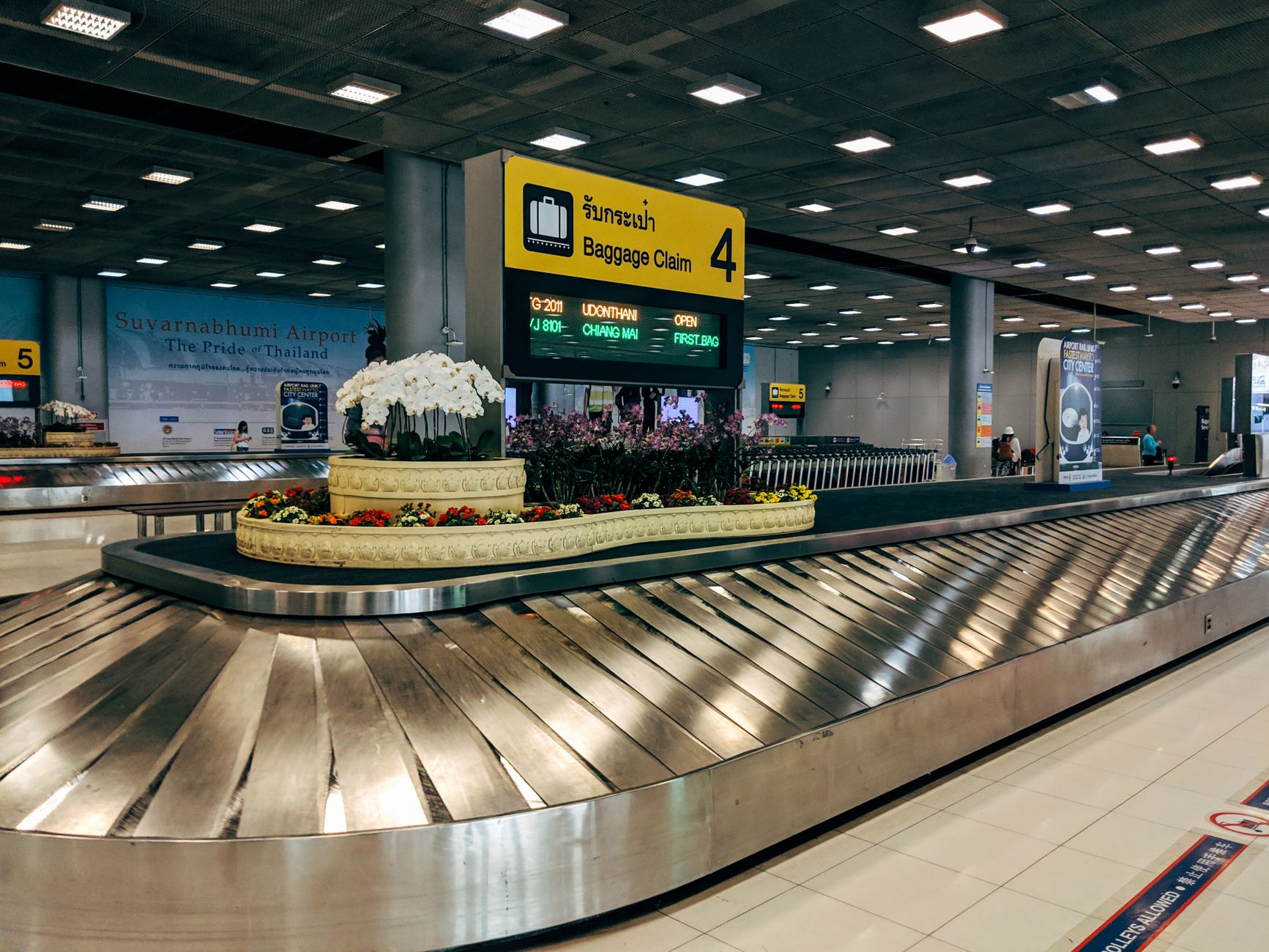
Left luggage. At Hongqiao there is a staffed office at the West Entrance on B1, charging around ¥10 for a small bag and ¥20 for a large one, plus lockers in the metro station priced by size and duration, and further left-luggage counters at both sides of the 2F waiting hall. Shanghai Railway Station charges roughly ¥10 a day. This makes a long layover between a morning arrival and an evening train entirely manageable — drop the bags and go into the city.
On the train there is no check-in and nothing is weighed. The official allowance is 20 kg for an adult and 10 kg for a child with a 130 cm sum of dimensions, and it is essentially never enforced for ordinary suitcases. Bags go overhead or in the racks at the ends of the carriage. Get on early if you have a big case, because the end racks fill.
Food. Station concourses are far better than the trains. Hongqiao’s 3F mezzanine and B1 both have proper restaurants and chains; the on-board trolley and buffet car sell meals at ¥45–65 and they are mediocre. Every carriage has a boiling-water dispenser, which is what the instant noodles everyone else is carrying are for. Buy food before you board.
Waiting comfortably. Seats near the gates go first; the mezzanine at Hongqiao usually has space. Power sockets are scarce in the waiting halls and present at every seat in every class on the train, so charge en route rather than beforehand. There is no reliable on-board wi-fi.
Tickets, passports and the gate
Chinese rail tickets are electronic and tied to your passport. There is no paper ticket to collect, no ticket window to queue at, and nothing to print. You tap or scan the physical passport at the entrance, at the gate and on the way out at the other end. Bring the actual passport, not a photocopy and not a photograph.
Tickets go on sale exactly fifteen days before departure at 08:00 Beijing time. There is no earlier window and no advance-purchase discount — Chinese fares are near-fixed, so waiting costs you nothing except availability. Sell-outs concentrate on Friday evenings, Sunday afternoons and public holidays.
Two booking routes work for foreigners. 12306, the official China Railway app, now accepts foreign passports: register with the passport number, no Chinese phone or bank account required, and it takes Visa, Mastercard, JCB, Diners Club and UnionPay, plus linked Alipay or WeChat Pay. American Express is not accepted. Verification is usually automatic within minutes, occasionally up to a day while it syncs with immigration records. Trip.com resells the same seats at face fare plus a small service fee, with a more forgiving foreign-card checkout and better English; refunds route through the agency, which is slower.
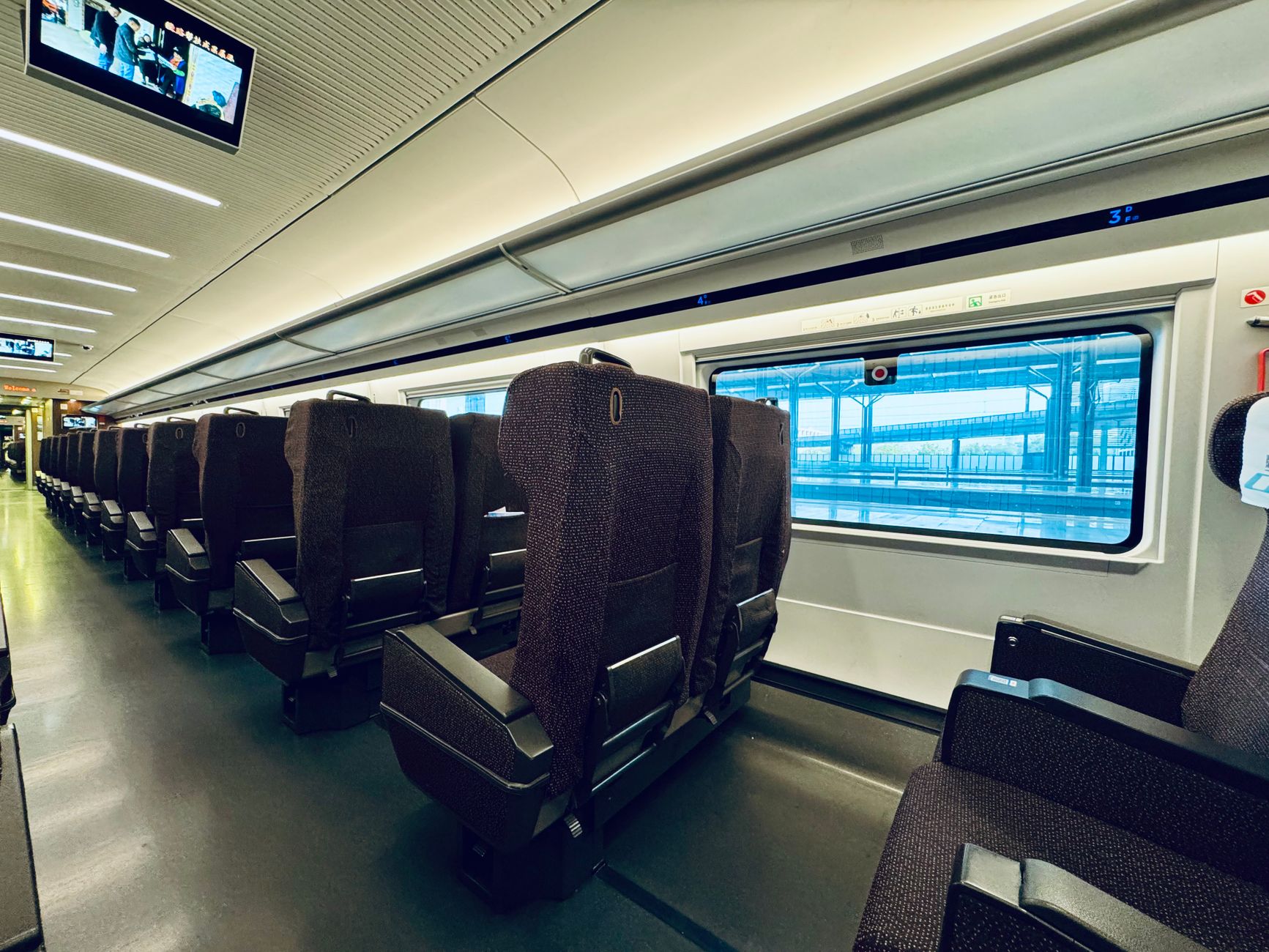
Class, briefly: second class is 3+2 seating with a tray table and a power socket, and it is perfectly comfortable for four hours. First class is 2+2 at roughly 1.7× the fare. Business class is a lie-flat pod at three to four times second class, with a station lounge and a hot meal. On seat letters, note there is no E — the columns are A, B, C, D and F, and A and F are the windows.
If you are heading somewhere specific, our day-trip guides cover the journeys most visitors make: Suzhou at 25–40 minutes and ¥40–60, Hangzhou at 45–60 minutes and ¥73–100, and Nanjing at just over an hour. All three leave from Hongqiao.
Arriving in Shanghai by train
Coming the other way is simpler, because nothing is timed and nothing closes. You get off, follow the crowd, scan your passport at the exit barrier, and you are in the arrivals hall.
At Hongqiao that hall is B1, and everything you need is on the same level: the metro entrance for Lines 2, 10 and 17, the taxi rank, the long-distance bus station and the left-luggage office. Follow the signs for 地铁 (metro) rather than joining the taxi queue, which after a Beijing arrival can run to forty minutes and puts you on the expressway at exactly the wrong time. Line 2 takes you straight to East Nanjing Road for the Bund and People’s Square; Line 10 serves the French Concession, Xintiandi and the Old City.
At Shanghai Railway Station the exits split between the north and south squares, and it matters which one you take: Lines 3 and 4 are under the north square, Line 1 under the south. If you are heading for a hotel near People’s Square or the Bund, you want Line 1 and the south square.
Two practical things on arrival. First, set up a payment app before you get here if you have not already — the metro gates take a QR code from Alipay or WeChat Pay, and fumbling with a ticket machine while three hundred people file past is a poor introduction to the city. Our guide to the Shanghai transport card covers the physical alternative. Second, if your hotel check-in is hours away, use the left-luggage office rather than dragging a case around Huangpu in August. It is ¥10–20 and it transforms the day.
What people get wrong at Shanghai train stations
Going to the wrong station. The single most expensive mistake available. Check the Chinese characters, not the English.
Arriving twenty minutes before a train at Hongqiao. The walk from the metro to a distant gate, through security and a passport check, is longer than that on its own.
Assuming the gate will stay open. Three to five minutes before departure, it shuts. This is not a guideline.
Bringing a large power bank. Anything over 100 Wh is refused at the scanner and you will be asked to bin it. Check the rating printed on it before you leave the hotel.
Watching the destination instead of the train number. Four trains to Hangzhou in an hour, four different gates.
Booking too early. You cannot. Fifteen days before departure, 08:00 Beijing time, and not a minute sooner.
Not eating first. The concourse is good. The train is not.
Frequently Asked Questions
Which station do I use for the train to Beijing?
Hongqiao for almost all high-speed services — around forty daily departures each way, four and a half to six hours, with second class up to about ¥669. The ceiling on published fares rose 20% (to about ¥803) from 26 May 2026, though fares initially stayed where they were. Some overnight D-train sleepers leave from Shanghai Railway Station instead, taking about twelve hours. Check the Chinese characters on your booking.
How early should I arrive at Hongqiao Railway Station?
Forty minutes at an absolute minimum, sixty if you have luggage or it is a public holiday. The station is enormous: the walk from the metro at B1 to a far gate on 2F, through a bag scan and a passport check, can take twelve minutes before you have even sat down.
Can I store luggage at a Shanghai train station?
Yes. Hongqiao has a staffed left-luggage office at the West Entrance on B1 at around ¥10 for a small bag and ¥20 for a large one, plus lockers in the metro station and counters at both sides of the 2F waiting hall. Shanghai Railway Station charges roughly ¥10 a day.
Do I need to print my train ticket?
No. Chinese rail tickets are electronic and tied to your passport. You scan the physical passport at the station entrance, at the gate and on exit at your destination. There is nothing to collect and no ticket window to queue at — but you must have the actual passport with you.
What happens if I miss my train?
The gate closes three to five minutes before departure and it is enforced without exception. A missed train usually means buying a new ticket, with at best a partial refund on the old one at the ticket office. Build in more time than feels necessary.
Is Hongqiao Railway Station connected to Hongqiao Airport?
Yes — an indoor walkway links it to Terminal 2, about ten minutes on foot with a bag, and Metro Line 2 and Line 10 serve both. It makes train-to-plane connections unusually easy, though you should never book a same-day international flight off a domestic train given how delay-prone Chinese domestic aviation is.
How do I get from the Bund to Hongqiao Railway Station?
Metro Line 2 from East Nanjing Road, 40–50 minutes, ¥5–7. A taxi is ¥70–100 and takes 35–60 minutes, but the expressways are unpredictable and a Friday evening run can take far longer. Locals take the metro out and a taxi back.
What is Shanghai East Railway Station?
A station under construction at Zhuqiao in Pudong, about five kilometres from Pudong Airport Terminal 1, planned with fifteen platforms and thirty tracks. It is due to open to the public in 2027 and is not in service now, despite appearing in some older articles as though it were.
Can foreigners buy Chinese train tickets online?
Yes. The official 12306 app accepts foreign passports with no Chinese phone number or bank account, and takes Visa, Mastercard, JCB, Diners Club and UnionPay — but not American Express. Trip.com sells the same seats with a small fee, easier card handling and better English. Tickets go on sale fifteen days before departure at 08:00 Beijing time.
Is there wi-fi and power on Chinese high-speed trains?
There is a power socket at every seat in every class, and hot-water dispensers in every carriage. On-board wi-fi exists on some services and is not reliable — assume you will use your own mobile data, which works fine at 300 km/h with occasional drops in tunnels.
Which is better, the train or a flight?
The site’s rule of thumb: under five hours take the train, over eight fly, and decide on the merits in between. Trains leave from the centre of one city and arrive in the centre of another, there is no check-in, and they are far more punctual than Chinese domestic flights, which are delay-prone especially out of Pudong in summer.
Get the station right and everything after it is easy: Chinese high-speed rail is punctual, comfortable, cheap by European standards and the best way to see the country. Check the characters on your booking, allow more time than feels sensible at Hongqiao, and eat before you board. If you are working out where to go next, our day trips from Shanghai covers what is within an hour, and Shanghai versus Beijing is worth reading before you commit to the four-and-a-half-hour run north.