China’s high-speed rail is so good that visitors assume it is always the answer, and for Suzhou, Hangzhou, Nanjing and Beijing it is. But the country is the size of Europe, and beyond about eight hours on the rails the maths flips hard. Domestic flights from Shanghai are what open up Sichuan, Yunnan, Guangxi, Hunan and Hainan — the parts of China that look nothing like the eastern seaboard and that most first-time visitors never see because they assumed the train went everywhere.
Booking domestic flights in China as a foreigner is also far easier than the internet suggests. You need a passport and a working payment method, and that is genuinely it: no Chinese ID, no Chinese bank account, no VPN, no local phone number. There are a few things that will trip you up — self-service kiosks that may not read a foreign passport, a checked-baggage system priced by weight rather than by piece, a delay record that makes same-day international connections a bad idea — and once you know them the whole thing is routine. This guide covers the booking platforms, the airport choice, the rules, and the five destinations actually worth adding to a Shanghai trip.

Table of Contents
- Train or fly: where the line is
- Where to book
- The passport rules
- Hongqiao or Pudong?
- The airlines, and Spring
- Baggage, which works differently here
- At the airport on the day
- Delays, and how to plan around them
- The five best add-on routes
- What domestic flights from Shanghai cost
- The visa constraint people forget
- What people get wrong
- Frequently Asked Questions
Train or fly: where the line is
The rule the site uses is simple and holds up well: under five hours take the train, over eight hours fly, and decide in between on price and convenience.
Rail wins under five hours because Chinese stations are central, there is no check-in, no meaningful baggage limit and no security theatre beyond a bag scan, and the trains actually run on time. Flying wins over eight because the difference stops being marginal and starts being a whole day.
| From Shanghai to | By train | By air | Take |
|---|---|---|---|
| Suzhou | Under an hour | — | Train, obviously |
| Hangzhou | About an hour | — | Train |
| Huangshan North | A few hours | — | Train |
| Beijing | 4h30m–6h; fares float, so check 12306 | Under three hours | Train |
| Xiamen | Half a day | Under three hours | Either |
| Xi’an | Half a day or more | Under three hours | Either |
| Zhangjiajie | Most of a day | Under three hours | Fly |
| Guilin | Most of a day | Under three hours | Fly |
| Chengdu | A full day | About three hours | Fly |
| Kunming, Sanya, Lhasa, Ürümqi, Harbin | Very long | Several hours | Fly |
Two of those deserve a note. Zhangjiajie and Guilin are long rides by rail, so check the timetable on 12306 before you decide against flying. And Chengdu, a full day by train, is a clear fly-don’t-train case.
For everything under five hours, our day trips from Shanghai guide covers the rail options.
Where to book
Three routes, in descending order of how well they work for a foreign visitor.
Trip.com. The default and the right answer for most people. Full English, takes international Visa and Mastercard with no Chinese bank account, shows every Chinese carrier including the budget ones, and its customer service actually answers in English when something goes wrong. The service fee is small and worth it. You will need to enter your passport details exactly as printed, which matters more than it sounds — see below.
Fliggy (飞猪), Alibaba’s travel arm. Cheaper on some routes and integrated into Alipay, which you will have set up anyway. The English is patchier than Trip.com’s and the interface assumes a Chinese user. Worth checking against Trip.com if you are booking several sectors.
The airline’s own app or site. China Eastern, China Southern, Air China, Juneyao and Spring all have English versions of varying quality. Occasionally cheaper, particularly on Spring, which prices its own channel below the aggregators. Foreign-card acceptance is the weak point; if a card is declined, linking it inside Alipay and paying through that usually works.
What does not work: Google Flights and Skyscanner are fine for researching times and rough prices, but you generally cannot complete a booking through them on Chinese domestic inventory, and Google is blocked on the mainland anyway. Use them from home to scope the route, then book through one of the three routes above.
When to book: Chinese domestic air fares are dynamic; rail fares move far less, though they are not fixed. Two to three weeks out is where the price usually settles. Inside a week it climbs; more than a couple of months out you are often looking at an unrepresentative opening price. Avoid buying for the first week of October or Chinese New Year at any price you would call reasonable.
The passport rules
This is the section that decides whether your travel day is boring or memorable, and boring is the goal.
Your passport is your ticket. Chinese domestic flights are booked against an identity document, and for a foreigner that is the passport. There is no paper ticket. What matters is that the name on the booking matches the passport machine-readable zone exactly — same spelling, same order, no middle name if the passport does not show one in that field, no accents the booking form cannot take. A mismatch is the single commonest reason a foreign passenger is turned away at check-in, and it is not negotiable at the desk.
Bring the physical passport. A photograph, a photocopy or a scan will not do. Nor will a residence permit on its own for a short-stay visitor.
Use the staffed check-in counter, not the kiosk. A self-service machine may not read a foreign passport, and if it will not, you end up at the counter anyway. Online check-in is likewise unreliable for foreign documents. Go to a human, collect a paper boarding pass, and allow the extra fifteen minutes for the queue. This is the tip that saves the most stress.
You do not need: a Chinese ID, a Chinese phone number, a Chinese bank account, a visa beyond whatever got you into the country, or a VPN. Domestic air travel in China is not restricted for foreign visitors and nobody will ask you why you are going.

Hongqiao or Pudong?
Shanghai has two airports and for domestic flying the answer is usually clear.
Hongqiao (SHA) is the domestic airport. It is 13 km from the centre and served by metro Lines 2 and 10 (Line 17 stops at the railway station, not the terminals), it is smaller and quicker to move through, and it is attached to Hongqiao Railway Station by a walkable indoor connection of about ten minutes — which makes multi-modal trips easy. T2 handles domestic; T1 is mixed. If you have a choice, fly from here.
Pudong (PVG) is the international airport and also runs a substantial domestic operation, largely for connections. Line 2 takes about an hour to People’s Square, a taxi around 50 minutes depending on traffic, and the Maglev to Longyang Road with a change of line is the other option. Fly from here if the route or the fare is much better, or if you are connecting to or from an international flight.
Two practical notes. Domestic arrivals at either airport do not clear immigration — you walk off and out. And the two airports are about an hour apart, so a self-transfer between them needs at least three hours and preferably four. Our Hongqiao airport guide and Pudong to the city centre guide cover the transfers with current fares.
A taxi from the centre is metered, so the fare depends on distance and traffic, and Pudong is by far the longer ride. The metro is the cheap way to either airport.
The airlines, and Spring
China Eastern is Shanghai’s home carrier and has the densest domestic network out of both airports. Shanghai Airlines is part of the same group. Juneyao is the local mid-market alternative and is generally well regarded. China Southern and Air China both serve Shanghai heavily. Service on all of these is fine — meals on anything over about ninety minutes, decent legroom, no charge for a checked bag.
Spring Airlines deserves its own paragraph. It is a Shanghai-based low-cost carrier with hubs at both Hongqiao and Pudong, and its fares are built to undercut the full-service airlines. The trade-offs come with the model: a 7 kg carry-on limit, and a checked-bag allowance that depends on the fare bundle you buy (Spring sells bundles with 20 kg and 30 kg), so check what your fare includes on Spring’s own site, ch.com, before you pay. For a two-hour hop with hand luggage it is excellent value. For a family with suitcases it usually is not, once you have paid for the bags.
Foreign carriers do not operate Chinese domestic sectors, so the choice is between Chinese airlines whatever your loyalty programme says.
Baggage, which works differently here
Chinese domestic baggage is weight-based rather than piece-based, which catches out anyone used to the American or European systems.
The standard economy allowance on the full-service carriers is 20 kg of checked baggage — as a total weight, not as one bag of any size. Business class gets more. Carry-on limits differ from airline to airline, so look up yours before you pack.
| Checked | Carry-on | Excess | |
|---|---|---|---|
| Full-service economy (China Eastern, Air China, China Southern, Juneyao) | Typically 20 kg total, free | Varies by airline | Charged per kg |
| Spring Airlines | Depends on the fare bundle (20 kg and 30 kg bundles sold) | 7 kg | Depends on your fare |
| Business class | More than economy; check your airline | Higher | — |
Power banks cause the most grief at Chinese airport security, and the rules are tiered. Up to 100 Wh is allowed; 100 to 160 Wh needs the airline’s approval, with no more than two per passenger; anything over 160 Wh, or with no readable Wh rating, is banned. On domestic flights, a power bank without a clear China Compulsory Certification (3C) mark, or from a recalled batch, has been banned since 28 June 2025, and every power bank goes in hand luggage, never the hold. Lighters and matches are also confiscated on domestic flights. Check your bag before you leave the hotel rather than at the scanner.
At the airport on the day
Arrive two hours before a domestic departure. Ninety minutes is technically enough at Hongqiao and is cutting it fine anywhere else, particularly given the staffed-counter queue.
The sequence: entrance bag scan into the terminal, then the staffed check-in counter for a paper boarding pass and bag drop, then security, then the gate. Security is thorough — laptops and tablets out, liquids out, a body scan and often a pat-down. Chinese domestic security is slower than European security and much slower than you expect.
Check-in cut-offs depend on the airport and the airline: China Southern, for example, closes domestic check-in 40 minutes before departure at Hongqiao and 45 minutes before at Pudong. Gates close about 15 minutes before.
Boarding passes are paper and you will need yours at the gate and sometimes again on the airbridge. Keep it. Announcements are in Mandarin and English at the major airports and in Mandarin only at some smaller ones, so watch the boards rather than listening for your flight.

Delays, and how to plan around them
Chinese domestic aviation has a real and well-documented delay problem, driven mainly by military airspace restrictions and by summer convective weather. It is not a small effect and you should plan around it rather than hope.
What this means in practice:
Never book a same-day international connection off a domestic leg unless it is a single through-ticket with the same airline and a protected connection. A separate ticket that you miss is a ticket you have simply lost. Put a night in Shanghai between the domestic return and the flight home.
Morning flights are markedly more reliable than afternoon and evening ones, because delays cascade through the day. Fly early and you inherit less of that knock-on.
Summer afternoons need extra slack: thunderstorm season brings delays, particularly later in the day.
Keep the flight in the airline’s app or on Trip.com so you get the delay notification before the board updates, which is often twenty minutes earlier.
Compensation exists in principle for long delays caused by the airline but not for weather or air traffic control, which is what most delays are attributed to. Travel insurance with a delay clause is more use than arguing at a desk. Our China travel insurance guide covers what to look for.
The five best add-on routes
These are the places worth flying to from Shanghai, in order of how much they add to a trip that is otherwise all eastern-seaboard cities.
1. Zhangjiajie — 2h30m. The sandstone pillars of Wulingyuan, the ones that got borrowed for Avatar, plus the Tianmen Mountain cable car and glass walkway. Three to four days does it properly. The train takes seven to nine hours and runs twice a day, so this is a fly-only destination in practice. Fly into Zhangjiajie Hehua (DYG). It is the most visually distinct place on this list and nothing in eastern China resembles it.
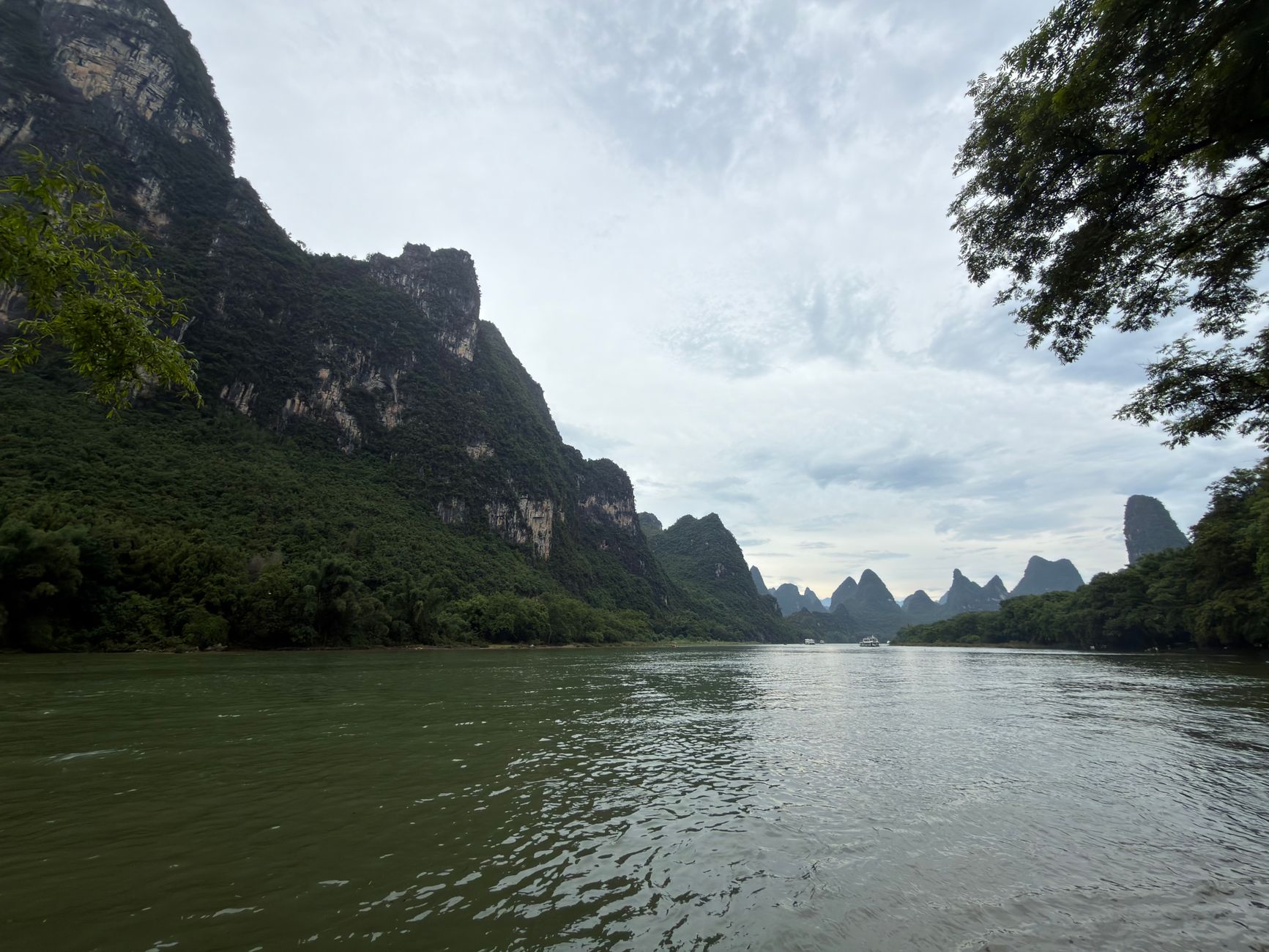
2. Guilin and Yangshuo — 2h35m. Karst hills along the Li River, and the landscape most people picture when they picture China. Fly to Guilin (KWL), then move straight down to Yangshuo, which is where you actually want to be — the Li River cruise or the cheaper Yulong River bamboo raft, cycling through the karst, and a small town that is touristy but genuinely lovely at either end of the day. Three to five days.
3. Chengdu — about 3 hours. Pandas, Sichuan food, teahouses and the most relaxed big city in China. It is also the gateway to Jiuzhaigou, Leshan and the Tibetan fringe. A full day by rail against about three hours in the air makes this a clear case for flying. Three to four days, more if you go west.
4. Xiamen — 2h. A coastal city with a walkable colonial island at Gulangyu, a genuinely different Minnan cuisine, and a much slower pace than Shanghai. The train is a realistic alternative here, with plenty of services a day, so compare prices. Two to three days.
5. Kunming and Yunnan — 3h30m. Spring-like weather all year, and the jumping-off point for Dali, Lijiang and Shangri-La. This is the biggest departure from eastern China culturally — twenty-five ethnic minorities, a different food culture, mountains. A week, minimum, to be worth the flights.
Two notes. Sanya, on Hainan, is a four-hour flight and a good beach if you want one, but it is a Chinese resort city rather than a cultural destination. And Lhasa requires a Tibet Travel Permit arranged through a licensed tour operator, weeks in advance, and cannot be done independently — do not plan it as a spontaneous add-on.
What domestic flights from Shanghai cost
Typical one-way economy fares, booked two to three weeks out, outside holidays:
| Route | Flight time | Fare level |
|---|---|---|
| Shanghai–Xiamen | Under three hours | Lower end |
| Shanghai–Zhangjiajie | Under three hours | Mid-range |
| Shanghai–Guilin | Under three hours | Mid-range |
| Shanghai–Chengdu | About three hours | Upper end |
| Shanghai–Kunming | Over three hours | Upper end |
| Shanghai–Sanya | The longest of these | Swings widely with the season; check Trip.com |
Intercity economy fares out of Shanghai move with the season, the day of the week and how far ahead you book. Fridays and Sunday evenings are dearest. Golden Week and Chinese New Year fares run two to three times normal, and unlike rail — where fares shift far less and scarcity shows up as sell-outs — air fares simply climb.
Set against the rail alternative, flying is often cheaper as well as faster on the long routes, and Chengdu is the clearest case: price a second-class seat against the air fare for your date before you commit to a day on the train. Our Shanghai trip cost guide puts these numbers in the context of a whole trip.
The visa constraint people forget
Before you book anything, check that your entry permission actually allows you to go where you are flying.
If you are in China on the 240-hour visa-free transit, you are restricted to 24 designated provinces, autonomous regions and municipalities. Cross-province travel within those 24 is allowed, but outside them is not. Of the destinations above:
- Inside the zone: Zhangjiajie (Hunan), Guilin (Guangxi), Xiamen (Fujian), Huangshan (Anhui), Xi’an (Shaanxi), Chengdu (Sichuan), Kunming (Yunnan).
- Outside it: Tibet and Xinjiang.
So a transit traveller can fly to Zhangjiajie or Chengdu, but not to Lhasa or Ürümqi. Airline staff will not check this for you — the problem surfaces later.
The 30-day visa exemption that most of Western Europe, Japan, South Korea, Australia and New Zealand now hold takes you well beyond the transit zones, and so does an L tourist visa, though restricted areas still need their own approval or permits. If Xinjiang is the point of the trip and you hold a US passport, get the visa rather than trying to make the transit rule stretch. Our 240-hour transit guide lists the designated regions and Shanghai entry requirements covers which category applies to you.
What people get wrong
Using the self-service kiosk. There is no point gambling on whether it will take a foreign passport. Queue for a person.
Getting the name wrong at booking. It must match the passport exactly. This is the commonest hard failure and there is no fixing it at the airport.
Booking a same-day international connection off a domestic leg. Chinese domestic delays are frequent enough that this will eventually cost somebody their flight home, and on separate tickets nobody owes you anything.
Assuming 20 kg means one bag of any weight. It is a total, and it is weighed.
Booking Spring Airlines with suitcases. The headline fare is low, but the carry-on limit is 7 kg. Add checked bags and the saving often disappears.
Flying somewhere your visa does not cover. The 240-hour transit rule covers 24 regions, and Tibet and Xinjiang are not among them.
Turning up ninety minutes before. Two hours, because of the counter queue and slow security.
Bringing a large or unmarked power bank. Between 100 and 160 Wh you need the airline’s approval; above 160 Wh, or with no readable rating, it will not fly at all, and on domestic flights neither will one without a clear 3C mark.
Frequently Asked Questions
Can foreigners book domestic flights in China?
Yes, with a passport and a working card. You do not need a Chinese ID, a Chinese bank account, a local phone number or a VPN. Trip.com is the easiest platform — full English, accepts international Visa and Mastercard — with Fliggy and the airlines’ own apps as alternatives. Nobody will ask why you are travelling.
Do I need my physical passport to fly domestically in China?
Yes. A photo, photocopy or scan will not be accepted, and the passport is what you check in with, clear security with and board with. The name on the booking must match the passport exactly — a mismatch is the commonest reason a foreign passenger is refused at check-in and it cannot be fixed at the desk.
What if the self-service kiosk won’t read my passport?
A kiosk may not be able to process a foreign document, and online check-in is similarly unreliable. Go to a staffed counter, collect a paper boarding pass, and allow an extra fifteen minutes for the queue.
Should I fly from Hongqiao or Pudong?
Hongqiao for domestic wherever you have a choice — it sits 13 km from the centre with its own stops on Lines 2 and 10, it is smaller and quicker to move through, and it is physically attached to Hongqiao Railway Station, where Line 17 also calls. Pudong is about an hour out on the metro, or around 50 minutes by taxi, and makes sense mainly for international connections or a much better fare. The two airports are about an hour apart, so allow three to four hours for a self-transfer.
How much do domestic flights from Shanghai cost?
It depends on the route, the season, the day of the week and how far ahead you book; two to three weeks out is usually where fares settle. Spring Airlines, the Shanghai-based low-cost carrier, is often cheaper, but it has a 7 kg carry-on limit and a checked-bag allowance that depends on the fare bundle you buy. Fares climb sharply for Golden Week and Chinese New Year; rail fares move much less, though they are not set in stone.
What is the baggage allowance on Chinese domestic flights?
Economy on the full-service carriers is typically 20 kg of checked baggage as a total weight, not as one bag of any size; carry-on limits vary, so check your airline. Spring Airlines has a 7 kg carry-on limit, and its checked allowance comes with the fare bundle you choose. Power banks up to 100 Wh are fine in hand luggage, 100 to 160 Wh need airline approval (two at most), and anything over 160 Wh, unrated or, on domestic flights, missing a clear 3C mark is refused.
How early should I get to the airport?
Two hours for a domestic departure. Check-in cut-offs vary by airport and airline (China Southern stops domestic check-in 40 minutes before departure at Hongqiao and 45 at Pudong), gates shut about a quarter of an hour before, and Chinese domestic security is slower than most visitors expect. Ninety minutes works at Hongqiao if you are travelling light and everything goes right.
Are Chinese domestic flights often delayed?
Yes, more than in Europe or North America, mostly because of military airspace restrictions and summer convective weather. Morning flights are markedly more reliable because delays cascade through the day, and summer afternoons out of Pudong are the worst combination. Never book a same-day international connection off a separately ticketed domestic leg.
Is it cheaper to fly or take the train in China?
Under five hours the train is cheaper and better. Over eight hours flying is faster and often cheaper too — Chengdu is the classic example, where a seat on a plane can undercut a second-class rail ticket for a fraction of the journey time. Between five and eight hours, compare on the day.
Can I fly to Chengdu on the 240-hour visa-free transit?
Yes. Sichuan is one of the 24 designated provinces and municipalities the transit rule covers, with Chengdu among its permitted cities, and Yunnan is inside the zone too; Tibet and Xinjiang are not. Zhangjiajie, Guilin, Xiamen, Xi’an and Huangshan are all inside the zone as well. If Xinjiang is the point of the trip, get a proper visa.
Which Chinese airline is best?
China Eastern has the densest network out of Shanghai and is perfectly good; Juneyao is well regarded; Air China and China Southern are both fine. Service on the full-service carriers is better than most Western short-haul — a meal on anything over about ninety minutes, decent legroom and a free checked bag. Spring is the budget option and behaves like one.
What is the best add-on destination from Shanghai by air?
Zhangjiajie at two and a half hours, for scenery that looks nothing like anywhere else in China, or Guilin and Yangshuo at two thirty-five for the karst landscape along the Li River. Chengdu at about three hours is a strong case for flying rather than training, since the train takes a full day. Xiamen is the easy one; Kunming and Yunnan the most different.
Book on Trip.com two to three weeks out, fly from Hongqiao where you can, check your passport name character by character, and use a staffed counter. If your onward plan is rail rather than air, the Hongqiao guide covers the station attached to the terminal, and essential apps for Shanghai covers the payment and travel apps to install before you fly. Boarding-document rules are published by Shanghai Airport Authority, and the domestic baggage rules by TravelChinaGuide.